
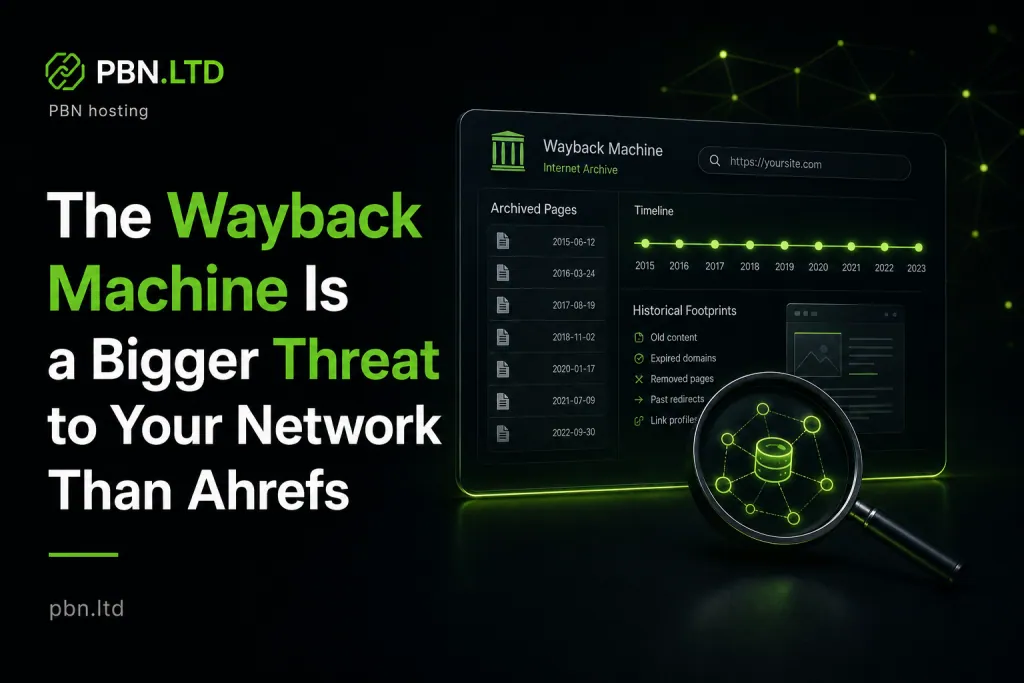
Ask a PBN operator how they protect their network from discovery and you’ll hear a lot about blocking crawlers. Block Ahrefs. Block Semrush. Block Majestic. Keep the backlink scrapers out so competitors can’t map which sites link to which money sites. It’s sensible — hiding your link graph from the commercial backlink tools genuinely does make a network harder to reverse-engineer. But there’s a public archive that most operators barely think about, that no amount of crawler-blocking touches, and that can expose a domain’s entire guilty history to anyone who types in a URL: the Wayback Machine. For network safety, the archive is arguably a bigger threat than any backlink tool, because it doesn’t show who links to you — it shows what your sites used to be. And what a PBN domain used to be is often the most incriminating thing about it.
This is worth taking seriously, because the effort operators pour into blocking backlink scrapers can create a false sense of security while the archive sits wide open, telling the story of every domain in the network to any human who bothers to look. Let’s go through what the archive actually exposes, why it’s harder to defend against than a scraper, and — timely in 2026 — how the archive itself is changing in ways that matter for domain vetting.
What Ahrefs Sees Versus What The Archive Sees
Start with the distinction, because it’s the whole point. Backlink tools like Ahrefs build a picture of a site’s link graph — who links to it, what anchors they use, how the profile has grown. That’s what an operator blocks: keep the scraper out and a competitor can’t easily see that twenty of your network sites all point at one money site. Blocking those tools is a defence of your link relationships.
The Wayback Machine sees something completely different and, for a PBN, often more damning: what the site itself used to be. It stores dated snapshots of the actual pages a domain hosted across its whole life. It doesn’t care about your current link graph; it shows the casino content the domain hosted in 2019, the sudden switch from a Portuguese wedding-photography blog to an English “marketing” site, the gap where the domain sat parked, the thin spun articles a previous owner stuffed on it. That history is exactly what marks a domain as a rebuilt expired PBN rather than a genuine site, and it’s the same history that matters so much when evaluating expired domains — except now it’s being read about your network, by someone who wants it dead.
Why The Archive Is Harder To Defend Against
Here’s what makes the archive a nastier problem than a backlink scraper: the ways you’d normally hide from a crawler don’t reliably get you out of it, and the people who use it against you aren’t running a tool you can block.
A Human Is Looking, Not A Bot
Backlink tools are automated — block the bot and the data stops flowing. But the archive is used by people: a manual reviewer assessing a domain, a competitor investigating your network, someone who received a link from one of your sites and got curious. A human with a browser and a URL can pull up a domain’s history in seconds, and there’s no bot to block because the “attack” is just a person reading a public web page. You can’t firewall your way out of someone looking at an archive.
The History Predates Your Ownership
The most damaging snapshots were usually created before you ever owned the domain — by the previous owner, or the owner before them. You can control what your site shows today, but you can’t retroactively un-archive the casino content or the spun filler a prior owner left behind. The record of the domain’s past lives is already captured and dated, and it sits there regardless of how clean your current site is. A pristine site today with a spam-farm history in the archive is a domain whose past contradicts its present, and that contradiction is the tell.
It Reveals The Reset You’re Hoping Google Ignores
The archive lays out the exact pattern that undermines a rebuilt domain: a coherent site, then a gap, then a totally different site in a different language or niche. That discontinuity is precisely what makes Google treat a rebuilt domain differently than operators hope, the whole subject of how Google sees a rebuilt domain. The archive doesn’t just expose the spam past — it timestamps the ownership reset, showing anyone reviewing the domain that the “aged authority” they’re looking at belongs to a site that no longer exists.
Why This Matters More Than It Used To
You might think none of this matters unless someone bothers to look — but the people most likely to look are exactly the ones who can hurt you. A competitor trying to knock your rankings will investigate your network and can use a documented spam history as ammunition, including in the kind of manual-review or complaint processes that have become more dangerous in 2026. And a manual reviewer, once pointed at a domain, has the archive as a ready-made record of everything the domain has ever been. This is the human-review layer sitting on top of the algorithmic detection in how SpamBrain maps networks: the machine reads your footprints at scale, but a person with the archive can build a case against a specific domain in minutes.
The uncomfortable asymmetry is that operators spend real effort on the automated threat (blocking scrapers) and almost none on the manual one (the archive), even though the manual one is often what actually gets a network reported or a domain rejected. The scraper tells a competitor your links; the archive tells them your domain is a rebuilt spam property. The second is the more damning story, and it’s the one sitting in the open.
The 2026 Twist: The Archive Is Changing
There’s a genuinely current wrinkle that cuts both ways. Through late 2025 and into 2026, major publishers — large news organisations and networks of local sites — have moved to block the Internet Archive’s crawlers, driven by concerns about AI companies scraping their content through the archive as a backdoor. A large share of major publishers now disallow at least some of the Archive’s bots, and some content is being retroactively pulled from the record.
For domain vetting, this has a real consequence: the historical record is getting patchier. Domains that were previously easy to research through the archive may now have gaps, which cuts two ways for an operator. On one hand, some incriminating history may become harder for a casual investigator to pull up. On the other, it makes your own due diligence less reliable — when you’re assessing an expired domain to build on, a thinner archive means you’re more likely to miss a spam past that’s still there in Google’s memory even if the archive no longer shows it. A gap in the Wayback Machine is not proof a domain is clean; it’s just a blind spot. Relying on “nothing bad in the archive” was always weak, and in 2026 it’s weaker.
What To Actually Do About It
You can’t rewrite a domain’s archived history, but you can factor the archive into how you vet, build, and assess the network. Practically:
- Check the archive before you buy, not after. Pull the full history of any expired domain and read what it actually hosted across its life. A clean current snapshot means nothing if the domain spent years as a casino or pharma site. The archive is a vetting tool first — use it on your own candidates the way an investigator would use it on you.
- Treat a bad history as disqualifying, not fixable. If the archive shows spam, adult, gambling, or an abrupt niche/language reset, that’s a domain whose past will always contradict its present. No quality of rebuild erases the archived record; the better move is usually to walk away.
- Don’t trust an empty archive as a clean bill of health. With publishers restricting the Archive, gaps are more common. Cross-check history against other signals rather than assuming a thin archive means a clean domain. Absence of evidence isn’t evidence of a clean past.
- Assume a human can and will look. Build and run the network on the assumption that a competitor or reviewer can pull the archive at any time. That’s an argument for genuinely clean domains with coherent histories — the kind that survive a manual look — rather than lipstick on a spam-farm past.
None of this replaces the value of blocking backlink scrapers — that’s still worth doing to protect your link graph. The point is that it’s only half the picture. Real network safety means the domains themselves have histories that survive scrutiny, hosted cleanly so the present doesn’t contradict the past. Durable, well-chosen properties — the kind behind quality homepage PBN links — are the ones whose archive tells a boring, coherent story instead of a guilty one.
The Bottom Line
Blocking Ahrefs and the other backlink scrapers hides your link relationships, and that’s worth doing. But it does nothing about the Wayback Machine, which exposes something often more incriminating: what every domain in your network used to be. A human — a competitor, a reviewer — can pull a domain’s spam past, ownership resets, and thin-content history in seconds, with no bot to block and a record that predates your ownership and can’t be un-archived. That manual threat gets far less attention than the automated one, even though it’s often what actually gets a domain rejected or a network reported. And in 2026, with publishers restricting the archive, the record is getting patchier — which makes your own vetting less reliable, not safer. The defence isn’t a firewall; it’s choosing domains whose history survives a look and building them on PBN Hosting so the clean present matches a clean past. Check the archive like your competitors will — because they can, and the tools you blocked never told them the half of it.