
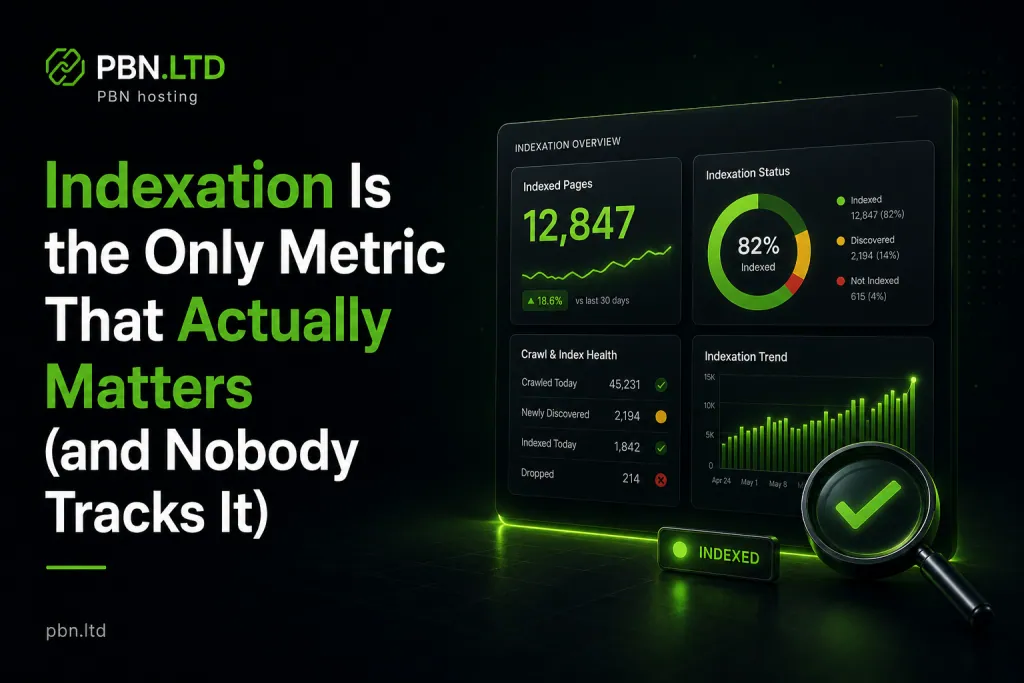
Walk into any conversation about PBN quality and you’ll hear the same vocabulary: DR, DA, TF, CF. Operators obsess over these numbers — buying domains by them, pricing links by them, filling dashboards with them, refreshing them every few months to see which sites are strong and which are weak. And those metrics do carry some directional information. But there’s a single metric that overrides all of them, decides whether a site is worth anything at all, and yet appears on almost nobody’s dashboard: is the page actually indexed? Because a PBN page that isn’t in Google’s index passes exactly zero authority — no PageRank, no trust, no topical signal — no matter how gorgeous its DR looks. A deindexed DR 40 page is worth less than an indexed DR 8 one. It is worth nothing.
That gap between the metric everyone watches and the metric that actually determines value is where a lot of link-building money quietly evaporates. So this is the case for treating indexation as the primary health metric of a network — why it matters more than any authority score, why it decays silently after setup, and how to actually monitor it across a network instead of finding out too late.
Why Indexation Beats Every Authority Score
The logic is almost embarrassingly simple, which is probably why it gets overlooked. A backlink only does anything once the page it sits on is in Google’s index. Indexation is the step where Google has discovered, crawled, and actually stored the page. Until that happens, the page is invisible to Google in every way that matters — the link on it might as well not exist. It passes no authority, no relevance, nothing. Discovery and crawling aren’t enough; a page can be crawled and still sit in a ‘discovered, not indexed’ limbo, contributing nothing.
Now hold that against the authority metrics. DR, DA, TF, and CF are all calculated by third-party tools based on a domain’s backlink profile. Critically, those tools don’t know or care whether Google currently indexes the domain. A page can show a healthy DR while being completely deindexed, because the tool computing the DR is looking at links, not at Google’s index. So the number on your dashboard can say ‘strong’ while the page is, in Google’s eyes, gone. The metric everyone trusts is blind to the one condition that actually determines whether the link works. That’s the same blindness that makes authority scores dangerous when evaluating expired domains — a high number on a deindexed domain is a mirage, and indexation is the check that pops it.
Indexation Decays — Silently
Here’s what makes this genuinely dangerous rather than just a setup checkbox: indexation isn’t permanent, and when it slips, nothing tells you. A page that was indexed when you placed the link can quietly fall out of the index months later, and your dashboard — refreshing DR every quarter — will show no change at all. The authority score sits there looking healthy while the actual value has dropped to zero. You’re reporting a strong link that stopped working, and you don’t know it.
Why PBN Pages Fall Out
PBN pages are especially prone to slipping out of the index because they lack the signals that keep real pages in it. Genuine sites get traffic, engagement, fresh internal linking, and regular crawling — all of which keep them healthy in the index. A network page that sits static, gets no visitors, and rarely updates gives Google every reason to crawl it less and eventually drop it. Thin or dormant sites are exactly what Google deprioritises. So the very things that make a site a lazy PBN — no activity, no audience, no freshness — are the things that cause silent deindexation over time.
Why You Won’t Notice Reactively
The trap is that the symptom looks like something else. When a link silently deindexes, you don’t get an alert — you get a gradual softening of the ranking benefit, which is easy to misattribute to an algorithm update, competition, or nothing at all. You keep the site in your network, keep counting its link, keep trusting its DR, while it contributes nothing. And because how SpamBrain evaluates sites already devalues plenty of links quietly rather than issuing visible penalties, operators are conditioned to see ‘link stopped working’ as normal noise. Deindexation hides comfortably inside that noise. The only way to catch it is to look for it directly.
How To Actually Monitor Indexation Across A Network
The good news is that indexation is one of the few things in SEO you can check definitively — Google either shows the page or it doesn’t. The challenge is doing it systematically across a whole network rather than ad hoc. A practical approach:
- The direct check. Searching the exact page in Google — the site: operator on the specific URL — gives you a yes/no answer. If the page appears, it’s indexed; if a recently-active page returns nothing, that’s a red flag. This is the ground truth every other method approximates.
- Make it a column, not an afterthought. Add an index-status field alongside your DR/TF columns and treat it as the first thing you look at, not the last. A site’s authority score is meaningless until its index status is confirmed. Order your dashboard to reflect that.
- Check on a schedule, because it decays. A one-time check at setup is worthless three months later. Re-verify indexation on a regular cycle — monthly is sensible for an active network — so you catch a page falling out weeks after it happens, not quarters.
- Watch for repeat offenders. If a particular domain keeps struggling to hold indexation, that’s telling you it’s a low-quality asset. A site that won’t stay indexed isn’t a site to keep nursing; it’s one to retire before it drags on your reporting.
- Act immediately when a page drops. A deindexed site in your network is worse than neutral — it’s a dead link in your money site’s profile and a dormant-looking property in your network. When you find one, address it: remove the link from your profile, and decide whether the site can be revived or should be cut.
Doing this by hand across dozens of sites is exactly the kind of grind that gets skipped, which is why it’s worth having it automated: our hosting runs automatic Google index checks on every domain — checking when you add a site and again every week, then emailing you the moment one drops out — so silent deindexation gets caught while you sleep instead of quarters later. It’s also why the indexation record of what you’re buying matters so much: when you evaluate PBN links for sale, the question isn’t just how strong the domain’s metrics are — it’s whether its pages actually stay indexed, because that’s what determines if the link does anything at all.
What This Means For How You Value A Network
Reframe the whole exercise around indexation and a lot of decisions get clearer. The strength of a network isn’t its average DR — it’s the proportion of its pages that are genuinely indexed and staying that way. A small network of reliably-indexed sites outperforms a large one full of pages drifting out of the index, because only the indexed pages are doing any work. This is why the durable, well-maintained placements from something like homepage PBN links hold their value: a homepage on an active, properly-hosted site stays indexed, and an indexed link is the only kind that ranks anything.
It also reframes what ‘maintenance’ means. Keeping a network healthy isn’t about topping up DR; it’s about keeping pages in the index — which means keeping the sites active, crawlable, and worth crawling. That’s a hosting-and-content problem as much as a link problem, and it’s the real reason a network needs proper infrastructure rather than cheap, neglected hosting where sites quietly rot out of the index.
The Bottom Line
Every authority metric in SEO — DR, DA, TF, CF — is calculated from a domain’s links and is blind to the one condition that actually determines whether those links work: whether Google indexes the page. An unindexed page passes nothing, regardless of how strong its score looks, and indexation decays silently after setup, hiding inside the general noise of links that quietly stop working. The metric everyone tracks can say ‘healthy’ while the page is, to Google, gone. So track the one that can’t: check indexation directly, make it the first column on your dashboard, re-verify it on a schedule, retire sites that won’t hold it, and act the moment a page drops. Host your network on PBN Hosting that keeps sites active and crawlable, and judge your network by how much of it is genuinely in the index — because that, and not the DR number next to it, is the only thing passing any value at all.