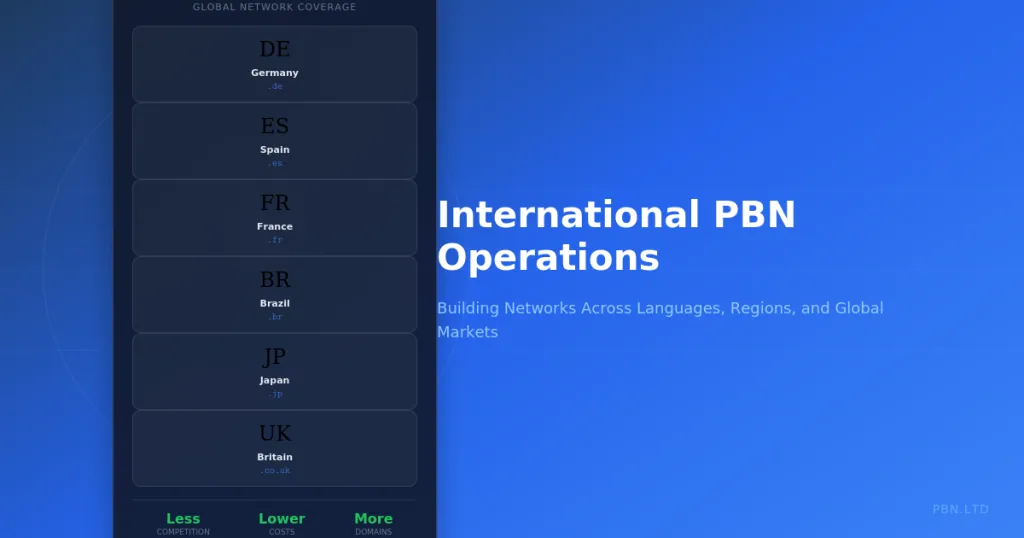
English-language PBNs dominate discussions about private blog networks, but enormous opportunities exist in other languages and regions. International markets often have less competition, more available domains, and lower costs while serving money sites targeting global audiences.
Building international PBN networks introduces unique challenges. Language barriers affect content creation. Regional domain markets operate differently. Cultural considerations influence what appears natural. Technical requirements vary by target geography.
This guide covers the strategic and operational considerations for building PBN networks that span languages, countries, and regions. Whether you are expanding an English network internationally or building dedicated regional networks, these principles help you succeed across borders.
Why Build International PBNs
Several compelling reasons drive operators toward international PBN building.
Supporting International Money Sites
If your money sites target audiences in Germany, Spain, Brazil, or Japan, English-language PBN links provide limited value. Search engines evaluate relevance based on language and regional signals. A German-language site benefits most from German-language links.
Building PBNs in the same language as your money sites creates topical and linguistic relevance that cross-language links cannot match. The contextual signals align properly with what search engines expect.
Even money sites targeting multilingual markets benefit from language-matched links. A site serving Spanish speakers in the US gains from Spanish-language PBN links even though the target audience is geographically American.
Less Competition for Domains
English-language expired domain markets are heavily contested. Every serious PBN builder competes for the same quality domains, driving up prices and reducing availability.
Non-English domain markets often have less competition. Fewer operators hunt German, French, or Portuguese expired domains. Quality domains remain available at reasonable prices longer after expiration.
This reduced competition translates directly to better economics. Domains that would cost hundreds in English markets might cost tens in other languages. The arbitrage opportunity is significant.
Diversification Benefits
Networks spanning multiple languages and regions provide natural diversification. Algorithm updates targeting English-language manipulation may not affect other languages equally. Regional enforcement varies.
Spreading operations across languages also reduces single-market risk. If one market becomes problematic, others continue operating. This resilience protects overall operations.
Domain Considerations for International PBNs
Domain selection for international PBNs requires understanding regional markets and TLD implications.
Country Code TLDs
Country code TLDs like .de for Germany, .fr for France, or .br for Brazil carry strong geographic signals. Search engines interpret these domains as targeting specific countries. This geographic targeting strengthens relevance for country-specific money sites.
CCTLDs also face different registration requirements. Some require local presence or local registrars. Others are freely available to anyone. Research registration requirements before pursuing domains in specific countries.
The expired domain market for CCTLDs varies dramatically by country. Established markets like .de and .uk have active auction scenes. Smaller markets may have limited expired domain availability but also limited competition.
Generic TLDs for International Sites
Generic TLDs like .com, .net, and .org can serve international purposes with proper configuration. Language signals, hosting location, and Search Console geographic targeting can override TLD assumptions.
Using generic TLDs for international sites provides flexibility. The same domain can theoretically target different regions through configuration changes. However, CCTLDs provide stronger initial signals.
For PBN purposes, matching the TLD type common in your target market often makes sense. If competitors and natural sites in your target market predominantly use CCTLDs, your PBN sites probably should too.
Evaluating International Domains
The same domain evaluation principles apply across languages, but execution differs. Backlink analysis requires understanding which sites carry authority in each market. A powerful German news site may be unknown to English-focused evaluators.
Spam patterns also vary by region. Understanding what looks natural versus manipulated in each market requires familiarity with local SEO practices. What passes as normal in one country might appear suspicious in another.
Archive verification becomes more important for international domains. Verifying previous content through Wayback Machine helps ensure domains were actually used for legitimate purposes in the target language.
Content Creation Across Languages
Content quality matters in every language. Creating quality content in languages you do not speak presents obvious challenges.
Native Speaker Content
Machine translation has improved dramatically but still produces content that native speakers recognize as unnatural. For PBN content that needs to pass quality assessment, native speaker creation remains essential.
Freelance platforms provide access to writers in virtually every language. Costs vary significantly by region. Writers in some markets charge substantially less than English-market equivalents while producing quality work.
When hiring international writers, provide clear briefs and examples. Language barriers make miscommunication more likely. Detailed instructions reduce revision cycles and quality issues.
Translation Tools and Plugins
For operators testing new markets or running multilingual sites from a single base, translation plugins offer a practical starting point. While not a replacement for native content on high-value sites, automated translation can help scale operations across languages.
Tools like GTranslate provide WordPress integration that automatically translates content into multiple languages. This can be useful for quickly launching multilingual versions of PBN sites, though you should still have native speakers review important pages and content containing money site links.
The hybrid approach works well for many operators. Use translation tools to create the bulk of supporting content quickly, then invest in native-written content for the pages that carry your most important links. This balances efficiency with quality where it matters most.
Quality Verification Challenges
If you do not speak the target language, verifying content quality becomes difficult. You cannot assess whether writing flows naturally, whether terminology is appropriate, or whether cultural references make sense.
Several approaches help manage this challenge. Hire separate editors to review content. Use native speaker quality checkers distinct from content creators. Build relationships with trusted writers whose work you can rely on.
Basic plagiarism and quality tools work across languages. Copyscape detects duplicate content regardless of language. Readability metrics exist for most major languages. These tools provide partial verification even without language fluency.
Cultural Adaptation
Content must fit cultural expectations beyond just language. Formality levels, communication styles, and topic approaches vary by culture. German business content differs from Brazilian business content in tone and structure, not just language.
Brief writers on cultural expectations when possible. Provide examples of successful content from the target market. Let native speakers make cultural decisions rather than imposing assumptions from your own cultural background.
These considerations align with broader PBN content principles but require additional cultural awareness when working across languages.
Technical Configuration for International Sites
Proper technical setup helps search engines understand your sites’ target audiences.
Language Declaration
Declare site language properly through HTML lang attributes, content-language headers, and metadata. These signals help search engines categorize content correctly for language-specific searches.
Consistency matters. The declared language should match actual content. A site declaring German but containing English content sends confusing signals. Ensure all language signals align with actual content.
Geographic Targeting
Search Console allows geographic targeting for generic TLD sites. This setting tells Google which country you want to target. For PBN sites targeting specific countries, configure this appropriately.
Hosting location provides geographic signals. Hosting German-targeted sites in Germany strengthens geographic relevance. While not absolutely required, local hosting aligns all signals consistently.
IP diversity considerations extend to geography. International networks benefit from hosting distributed across relevant regions. Our IP diversity infrastructure supports geographic distribution alongside standard IP separation.
Hreflang Implementation
If you operate PBN sites that have content in multiple languages or target multiple regions, hreflang tags help search engines understand relationships. This is more relevant for sophisticated multi-regional operations than simple single-language PBNs.
Incorrect hreflang implementation causes more problems than no implementation. If using hreflang, ensure implementation is technically correct. Validation tools can verify proper setup.
Regional SEO Landscape Differences
SEO practices and enforcement vary significantly by region.
Market Maturity Variations
SEO sophistication varies by market. English-language SEO is highly competitive with advanced practitioners. Some regional markets have less sophisticated competition, creating opportunities for operators with advanced knowledge.
This maturity difference affects what link building looks natural. In markets where aggressive SEO is common, your tactics blend in more easily. In markets where SEO is less developed, sophisticated manipulation may stand out.
Research the competitive landscape in each target market. Understand what normal link building looks like. Adapt your approach to match local norms.
Algorithm Application Differences
Google applies updates globally but effects vary by region. Algorithm changes sometimes impact English results more than other languages. Regional search indices have different characteristics.
This does not mean manipulation is safe in non-English markets. Spam detection systems operate across languages. But the specific patterns triggering detection may differ, and enforcement intensity varies.
Stay informed about algorithm impacts in your target markets. Regional SEO communities discuss updates specific to their markets. This intelligence helps you adapt strategies appropriately.
Non-Google Search Engines
Some markets have significant non-Google search engines. Yandex dominates Russia. Baidu dominates China. Naver is major in South Korea. These engines have different ranking factors and different manipulation detection.
If targeting markets with alternative search engines, research their specific requirements. PBN tactics effective for Google may not transfer directly. Each engine requires adapted approaches.
For most Western markets, Google dominates sufficiently that Google-focused tactics work. But never assume Google supremacy without verifying market-specific search engine usage.
Operational Challenges
International operations introduce operational complexities beyond single-market networks.
Communication and Coordination
Working with international team members or contractors requires managing time zones, language barriers, and cultural communication differences. Instructions that seem clear may be interpreted differently across cultures.
Over-communicate when working internationally. Provide more context than you would with local team members. Confirm understanding explicitly rather than assuming alignment.
Document everything in writing. Written instructions can be translated and referenced. Verbal instructions may be misunderstood or forgotten across language barriers.
Payment and Financial Considerations
International payments involve currency conversion, transfer fees, and varied payment method availability. PayPal, Wise, and similar services facilitate international payments but costs add up.
Domain registration in different countries may require different payment methods. Some registrars only accept local payment options. Plan payment infrastructure before pursuing domains in new markets.
Tax implications vary by country. Paying contractors internationally may have reporting requirements. Consult appropriate advisors about tax obligations for international operations.
Legal Considerations
Different countries have different laws regarding website operation, data privacy, and business practices. GDPR affects sites targeting EU visitors regardless of where operators are located.
Some countries have specific requirements for commercial websites. Registration requirements, disclosure obligations, and content restrictions vary. Research legal requirements for each target market.
This is not legal advice. Consult qualified professionals about compliance requirements for your specific international operations.
Managing Multi-Language Networks
Operating across multiple languages requires organizational systems that accommodate complexity.
Segmented Organization
Organize networks by language or region. Keep German sites separate from Spanish sites separate from English sites. This segmentation simplifies management and prevents cross-contamination of network footprints.
Treat each language segment as a distinct network. The management principles for single networks apply within each segment, but segments remain isolated from each other.
Documentation becomes more critical with international operations. Track which sites serve which markets, which contractors work on which languages, and which money sites each segment supports.
Language-Specific Teams
As international operations grow, consider language-specific team structures. A German content team handles German sites. A Spanish team handles Spanish sites. Specialization improves quality within each language.
This structure also provides built-in quality control. Native speakers naturally notice quality issues that non-speakers would miss. Language-specific teams catch problems before they persist.
Maintain oversight across language teams even if you do not speak all languages. Metrics, deadlines, and output quantity can be monitored regardless of language. Quality sampling with external reviewers provides verification.
Cross-Language Footprint Prevention
Operating in multiple languages creates footprint risks beyond single-language operations. Registration patterns, hosting patterns, and operational timing that spans languages can reveal network connections.
Vary operational patterns across language segments. Do not register all domains from the same account. Do not launch all sites on the same schedule. Do not use identical technical configurations across languages.
The same diversity principles that protect single-language networks apply even more critically to multi-language operations. More sites across more markets means more opportunities for pattern formation.
Starting International Expansion
Practical guidance for operators considering international PBN expansion.
Choosing First Markets
Start with markets where you have existing advantages. If you speak Spanish, Spanish-language markets make sense. If you have contacts in Germany, German markets are more accessible. Leverage existing knowledge and relationships.
Consider market economics. Large markets with active domain trading and available contractors provide easier entry. Smaller markets may have less competition but also less infrastructure.
Align with money site needs. If your money sites target specific international markets, prioritize those markets for PBN expansion. Relevance to actual revenue opportunities should guide decisions.
Building Local Knowledge
Before building extensively in a new market, invest in understanding it. Research the local SEO landscape. Identify quality domain sources. Find reliable content providers. This groundwork prevents costly mistakes.
Connect with SEO professionals in target markets. Online communities, conferences, and networking provide insights that research alone cannot. Local perspectives reveal opportunities and risks you might miss.
Start small and learn. Build a few sites in a new market before scaling. Verify that your approaches work before committing significant resources.
Scaling Internationally
Once you have proven approaches in new markets, scale deliberately. Each market requires infrastructure, relationships, and expertise. Rushing expansion without these foundations leads to quality problems.
Consider whether to deepen existing markets or add new ones. Expanding an established German operation may deliver more value than adding a new Italian operation. Focus and depth often beat breadth.
International expansion multiplies complexity. Only expand as fast as your systems and team can absorb. Sustainable growth maintains quality across all markets.
Conclusion
International PBN operations offer compelling opportunities for operators willing to navigate additional complexity. Less competition, lower costs, and natural diversification benefit those who build across languages and regions.
Success requires respecting language and cultural differences. Native content, proper technical configuration, and market-specific strategies matter. Shortcuts that work domestically may fail internationally.
Build international operations deliberately. Start with markets where you have advantages. Invest in local knowledge before scaling. Maintain quality standards across all languages.
For PBN hosting infrastructure supporting international operations, our platform provides the geographic IP distribution and management capabilities needed for multi-region networks. Build globally with confidence knowing your hosting supports international complexity.