
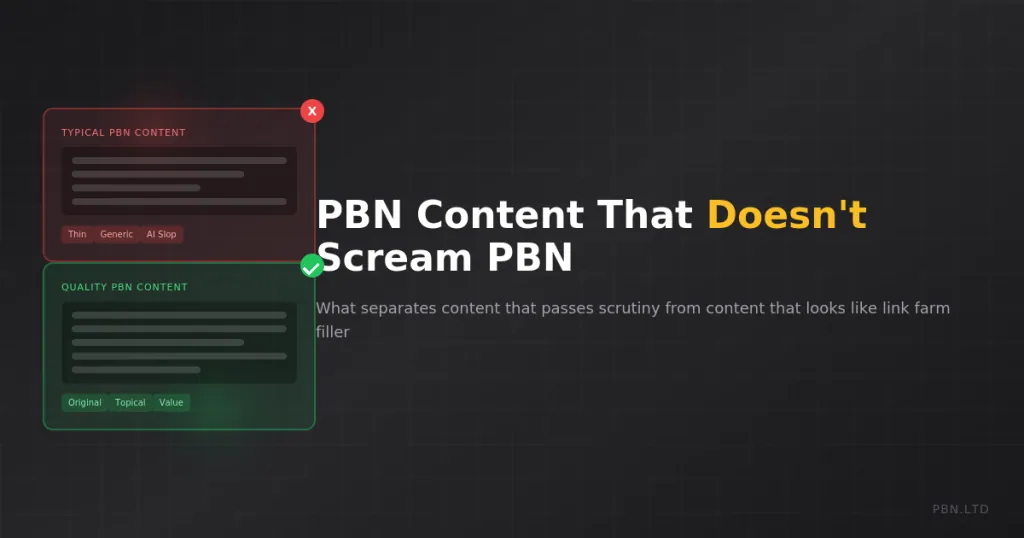
You can spot a PBN site in seconds. Generic stock photos. Thin articles that say nothing. Random topics with no coherence. A single outbound link to some commercial page that has nothing to do with anything else on the site.
If you can spot it, so can Google. And so can the manual reviewers who examine flagged sites.
This guide covers what separates PBN content that passes scrutiny from content that screams link farm. We cover the specific patterns that expose sites, the content strategies that work, and the investment required to build PBN sites that look like legitimate independent websites.
The difference is not subtle. It is the difference between networks that last years and networks that get burned within months.
The Problem with Typical PBN Content
Most PBN content fails because it was created with the wrong goal. The operator wanted content that existed, not content that mattered. They needed something on the page to make it look like a website. That is exactly what they got, and exactly what it looks like.
The Filler Article Problem
Filler articles are the most common PBN content type. They cover generic topics superficially, saying nothing that could not be found in a thousand other places. They exist to create the appearance of content without providing actual value.
These articles share recognisable characteristics. They hit arbitrary word counts without saying anything substantial. They use obvious keyword stuffing or awkward phrasing. They lack any original insight, data, or perspective. They could have been written about any topic by anyone with no expertise.
Google’s helpful content system specifically targets this type of content. Sites filled with filler articles get classified as unhelpful and lose ranking ability entirely. A PBN site that cannot rank cannot pass meaningful link equity.
The Spun Content Problem
Article spinning was a popular shortcut. Take one article, run it through software that replaces words with synonyms, and generate dozens of unique versions. The result is technically unique content that reads like it was written by a malfunctioning robot.
Modern language models have made detecting spun content trivial. The unnatural phrasing, awkward synonym choices, and lack of coherent flow are obvious to anyone who reads it and to any algorithm trained to evaluate content quality.
Spun content marks your site as low quality immediately. It provides no user value and signals that the site exists only to manipulate search results.
The AI Slop Problem
The arrival of accessible AI writing tools created a new category of bad PBN content. Operators discovered they could generate thousands of words in seconds. What they did not realise is that everyone else discovered the same thing.
Generic AI content has distinctive patterns. The same sentence structures. The same transitional phrases. The same way of introducing topics, developing points, and concluding. When millions of pages share these patterns, they become a footprint as obvious as duplicate content.
Google has explicitly stated that AI-generated content created primarily to manipulate rankings violates their guidelines. The March 2024 core update specifically targeted scaled content abuse, which includes mass-produced AI content across PBN sites.
The Topical Incoherence Problem
Real websites have focus. A cooking blog writes about cooking. A tech site covers technology. A local business discusses their industry and community. Topics relate to each other and build a coherent picture.
Typical PBN sites have no focus. One article about health insurance. Another about dog training. A third about cryptocurrency. A fourth about vacation destinations. The only connection between them is the outbound link to the same money site.
This incoherence is a massive red flag. No legitimate website operates this way. The random topic collection exists only because the operator needed content and grabbed whatever was available or cheap.
What Good PBN Content Looks Like
Good PBN content is indistinguishable from content on legitimate independent websites. That is the standard. If a manual reviewer looked at your PBN site, would they see a real website or a link farm?
Topical Focus and Coherence
Every PBN site should have a clear topical focus that makes sense for the domain and the outbound links it will carry.
If you are linking to a plumbing company, your PBN site should cover topics related to home improvement, plumbing, home maintenance, or local services. Not cryptocurrency and travel destinations.
This topical alignment serves multiple purposes. It makes the outbound link contextually relevant, which increases its value. It makes the site look legitimate because real sites have focus. It helps with topical authority signals that search engines use to evaluate sites.
Plan your PBN sites around niches, not around convenience. A site about home improvement can link to plumbers, electricians, contractors, and related businesses naturally. Build the site first, then use it for appropriate clients.
Genuine Information Value
Good PBN content provides genuine value to anyone who might read it. This is not about fooling Google. It is about creating content that would satisfy a real visitor.
Ask yourself: if someone landed on this page from a search, would they find what they were looking for? Would they learn something? Would they consider the content worth their time?
This standard eliminates most PBN content immediately. The thin articles that say nothing useful fail this test. The spun content that makes no sense fails. The AI slop that covers topics superficially without insight fails.
Creating genuinely valuable content costs more. It requires either skilled writers or significant time investment. This is the price of building PBN sites that last.
Original Perspective or Information
The best PBN content offers something that cannot be found elsewhere. This could be original research, unique perspective, local knowledge, or expert insight.
Original content is harder to produce but dramatically more valuable. It attracts natural links. It ranks on its own merit. It passes any quality review because it genuinely contributes something.
Consider commissioning content from actual experts in the niche. A real plumber writing about common plumbing problems will produce content that no AI or generalist writer can match. The cost is higher but the result is a genuinely useful page.
Appropriate Depth and Length
Content length should match the topic, not hit arbitrary targets. A simple factual question might be best answered in 300 words. A comprehensive guide might require 3,000.
The problem with most PBN content is not that it is too short or too long. It is that the length does not match the substance. A 1,500 word article that could have said everything meaningful in 400 words is obviously padded. A 400 word article on a complex topic is obviously thin.
Match length to topic. Say what needs to be said. Stop when you have said it. This produces content that reads naturally because it was written to communicate, not to fill space.
Content Types That Work for PBN Sites
Some content formats work particularly well for PBN sites because they justify a site’s existence, support natural outbound linking, and provide genuine value.
Resource Guides and How-To Content
How-to guides and resource compilations justify linking to external resources naturally. A guide to home renovation can naturally link to contractors. A resource on financial planning can naturally link to financial advisors.
These formats also tend to attract natural traffic and links because they provide genuine utility. A well-written how-to guide that actually helps people will perform as a real website, further legitimising the PBN site.
The key is making these guides genuinely useful. A how-to guide that does not actually explain how to do something is worse than no guide at all.
Local or Regional Content
Local content works exceptionally well for PBN sites. Content about specific cities, regions, or communities is naturally limited in scope. It justifies why a site might only have a few dozen pages. It explains why the site links to local businesses.
A site about living in Manchester can cover local restaurants, services, events, and businesses. Outbound links to Manchester-based clients are completely natural in this context.
Local content also tends to face less competition. National sites rarely cover hyper-local topics well. This creates opportunity for PBN sites to rank and generate real traffic, further legitimising them.
Industry Commentary and News
Commentary on industry developments provides a reason for a site to exist and a natural context for linking to industry businesses.
A site covering developments in renewable energy can naturally link to solar installation companies. A site discussing fitness trends can naturally link to personal trainers and gyms.
This format requires ongoing content to maintain credibility. A news site that has not published anything in six months looks abandoned. Plan for periodic updates if you use this approach.
Curated Collections and Lists
Curated lists of resources, tools, or providers justify extensive outbound linking by their nature. A list of the best accounting software naturally links to accounting software. A collection of home service providers naturally links to those providers.
The key is genuine curation. Real curated lists include options the curator does not benefit from. They explain why each option is included. They help readers make decisions. Fake curated lists only include sites the operator wants to link to, which is obvious.
Mix money site links with links to legitimate resources you have no connection to. This makes the curation appear genuine because it partially is.
Practical Content Creation Approaches
Creating good PBN content requires investment. The specific approach depends on your budget, scale, and the niches you serve.
Professional Writers
Hiring professional writers produces the best results but at the highest cost. A skilled writer with niche knowledge can create content that genuinely contributes value.
For competitive niches and high-value PBN sites, professional writing is worth the investment. A site with genuinely excellent content can rank, attract natural links, and remain effective for years.
Screen writers carefully. Many content mills call themselves professional but produce the same generic filler as anyone else. Request samples in your niche. Check for original insight versus regurgitated common knowledge.
Subject Matter Experts
Commissioning content from actual experts produces authenticity that no general writer can match. A real accountant writing about tax issues. A real chef writing about cooking techniques. A real mechanic writing about car maintenance.
Expert content often needs editing for readability, but the substance is genuine. This authenticity is exactly what Google’s E-E-A-T guidelines reward.
Find experts through professional networks, industry forums, or direct outreach. Many professionals will write occasionally for reasonable fees, especially if the topic interests them.
AI-Assisted Creation
AI tools can assist content creation if used properly. The key word is assist, not replace.
Use AI to generate outlines, suggest angles, or create initial drafts. Then rewrite substantially with human judgment, add original insights, verify facts, and inject genuine perspective. The result should not read like AI output because it has been transformed by human input.
Never publish raw AI output. The patterns are recognisable. The lack of genuine insight is obvious. The content fails to provide real value. AI assistance works only when it saves time on tasks that do not require originality, freeing human effort for the parts that do.
Repurposing and Localising
Existing quality content can sometimes be repurposed with substantial modification. A general article about home insulation could be localised to specific regions, updated with current pricing, and enhanced with local considerations.
This is not spinning. Repurposing requires genuine transformation. The localised version should contain substantial unique information that the original did not. If the modification is superficial, it provides no more value than spun content.
Content Presentation Matters
Good content poorly presented still looks like a PBN site. Presentation signals legitimacy.
Professional Formatting
Use proper headings, subheadings, and paragraph breaks. Long walls of text are difficult to read and look unprofessional. Structured content is easier to scan and signals editorial care.
Add formatting elements where appropriate: bullet lists for multiple items, numbered lists for sequential steps, bold text for emphasis on key points. These are normal elements of professional web content.
Relevant Images
Images should support the content, not just fill space. Generic stock photos of people shaking hands or pointing at laptops scream low-quality content site.
Use images that relate specifically to the content. Diagrams that explain concepts. Photos that illustrate points. Screenshots where relevant. Original images are best but quality licensed images work when they are actually relevant.
No images is better than irrelevant images. A text-focused site is perfectly legitimate. A site with random stock photos on every post is obviously trying to look like something it is not.
Author Attribution
Content with author attribution appears more legitimate than anonymous content. Real websites typically credit their writers.
Create author profiles that could be real people. This does not mean fake identities with stolen photos. It means consistent author personas with plausible biographies that could exist. Use stock photos clearly labelled as illustrations or no photos at all.
Better yet, use real authors when possible. Content from identifiable real people with verifiable backgrounds is exactly what E-E-A-T guidelines reward.
Integrating Links Naturally
The outbound link to your money site is the entire point of the PBN page. How you integrate that link matters as much as the content around it.
Contextual Relevance
The link should appear where it makes sense in the content flow. A mention of a service provider should link to that provider. A reference to a resource should link to that resource.
Forced links are obvious. An article about gardening tips that suddenly mentions and links to a divorce lawyer is clearly manipulation. Build content around topics where your target link fits naturally.
Multiple Outbound Links
Pages with a single outbound link look suspicious. Real content links to multiple sources. If you are writing about a topic, you would naturally reference multiple relevant resources.
Include links to authoritative sources alongside your money site link. Link to Wikipedia for definitions. Link to government sites for regulations. Link to major publications for supporting evidence. This is exactly what natural content does, and it is what we cover in depth in our guide on building natural anchor text profiles.
Anchor Text Variation
Exact-match anchor text on every link is a footprint. Real editorial links use varied anchor text: brand names, generic phrases, partial matches, and natural language references.
Plan anchor text across your network, not just on individual pages. The overall distribution should look natural. Mostly branded and generic anchors with occasional keyword-relevant anchors.
Quality Control Processes
Consistent quality requires systematic processes. Random quality produces inconsistent results.
Content Review Checklist
Before publishing any content to a PBN site, verify it meets standards. Does it provide genuine value? Is it topically coherent with the site? Does the link integrate naturally? Is the formatting professional? Would it pass manual review?
Create a formal checklist and use it consistently. This catches problems before they reach your live sites.
Periodic Content Audits
Review existing PBN content periodically. Standards change. Content that was acceptable two years ago may look thin by current standards.
Audit for outdated information, broken links, formatting issues, and content that no longer meets quality standards. Update or remove content that has degraded.
Competitor Comparison
Compare your PBN content to legitimate sites in the same niche. If your content is obviously worse, it is obviously a PBN. If your content is competitive with real independent sites, it will be treated like one.
This comparison should be honest. Look at real sites ranking for relevant terms. Would your PBN content deserve to rank alongside them? If not, improve it until it does.
The Economics of Quality PBN Content
Quality content costs more. This is unavoidable. The question is whether the investment is worthwhile.
Cheap content produces cheap results. PBN sites with thin content get deindexed faster, pass less link equity while they exist, and must be replaced more frequently. The apparent savings disappear when you account for shorter lifespan and reduced effectiveness.
Quality content produces lasting results. PBN sites with genuine content remain indexed longer, pass more link equity, and sometimes even attract natural traffic and links. The higher upfront cost is offset by longer effective lifespan.
The math typically favours quality. A PBN site that costs twice as much but lasts three times as long is the better investment. A site that attracts natural links multiplies its value beyond the original investment.
Build fewer sites with better content rather than more sites with worse content. This is the consistent lesson from operators who maintain effective networks over years.
Conclusion
PBN content that does not scream PBN is content that could exist on a legitimate independent website. That is the standard and there are no shortcuts.
The filler articles, spun content, and AI slop that populate most PBNs are obvious to anyone who looks and increasingly obvious to algorithms. Sites built on this content have limited lifespans and limited effectiveness.
Quality content requires investment. Real writers, genuine expertise, original perspectives, and proper presentation all cost more than the alternatives. This investment is not optional if you want PBN sites that last.
The operators who maintain effective PBN networks over years have all reached the same conclusion: content quality is not where to cut corners. Build it right or do not build it at all.