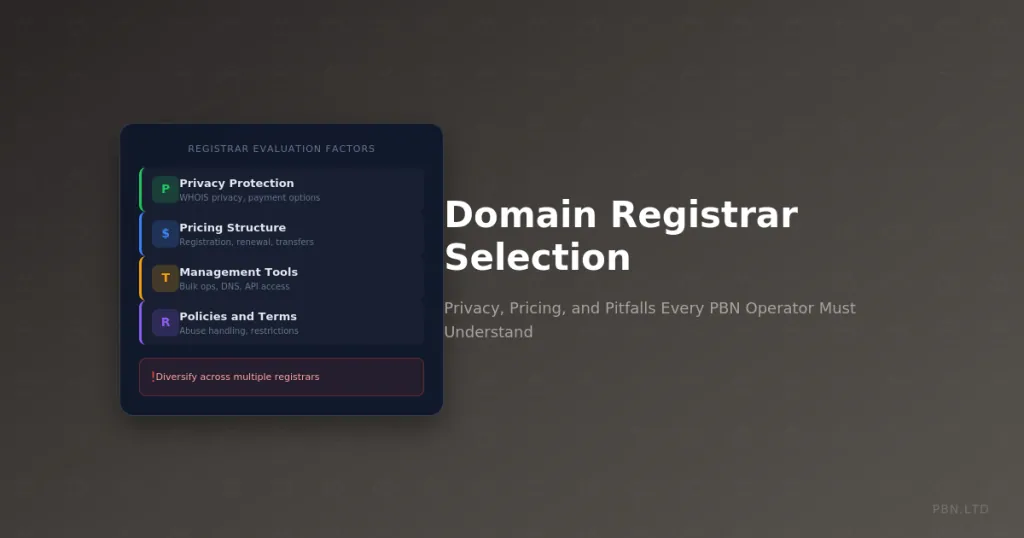
Your choice of domain registrar affects PBN security, operational efficiency, and long-term costs. Different registrars offer varying levels of privacy protection, pricing structures, and management features. Some registrars actively support privacy-conscious users while others expose owner information or impose restrictive policies.
For PBN operators, registrar selection extends beyond simple domain registration. You need to consider footprint implications, privacy features, bulk management capabilities, and policies that might affect network operations.
This guide examines registrar selection from a PBN operator’s perspective. We cover privacy considerations, pricing analysis, operational features, and the common pitfalls that catch operators off guard.
Why Registrar Choice Matters for PBNs
Domain registrar decisions have implications beyond simple convenience.
Footprint Creation Risk
Registering all your PBN domains through a single registrar creates a potential footprint. If someone investigates your network, shared registration details become a connection point. The same registrar, same registration dates, and similar nameserver patterns all reveal relationships.
This connects to broader footprint avoidance strategies. Registrar diversification should be part of your overall footprint management alongside hosting diversification and content variation.
Using multiple registrars adds operational complexity but reduces detectable patterns. Balance the convenience of centralized management against the security of distributed registration.
Privacy Protection Variations
WHOIS privacy protection varies significantly between registrars. Some include free privacy protection with every domain. Others charge extra. Some provide robust privacy while others offer minimal protection that still leaks information.
For PBN operations, privacy protection is not optional. Your personal information appearing in WHOIS records creates an obvious connection between domains. Even with privacy protection, the privacy service provider’s information might create patterns if you use the same registrar for all domains.
GDPR has improved privacy for European registrants, but protection levels still vary by registrar and TLD. Some TLDs require accurate WHOIS information regardless of privacy services.
Policy and Terms Considerations
Registrar terms of service vary in how they treat various website activities. Some registrars have vague policies that could theoretically apply to PBN operations. Others are more permissive or simply less likely to investigate customer activities.
Registrars also differ in how they handle abuse complaints. Some investigate thoroughly and suspend domains quickly. Others require substantial evidence before taking action. Understanding these tendencies helps you assess risk.
This is not about hiding illegal activity. It is about understanding that different registrars have different thresholds for what triggers review and action.
Privacy Features to Evaluate
Privacy protection is essential for PBN operations. Evaluate these specific features.
WHOIS Privacy Services
Basic WHOIS privacy replaces your contact information with the privacy service’s information. This prevents casual lookup of your personal details. However, the replacement information itself can become a pattern if identical across many domains.
Premium privacy services may offer additional features like different proxy identities for different domains, email forwarding that masks your real address, and stronger legal protections against information disclosure.
Evaluate whether privacy is included free or costs extra. Privacy fees of eight to twelve dollars per domain per year add up quickly across a network. Free privacy inclusion significantly affects total cost of ownership.
RDAP and New Privacy Standards
RDAP is replacing traditional WHOIS with a more structured protocol. This transition affects how registration information is accessed and what information is available. Different registrars are implementing RDAP differently.
Some registrars use RDAP’s tiered access model to provide better privacy by default. Others expose similar information to what WHOIS provided. Research how your prospective registrars handle RDAP.
Payment Privacy
Payment methods can create patterns independent of WHOIS information. Credit cards link multiple accounts. PayPal accounts connect registrations. Even billing addresses create connections.
Some registrars accept cryptocurrency, providing payment privacy. Others accept prepaid cards or virtual cards that add separation between your identity and domain purchases.
For serious footprint prevention, consider how payment methods might link otherwise separate registrar accounts. The payment layer is often overlooked in footprint discussions.
Pricing Structures and Hidden Costs
Domain pricing varies dramatically and advertised prices often obscure true costs.
Registration vs Renewal Pricing
Many registrars offer low first-year registration prices but charge significantly more for renewals. A domain registered for eight dollars might renew at eighteen dollars. Over a network’s lifetime, renewal pricing matters more than initial registration.
Calculate total cost of ownership including renewals. A registrar with higher initial pricing but consistent renewal rates may cost less over five years than one with promotional first-year pricing.
Watch for registrars that increase renewal pricing after you have accumulated domains. Switching registrars involves transfer fees and operational overhead, creating lock-in that some registrars exploit.
Transfer Pricing
Transfer fees affect your flexibility to move domains between registrars. Some registrars charge nothing for outbound transfers. Others impose fees that discourage leaving.
Inbound transfers typically include a year of registration, making them effectively a renewal at the transfer price. Compare transfer-in pricing against renewal pricing to find the best value for domain moves.
Bulk transfer capabilities matter for PBN operations. Transferring fifty domains individually is tedious. Registrars with bulk transfer tools save significant time.
Add-On Services and Upsells
Registrars often upsell additional services during checkout and renewal. Privacy protection, email forwarding, SSL certificates, and website builders add costs that may or may not provide value.
Evaluate which add-ons you actually need. For PBN domains, you likely need privacy protection but not website builders or premium email services. Avoid auto-selected add-ons that inflate costs.
Some registrars bundle useful features that others charge extra for. DNS management, email forwarding, and basic security features should arguably be included with registration.
Operational Features for PBN Management
Beyond pricing and privacy, operational features affect daily management efficiency.
DNS Management
Quality DNS management interfaces save time when configuring domains. Look for registrars with clean interfaces, bulk DNS editing, and reliable DNS infrastructure.
DNS propagation speed varies between registrar DNS services. Slow propagation delays site launches and changes. Some registrars offer faster propagation through better infrastructure.
Consider whether you will use registrar DNS or point to external DNS providers. If using external DNS, registrar DNS quality matters less. If using registrar DNS, it becomes a critical feature.
Bulk Management Tools
Managing dozens of domains individually wastes time. Look for registrars offering bulk operations: bulk renewal, bulk DNS changes, bulk privacy settings, and bulk transfers.
API access enables automated management. Registrars with robust APIs allow scripting common operations, integrating with your management systems, and automating routine tasks.
These bulk capabilities complement your centralized PBN management approach. The more you can automate and batch at the registrar level, the more efficient overall operations become.
Renewal Management
Auto-renewal prevents accidental domain expiration but requires keeping valid payment methods on file. Manual renewal provides more control but risks missing renewals.
Look for registrars with clear renewal notifications sent well in advance. Multiple reminder emails at thirty, fourteen, and seven days before expiration help catch domains that might otherwise lapse.
Grace periods after expiration vary by registrar and TLD. Understanding how long you have to renew an expired domain before it enters redemption helps recovery if renewals are missed.
Registrar Diversification Strategy
Strategic registrar use balances security against operational complexity.
How Many Registrars to Use
Using a single registrar for all domains creates obvious footprint risk. Using twenty different registrars creates management chaos. Finding the right balance depends on your network size and risk tolerance.
For networks under twenty sites, three to four registrars provide reasonable diversification without excessive complexity. Larger networks might use five to eight registrars, grouping domains logically.
Avoid having more than ten to fifteen domains per registrar account. This limits exposure if any single account faces issues while keeping management reasonable.
Account Separation
Even within a single registrar, separate accounts add protection. Different email addresses, different payment methods, and different contact information create separation that single-account management lacks.
Some registrars prohibit multiple accounts per person. Others allow it. Understand terms of service before creating multiple accounts. Violation could result in account termination.
Where multiple accounts are permitted, treat them as genuinely separate. Different passwords, different recovery options, and different management practices prevent cross-account contamination.
Grouping Strategies
Group domains at registrars strategically rather than randomly. One approach groups by money site, keeping all domains supporting a single money site at one registrar. If that money site project ends, cleanup is straightforward.
Another approach groups by risk level. Higher-risk domains at more privacy-focused registrars. Standard domains at cost-effective mainstream registrars. This allocates privacy investment where it matters most.
Avoid grouping patterns that reveal network structure. All domains in a niche at the same registrar creates detectable relationships. Spread related domains across different registrars.
Common Registrar Pitfalls
Learn from mistakes others have made with registrar selection and management.
Ignoring Renewal Price Increases
Some registrars dramatically increase renewal prices after initial registration. Operators who registered domains at promotional prices face sticker shock at renewal. By then, transferring away involves its own costs and complexity.
Always check renewal pricing before registration. If renewal prices are not clearly published, that itself is a warning sign. Reputable registrars are transparent about pricing.
Relying on Single Registrar
Operators who put all domains at one registrar face catastrophic risk if that registrar has problems. Account suspension, registrar business failure, or policy changes can affect your entire network simultaneously.
Diversification protects against single points of failure. Even if one registrar causes problems, your other domains continue operating normally.
Neglecting Transfer Locks
Transfer locks prevent unauthorized domain transfers but also prevent legitimate transfers when you want to move domains. Some registrars make removing transfer locks difficult or slow.
Understand your registrar’s transfer lock policies. Know how to disable locks when needed. Factor unlock timing into transfer planning.
Poor Security Practices
Weak passwords, missing two-factor authentication, and shared login credentials put your domains at risk. Domain hijacking through compromised registrar accounts happens regularly.
Use strong unique passwords for each registrar account. Enable two-factor authentication where available. Never share registrar credentials with people who do not absolutely need access.
Consider registrar security features. Some offer additional verification for sensitive operations like transfers. Others provide security alerts for account changes. These features protect your investment.
Special Considerations for Expired Domains
Acquiring expired domains for PBN use involves registrar considerations beyond new registrations.
Auction Platforms and Registrars
Domain auctions often require registration at the platform’s affiliated registrar. GoDaddy auctions typically result in GoDaddy registrations. NameJet auctions may involve different registrars depending on the domain source.
Factor auction platform registrar requirements into your diversification strategy. Winning auctions across multiple platforms naturally creates registrar diversification.
Consider post-auction transfers if the resulting registrar does not fit your strategy. Wait until the transfer lock period expires, then move domains to preferred registrars. This adds cost and time but enables proper organization. Our domain acquisition guidance covers the complete acquisition process.
Drop Catching Services
Drop catching services attempt to register domains immediately when they become available after expiration. Different services have relationships with different registrars, affecting where caught domains end up.
Using multiple drop catching services creates natural registrar diversification. Domains caught through different services land at different registrars.
Understand where domains will be registered before using drop catching services. Some services allow registrar selection. Others register at predetermined registrars.
Registrar Evaluation Checklist
Use this checklist when evaluating registrars for PBN use.
Privacy Assessment
Is WHOIS privacy included free or does it cost extra? What information does the privacy service expose? How does the registrar handle RDAP requests? What payment methods are accepted for privacy-conscious users?
Pricing Assessment
What is the registration price? What is the renewal price? What do transfers cost? Are there bulk discounts? What add-ons are pushed during checkout?
Operational Assessment
How good is the DNS management interface? Are bulk operations supported? Is API access available? How are renewal notifications handled? What are the grace periods for expired domains?
Policy Assessment
What do the terms of service actually prohibit? How does the registrar handle abuse complaints? What is the registrar’s reputation in operator communities? Are multiple accounts permitted?
Conclusion
Domain registrar selection significantly impacts PBN operational security and efficiency. Privacy features, pricing structures, and management capabilities all affect your network’s long-term success.
Diversify across multiple registrars to reduce footprint risk and single points of failure. Evaluate total cost of ownership including renewals, not just initial registration prices. Prioritize registrars with robust privacy features and efficient bulk management tools.
Avoid common pitfalls like ignoring renewal pricing, relying on single registrars, and neglecting security practices. Learn from others’ mistakes rather than repeating them.
Registrar strategy works alongside your hosting and content strategies to create resilient, undetectable networks. For PBN hosting that complements proper registrar diversification, our platform provides the IP diversity and management capabilities that complete a properly diversified PBN infrastructure.