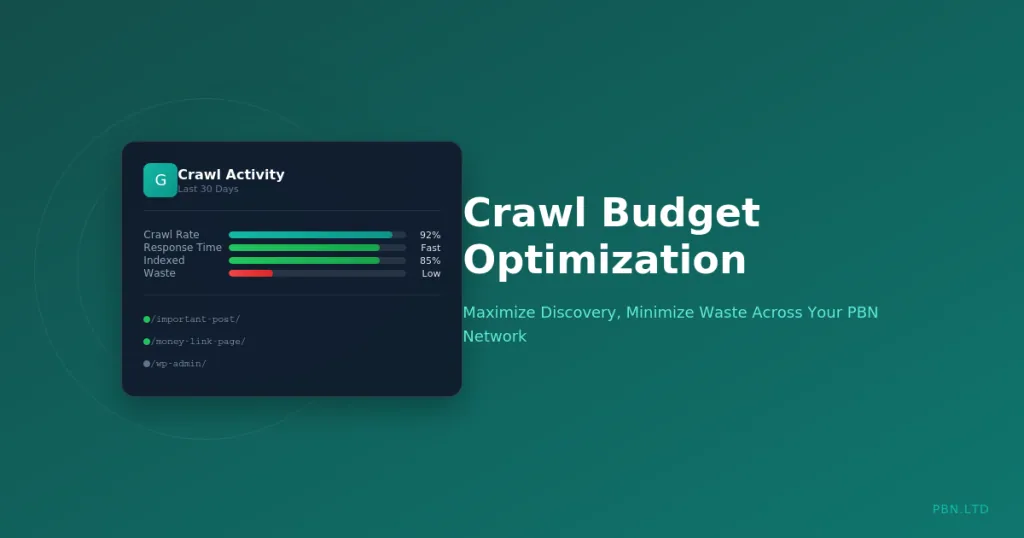
Google allocates limited crawling resources to each website. For large sites with millions of pages, crawl budget determines which pages get discovered and how quickly updates are processed. For smaller PBN sites, crawl budget works differently but still matters.
PBN sites face a specific crawl budget challenge. They typically have low authority, limited external signals, and minimal organic traffic. These factors reduce Google’s interest in crawling them frequently. Without optimization, new content and links may take weeks or months to be discovered.
This guide explains crawl budget in the context of PBN networks. We cover how to maximize the crawling your sites receive, avoid wasting crawl budget on unimportant pages, and ensure your money site links get discovered promptly.
Understanding Crawl Budget for Small Sites
Crawl budget discussions typically focus on large websites where Google cannot crawl everything. The concepts apply differently to small PBN sites, but understanding the fundamentals helps you optimize effectively.
Crawl Rate Limit
Google limits how aggressively it crawls any site to avoid overloading servers. This crawl rate limit caps the maximum crawling speed. For most PBN sites on decent hosting, the crawl rate limit is not the constraint. Google could crawl faster than it chooses to.
However, slow or unreliable hosting can trigger reduced crawl rates. If your server responds slowly or returns errors, Google backs off crawling to avoid problems. This makes hosting quality a crawl budget factor even for small sites.
Crawl Demand
Crawl demand reflects how much Google wants to crawl your site. Popular sites with frequently changing content and strong link profiles create high crawl demand. Google wants to keep its index fresh for sites that matter.
PBN sites typically have low crawl demand. Limited backlinks, minimal traffic, and infrequent content changes signal low importance. Google allocates crawling resources accordingly, visiting infrequently.
Increasing crawl demand requires making your site appear more valuable. More external links, more content updates, and signals of genuine utility all increase Google’s interest in crawling.
The PBN Crawl Challenge
For PBN sites, the challenge is not managing limited crawl budget across millions of pages. It is getting Google to crawl at all with reasonable frequency. A site that gets crawled once per month will have slow indexation of new content and delayed recognition of new links.
This connects directly to indexation strategies. Crawl budget optimization and indexation efforts work together to ensure Google discovers and processes your PBN content efficiently.
Factors Affecting PBN Crawl Budget
Multiple factors influence how frequently Google crawls PBN sites. Understanding these factors reveals optimization opportunities.
Site Authority and Backlinks
Sites with stronger backlink profiles receive more crawling attention. Google prioritizes crawling sites that matter based on link signals. A PBN site with quality supporting links will be crawled more frequently than an isolated site with no external links.
This creates a circular consideration. Powering up your PBN sites with tier two links not only increases the authority they pass to money sites but also increases crawl frequency, making new links more quickly discovered.
Content Freshness Signals
Sites that update content regularly train Google to crawl more frequently. If Google learns that a site publishes new content weekly, it will crawl weekly to find that content. Sites that never change get crawled less often because there is nothing new to discover.
Regular content publication on PBN sites serves multiple purposes. It makes sites appear legitimate, it provides fresh context for links, and it increases crawl frequency. Even modest publication schedules affect crawl patterns.
Server Response Quality
Fast, reliable server responses encourage more crawling. When Googlebot can crawl quickly without errors, it tends to crawl more pages. Slow responses or frequent errors cause Google to reduce crawl rate to avoid problems.
Our coverage of Core Web Vitals addresses the technical performance metrics that affect both crawling and user experience. Sites that perform well technically receive more favorable crawl treatment.
Site Structure and Internal Linking
Well-structured sites with clear internal linking help Google crawl efficiently. When pages link to each other logically, Googlebot can discover all content by following internal links. Poor structure with orphaned pages wastes crawl budget on navigation while leaving important content undiscovered.
Internal linking architecture affects both crawl efficiency and link equity distribution. See our guide on site architecture and internal linking for detailed optimization strategies.
Common Crawl Budget Waste
Limited crawl attention makes waste especially costly for PBN sites. Every crawl spent on unimportant pages is a crawl not spent on content with money site links.
Parameter URLs and Duplicate Content
WordPress and plugins often create multiple URLs for the same content. Sorting parameters, session IDs, tracking codes, and filter options all generate URLs that lead to duplicate or near-duplicate content.
Google may crawl these parameter URLs repeatedly, wasting crawl budget on content it has already seen. Proper canonical tags and parameter handling in robots.txt prevent this waste.
Audit your sites for parameter URL proliferation. Check Search Console for crawled URLs that should not exist. Address duplicate content issues before they consume limited crawl resources.
Archive and Date-Based URLs
WordPress creates archive pages by date, category, author, and tag. These archive pages often duplicate content available through other navigation paths. A small site might have dozens of archive pages all showing the same few posts.
Consider whether these archive pages add value. For PBN sites with limited content, date archives rarely help users or search engines. Noindexing or blocking these pages in robots.txt focuses crawl attention on actual content.
Media and Attachment Pages
WordPress creates individual pages for uploaded media files. These attachment pages typically contain just an image with minimal context. Google may crawl and index these pages, wasting budget and creating thin content issues.
Redirect attachment pages to the parent post or disable attachment pages entirely. Most SEO plugins include settings for this. Preventing attachment page indexation eliminates an entire category of crawl waste.
Admin and System URLs
Login pages, admin URLs, and system files do not need crawling. While WordPress blocks most admin URLs by default, plugins may create additional URLs that get crawled unnecessarily.
Review robots.txt to ensure admin areas and system files are blocked. Check Search Console for crawled URLs that should be excluded. Proper blocking prevents crawl waste on pages that should never be indexed.
Crawl Budget Optimization Techniques
Active optimization helps PBN sites make the most of limited crawl attention.
XML Sitemap Optimization
XML sitemaps tell Google which URLs matter. A well-constructed sitemap includes important pages and excludes pages you do not want crawled or indexed.
For PBN sites, include only content pages and posts with genuine value. Exclude archive pages, tag pages, and other derivative URLs. The sitemap should represent the content you actually want Google to find and index.
Use lastmod dates accurately. When content is updated, the lastmod date should change. This signals to Google that recrawling is worthwhile. Sitemaps with unchanging lastmod dates across all URLs provide no freshness signals.
Strategic Robots.txt Configuration
Robots.txt controls which areas Google can crawl. Use it to block access to areas that waste crawl budget: admin directories, plugin files, parameter-heavy URLs, and system paths.
Be careful not to block important content accidentally. A misconfigured robots.txt can prevent crawling of pages you need indexed. Test changes carefully and monitor Search Console for crawl errors after modifications.
Common beneficial blocks for PBN sites include wp-admin (except admin-ajax.php), plugin directories that generate front-end URLs, and parameter patterns that create duplicate content.
Internal Link Optimization
Internal links guide Googlebot through your site. Pages with more internal links pointing to them tend to get crawled more frequently. Use internal linking to direct crawl attention toward important pages.
Ensure pages with money site links receive internal links from other pages on the site. This increases their crawl priority and helps Google discover the outbound links they contain.
Avoid deep navigation structures that require many clicks to reach important content. Flatter site structures ensure all pages are accessible within two or three clicks from the homepage.
Page Speed Optimization
Fast pages allow more efficient crawling. When pages load quickly, Googlebot can crawl more pages in less time. Slow pages consume more crawl resources per URL.
Implement caching, optimize images, minimize JavaScript and CSS, and ensure fast server response times. These optimizations improve user experience while also improving crawl efficiency.
Quality PBN hosting provides the server performance foundation for fast page loads. Hosting that responds slowly or unreliably constrains both user experience and crawl efficiency.
Monitoring Crawl Activity
Understanding current crawl patterns helps identify optimization opportunities and verify that changes work.
Search Console Crawl Stats
Google Search Console provides crawl statistics showing how often Google crawls your site, response times, and any errors encountered. This data reveals whether your site receives adequate crawl attention.
Review crawl stats regularly for each PBN site. Look for trends in crawl frequency. Sudden drops may indicate problems. Gradual increases after optimization confirm improvements are working.
The crawl stats report also shows which response codes Google receives. Errors, redirects, and successful responses are all tracked. High error rates suggest technical problems that reduce crawl efficiency.
Server Log Analysis
Server logs provide detailed information about Googlebot visits. Log analysis shows exactly which URLs are crawled, when crawling occurs, and how the server responds.
For PBN sites, log analysis can reveal whether important pages are being crawled and whether crawl budget is being wasted on unimportant URLs. This granular data guides specific optimization efforts.
Log analysis requires technical capability and access to raw server logs. Not all hosting provides easy log access. Where available, periodic log review provides insights beyond what Search Console shows.
Index Coverage Reports
Search Console’s index coverage report shows which pages are indexed, which are excluded, and why. This report reveals crawl budget effectiveness: are the pages you want indexed actually being crawled and indexed?
Monitor index coverage alongside automatic indexation checks. Discrepancies between submitted pages and indexed pages indicate crawl or quality issues that need addressing.
Network-Level Crawl Considerations
Managing crawl budget across multiple PBN sites requires network-level thinking.
Avoiding Crawl Patterns
Identical site structures, identical robots.txt files, and identical sitemap configurations across sites create footprints. Vary your crawl optimization approaches across sites just as you vary themes and plugins.
Some sites might use comprehensive sitemaps while others rely more on internal linking for discovery. Some might block date archives while others leave them accessible. This variation prevents optimization approaches from becoming network signatures.
Coordinating Content Publication
Content publication timing affects crawl patterns. Publishing new content prompts recrawling. Coordinating publication across your network can help ensure important content gets discovered. Our content scheduling guide covers publication timing strategies.
Avoid publishing to all sites simultaneously, which could create a coordinated activity footprint. Stagger publication across days or weeks while still maintaining regular schedules that encourage crawl frequency.
Prioritizing High-Value Sites
Not all PBN sites deserve equal crawl optimization effort. Focus intensive optimization on high-value sites carrying important links. Lower-priority sites can receive standard configurations.
Sites linking to money sites with competitive keywords deserve the most attention. Faster crawling of these sites means faster discovery of valuable links. Sites serving as tier two support can receive less intensive optimization.
Advanced Crawl Optimization
For operators seeking maximum crawl efficiency, advanced techniques provide additional optimization.
HTTP Header Optimization
Proper HTTP caching headers help Googlebot crawl efficiently. Headers indicating that content has not changed allow Google to skip re-downloading unchanged content, preserving crawl resources for new content.
Implement proper Last-Modified headers and ETag support. These allow conditional requests where Google only downloads content that has actually changed since the last crawl.
Hreflang and Language Handling
For international PBN networks with multiple language versions, proper hreflang implementation prevents crawl budget waste on duplicate language detection. Clear language signals help Google crawl the appropriate versions efficiently.
Incorrect hreflang can cause Google to crawl the same content repeatedly trying to determine the correct language version. Proper implementation eliminates this waste.
JavaScript Rendering Considerations
Content that requires JavaScript rendering consumes more crawl resources than static HTML. Google must render JavaScript content, which takes additional processing. For PBN sites, minimizing JavaScript-dependent content improves crawl efficiency.
Use server-side rendering or static HTML whenever possible. If JavaScript is necessary, ensure critical content including money site links appears in the initial HTML rather than being injected by JavaScript.
Conclusion
Crawl budget optimization for PBN sites focuses on maximizing limited crawl attention rather than managing overflow. The goal is getting Google to crawl your sites frequently enough that new content and links are discovered promptly.
Eliminate crawl waste by blocking unimportant URLs, consolidating duplicate content, and removing unnecessary pages. Direct crawl attention toward important content through sitemaps, internal linking, and strategic prioritization.
Monitor crawl activity through Search Console and server logs. Verify that optimization efforts produce results. Adjust approaches based on observed crawl patterns.
Crawl optimization works alongside other technical SEO practices to ensure PBN sites function effectively. For comprehensive PBN hosting and management that supports these optimizations, our platform provides the technical foundation for sites that get crawled, indexed, and deliver link value to your money sites.