
Three years ago, you could populate a PBN site with AI-generated articles, point some links to your money site, and see results. The content didn’t need to be great. It just needed to exist—fill pages, provide context for links, make the site look active.
That approach is dying. If it’s not dead already for your niche, it will be soon.
Understanding why this changed—and what “quality” actually means for PBN content—is essential for anyone still building networks in 2026.
The Saturation Problem
When ChatGPT launched, it felt like a cheat code. Suddenly anyone could generate passable content at scale. PBN operators who had been struggling with content costs could now fill hundreds of pages in hours.
Everyone had the same idea.
The internet is now flooded with AI-generated content. Millions of pages that all sound vaguely similar—the same structure, the same hedging phrases, the same surface-level treatment of topics. “In today’s digital landscape…” “It’s important to note that…” “In conclusion, we can see that…”
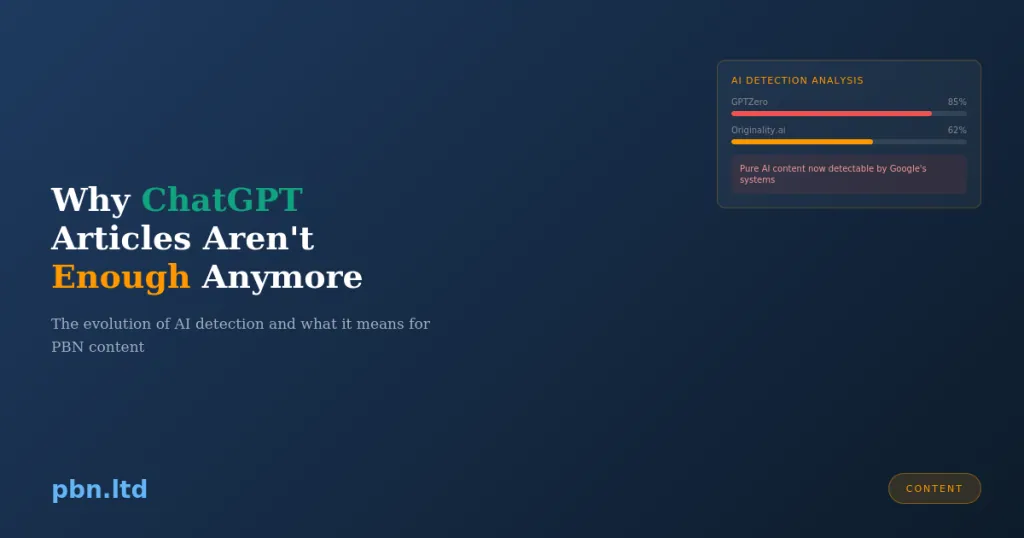
Google noticed. Of course they noticed. They’ve spent the past two years specifically targeting this flood of low-value AI content through helpful content updates and spam updates. Their systems are increasingly good at identifying content that exists to manipulate search rather than serve users.
The bar has risen because the floor collapsed. When everyone is producing mediocre AI content, mediocre AI content stops working.
What Google Actually Targets
Google isn’t against AI content per se. They’ve been clear about this. What they target is unhelpful content—regardless of how it was produced.
The signals they look at include:
Content that doesn’t satisfy user intent. Pages that rank for queries but don’t actually answer them. Users click, don’t find what they need, and bounce back to search results. This pattern tells Google the content isn’t helpful.
Content with no original value. Reworded versions of what already exists. Nothing new added, no unique perspective, no information you couldn’t find on a dozen other pages. Why should Google index another copy?
Content produced primarily for search engines. Pages that exist to attract crawlers and place links rather than serve human readers. The helpful content system specifically targets sites where this appears to be the primary purpose.
Sites with thin content across most pages. It’s not just individual pages—it’s the overall quality signal from the entire site. A site dominated by low-quality content drags down everything on that domain.
For PBN sites, this last point is critical. If your entire site is filled with thin AI content, the site-wide quality signal is negative. Even if individual pages aren’t terrible, the aggregate pattern marks the site as low-value.
The PBN-Specific Problem
PBN sites face a particular challenge. They need to look like legitimate sites while typically operating at minimal cost and effort. This tension has always existed, but AI content seemed to solve it—until it didn’t.
The characteristics that make AI content efficient for PBNs are exactly the characteristics Google has learned to identify:
Formulaic structure. AI content follows patterns. The same opening style, the same section organisation, the same conclusion format. Individually invisible, but detectable at scale.
Lack of specificity. Generic statements that could apply to any site in the niche. No concrete examples, no real case studies, no original data. The content is broad because AI doesn’t know specific details about your supposed expertise.
No authentic voice. Every post sounds the same—not just across your site, but across millions of AI-generated pages everywhere. There’s no personality, no perspective, no sense that a real person with real opinions wrote this.
Missing E-E-A-T signals. Experience, expertise, authoritativeness, trustworthiness. AI can’t demonstrate experience because it hasn’t experienced anything. It can’t show expertise because it’s generating generic content, not deep knowledge. The content might be factually accurate but lacks the signals that indicate genuine authority.
What “Quality” Actually Means for PBN Content
Let’s be realistic. We’re not suggesting every PBN post needs to be a masterpiece. You’re not trying to win journalism awards. You’re trying to build sites that pass value to your money sites.
Quality for PBN content means:
Content that could plausibly exist on a real site. Would a real business in this niche publish this? Would a real blogger write this? If the answer is no—if the content is obviously filler—it’s not good enough.
Content with some specific value. Say something concrete. Include a real example. Share an actual tip someone could use. Generic content is worse than short content that’s actually useful.
Content that varies in format and approach. Not every post needs to be a 1500-word guide with five H2 sections. Real blogs have variety—short updates, detailed guides, opinion pieces, lists, case studies. Vary your format.
Content that matches the site’s supposed identity. If your PBN site is supposedly a local plumber’s blog, the content should sound like a plumber wrote it—practical, direct, maybe a bit rough around the edges. Not polished corporate speak. Not academic prose. Match the voice to the persona.
Content that makes the link placement natural. The whole point is to place links. But if the content is so thin that any link looks forced, you’ve undermined the purpose. Build enough substance that a link to your money site actually makes contextual sense.
Using AI Effectively (Yes, It’s Still Possible)
AI isn’t useless for PBN content. It’s just not a complete solution anymore. Here’s how to use it effectively:
Use AI for drafts, not finished content. Generate a starting point, then rewrite substantially. Add specifics. Inject personality. Cut the generic filler. The final content should be more you than AI.
Use AI for research and structure. Let it help you outline topics, identify subtopics, gather general information. Then write the actual content yourself—or heavily rewrite what it produces.
Use different prompts and approaches. If you’re using AI, at least vary your prompts. Don’t generate 50 articles with the same prompt template. That creates patterns. Mix up the instructions, the tone requests, the structural guidance.
Combine AI with human editing. The economics might work for AI generation plus human editing. The human pass adds the specificity, personality, and natural variation that pure AI lacks.
Accept that some content needs to be human-written. For important pages—the posts that will carry your money site links—consider writing them properly or hiring someone who can. Not every page needs this investment, but the pages that matter do.
The Economics Have Shifted
The appeal of AI content was cost. Why pay writers when AI is essentially free?
But cheap content that doesn’t work isn’t actually cheap. If your AI-filled PBN sites get deindexed, the cost is the entire investment in those domains. If they stay indexed but pass no value, the cost is opportunity—time and money spent on a strategy that isn’t working.
The math now favours fewer, higher-quality PBN sites over large networks of thin sites. Ten sites with solid content will outperform fifty sites with obvious AI filler. And they’ll be more sustainable—less likely to trigger algorithmic penalties or manual reviews.
This doesn’t mean unlimited content budgets. It means being strategic—investing in quality where it matters, being thoughtful about how AI is used, building sites that can survive the ongoing crackdown on low-value content.
What Happens to Low-Quality PBN Sites
We’re already seeing it. Sites that were working fine two years ago are getting caught in helpful content updates. Networks that relied entirely on AI content are losing indexation. The links from these sites are passing less value—or triggering negative associations.
The pattern will continue. Google’s detection systems improve continuously. Techniques that work today get caught tomorrow. Building networks on the minimum viable content quality means rebuilding constantly as the minimum rises.
Building properly from the start—sites that look legitimate because they actually have legitimate content—is more sustainable. It costs more upfront but less over time.
Moving Forward
The era of “just fill it with AI content” is ending. That doesn’t mean PBNs don’t work—they do. It means the content bar has risen, and operators who don’t adapt will get left behind.
Audit your existing sites. Do they pass the “could this be real” test? Is there actual value on the pages, or just filler around links? Would a human visitor find anything useful?
For new sites, build with quality from the start. It’s easier than retrofitting quality onto thin sites later. Use AI as a tool, not a replacement for thought and effort.
If content creation isn’t your strength, factor professional content into your costs—or use services that handle it for you. Our PBN building service includes proper content as part of the build, because we’ve seen too many networks fail from content neglect.
The investment in quality content isn’t optional anymore. It’s the price of admission for PBN strategies that actually work in 2026 and beyond.