The story being told in most SEO coverage right now is one of collapse. Zero-click searches are eating the web. AI Overviews are absorbing queries that once reliably sent traffic to publisher sites. The organic channel is in terminal decline. Every headline is more catastrophic than the last. The reality, as usual, is more specific and more useful than the headline version — and for PBN operators in particular, understanding the actual picture matters more than reacting to the panic. The implications are neither as catastrophic as the worst coverage suggests nor as irrelevant as those who’ve decided to ignore it entirely would prefer.
What the Data Actually Shows
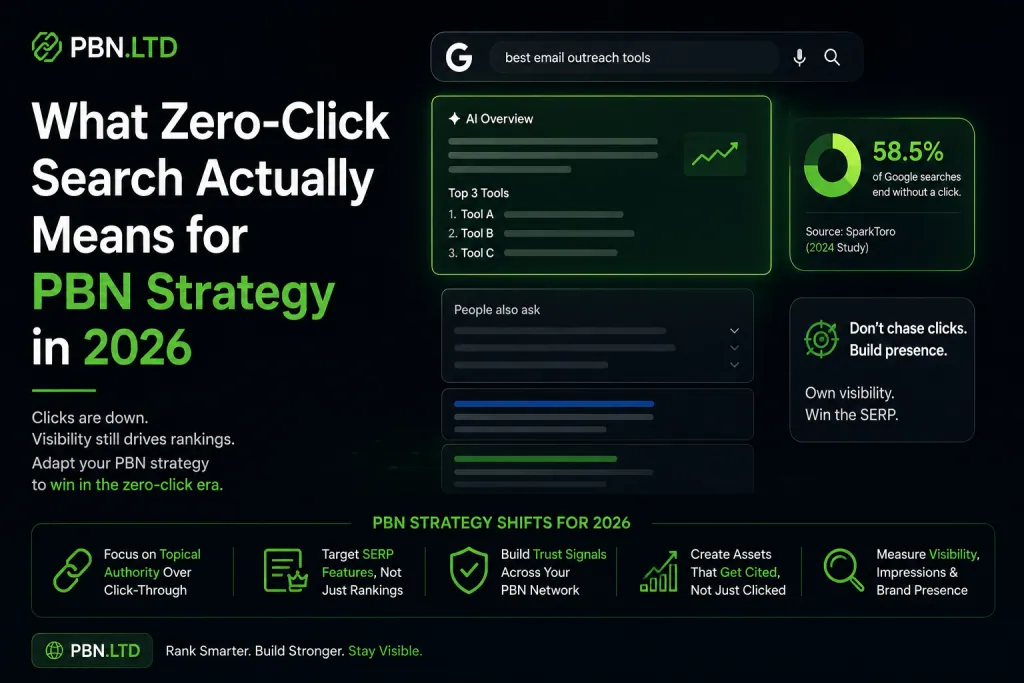
The numbers circulating across the SEO industry in 2026 are real, and they are significant. SparkToro’s clickstream data, compiled using Datos’ browsing panel, shows approximately 65% of all Google searches now end without a click to any external website. When an AI Overview appears above the organic results, that zero-click rate climbs to 83%. Without an AI Overview, the baseline zero-click rate sits at 60%.
A randomised field experiment by researchers at the Indian School of Business and Carnegie Mellon University — the most methodologically rigorous study on this question to date — found that AI Overviews reduced organic clicks by 38% on the queries where they appeared. The study ran across two weeks in January and February 2026, using a browser extension to randomly assign participants to see or not see AI Overviews, isolating the causal effect rather than relying on correlation. Removing top-positioned AI Overviews nearly doubled outbound click rates; lower-positioned ones had no measurable effect.
Ahrefs’ February 2026 analysis of 300,000 keywords found a 58% CTR drop at position 1 when an AI Overview was present — up from a 34.5% drop in their April 2025 measurement, which confirms the effect is growing as AI Overviews expand and mature. Pew Research’s behavioural tracking study of 68,879 real searches found that only 8% of users clicked an organic result when an AI Overview was present, compared to 15% without one. Only 1% of users clicked on the citation links referenced inside the AI Overview itself.
In Google’s AI Mode — the fully conversational interface launched in March 2025 where traditional results are replaced by an AI-generated response — Semrush data shows 93% of searches end without a click to any external site. AI Mode remains limited in rollout but is expanding.
These figures represent a meaningful structural shift in how search traffic is distributed. They do not represent the end of organic search. U.S. organic traffic was down 2.5% year-over-year in January 2026 according to Graphite data — a real decline, but nowhere near the channel collapse the dramatic framing suggests. Understanding precisely do backlinks still move rankings in 2026 is the foundational question that zero-click data now intersects with, because the answer shapes everything about how link investment should be evaluated.
The Most Important Distinction: Rankings vs Traffic
The single most important thing to understand about zero-click search from a PBN strategy perspective is this: zero-click behaviour affects traffic delivery from rankings, not the rankings themselves. PBN links move ranking positions. Whether that ranking position then converts into a website visit depends on what’s happening in the SERP above the organic results — and that is something neither the link nor the site operator controls.
This distinction matters enormously for how link investment is evaluated. The link’s job — passing PageRank and authority signals that improve a money site’s position in Google’s index — has not changed. What has changed is the downstream value of certain ranking positions for certain query categories, because those positions are now partially or significantly shielded from user clicks by SERP features.
An operator building PBN links to support a money site targeting informational queries is supporting rankings in the category where AI Overviews appear most frequently. An operator building links to support a money site targeting transactional queries — product searches, service comparisons, purchase-intent keywords — is supporting rankings in a category where AI Overviews appear on only 3-4% of queries. The PBN link’s mechanism is identical in both cases. The return on that investment is not.
Which Query Types Are Exposed, and Which Aren’t
The query-type breakdown of AI Overview prevalence is the most practically useful data for evaluating PBN link investment in the current environment. The picture is not uniform across the search landscape, and treating it as though it were produces bad decisions.
High-Exposure Queries: Informational and Editorial
Informational queries — how-to, what-is, definitional and explanatory searches — are the highest-exposure category. AI Overviews appear on these queries at rates measured between 40% and 70% depending on the sub-category. Queries in health, technology, and relationships niches have seen among the steepest increases in AI Overview trigger rates in 2026. Similarweb data found the zero-click rate in the news and editorial segment jumped from 56% to 69% within 12 months of the US AI Overviews launch. Money sites built primarily around informational content in these categories are operating in the highest-exposure territory.
Low-Exposure Queries: Transactional and Commercial
Transactional and commercial queries are substantially more protected. SE Ranking and Ahrefs data consistently shows AI Overviews appearing on only 3.2% to 4% of e-commerce queries. Product category pages, service pages, pricing comparisons, and purchase-intent searches remain largely outside the AI Overview coverage area because Google’s AI cannot complete a transaction — the click is still required for the user to accomplish what they actually came to do.
Branded queries present a counterintuitive pattern. Amsive’s analysis of 700,000 keywords found branded queries where an AI Overview appeared actually saw an 18.68% CTR increase, not a decrease. The summary functions as a trust confirmation rather than a substitute for the visit — users check details in the AI Overview and then click through. Money sites with meaningful brand recognition benefit from this effect rather than being harmed by it.
Local queries — searches with geographic intent where the user needs directions, hours, phone numbers, or local reviews — also remain largely click-dependent. The intent requires an action that can only be completed off the SERP, which protects these queries from AI Overview absorption almost entirely.
What This Means for Where PBN Links Should Be Directed
The zero-click data produces a clear strategic implication: the return on PBN link investment is increasingly a function not just of the ranking achieved, but of the query type that ranking serves. The same link effort directed at a transactional page rather than an informational page may deliver significantly more traffic value in 2026, even at the same ranking position.
Concentrate Support on Commercial Pages
If a money site has both informational content and commercial or transactional pages, the case for concentrating PBN link support on the commercial pages has strengthened considerably. A commercial page at position 3 for a transactional query delivers more traffic than an informational page at position 1 for an AI Overview-dominated query. topical authority for competitive keyword clusters determines whether a site can rank for commercial intent queries at all — without it, the underlying authority needed to compete for these terms isn’t present regardless of how many links support individual pages.
Reassess Purely Informational Money Sites
Money sites built primarily around informational content in high-exposure categories deserve harder scrutiny on whether PBN link investment is delivering adequate return in the current environment. This doesn’t render such sites worthless — informational content still generates impressions, brand exposure, and the referral quality of clicks that do arrive is higher because those users have already consumed a summary and want deeper information. But the volume case for heavy link investment in purely informational niches has weakened materially.
The Satellite Site Model Becomes More Compelling
One implication specifically relevant to PBN operators is the increased value of network sites that rank for their own queries rather than purely passing links. satellite PBN sites that rank and attract their own traffic has become a more attractive strategy in the zero-click era because it diversifies the value model — a network site attracting its own organic visitors generates independent value regardless of the link equity it passes. The investment required is higher, but its relative attractiveness compared to purely link-passing sites has increased as certain link strategies return less traffic to money sites.
For operators building or restructuring networks with this in mind, our professional PBN building service is available for networks where commercial niche targeting from the ground up is the priority.
The Link Equity Question Is Unchanged
It’s worth being explicit about what zero-click search does not change. It does not change whether Google uses backlinks to evaluate rankings. Links remain among the most significant ranking signals in Google’s algorithm, and the evidence from controlled studies, competitive SERP analysis, and industry observation is consistent that this remains true in 2026. Zero-click affects what happens after a ranking is achieved, not how rankings are determined.
The core function of a PBN link — passing PageRank from domains with established backlink profiles to money site pages — is unaffected by zero-click trends. how SpamBrain identifies and devalues manipulative link patterns has evolved in its ability to detect and discount low-quality link patterns, but this is a quality and footprint question that exists entirely independently of zero-click behaviour. A well-built link from a topically coherent site still moves rankings in 2026. The strategic question is whether the ranking being moved serves a query type that still delivers traffic when moved.
Practical Adjustments, Not Strategy Overhauls
Rather than broad restructuring, zero-click trends call for a series of specific adjustments to how PBN campaigns are planned and evaluated.
Audit Your Money Site’s Query Exposure Before Any Campaign
Before planning link deployment, categorise the target queries by AI Overview exposure risk. Use Google Search Console’s Performance report to identify pages where impressions are stable or rising while clicks are falling — this is the signature of click compression from SERP features above organic results. Knowing which pages are exposed tells you where the return on link investment is lowest.
Update What You Measure
Evaluate campaign outcomes against rankings and impression data, not traffic alone. In a zero-click environment, a ranking improvement that shows up as an impression increase without proportional traffic increase is still a real outcome — the ranking moved, the brand appeared in search, the page was assessed as relevant. Traffic is now an incomplete measure of whether links are working, particularly for money sites with any informational content exposure.
Don’t Change What’s Working Technically
Zero-click trends don’t affect how PBN links should be built or deployed. link velocity and natural acquisition timing still matters for avoiding footprint signals that trigger algorithmic discount. anchor text ratios for commercial and transactional pages for commercial pages remains critical for avoiding over-optimisation patterns that devalue link signals. indexation of the money site pages your PBN links are supporting remains a prerequisite — links pointing to pages Google hasn’t indexed deliver no equity regardless of their quality. None of the technical discipline around good footprint-free PBN hosting changes because of shifts in how users behave on the SERP.
The Larger Picture
Zero-click search is a real phenomenon with real strategic implications, and ignoring it produces worse decisions than engaging with it on its own terms. But the specific implication for PBN operators is more limited and more manageable than the broader SEO discourse suggests. Links still determine rankings. Rankings still deliver traffic for the query types most relevant to commercial outcomes. The task in 2026 is being more deliberate about which rankings are being supported and why — not abandoning the link infrastructure that underpins competitive search performance across virtually every contested niche.
If you want to work through how your specific network and money site setup is positioned against the zero-click environment, free personalised PBN and SEO advice is available.