
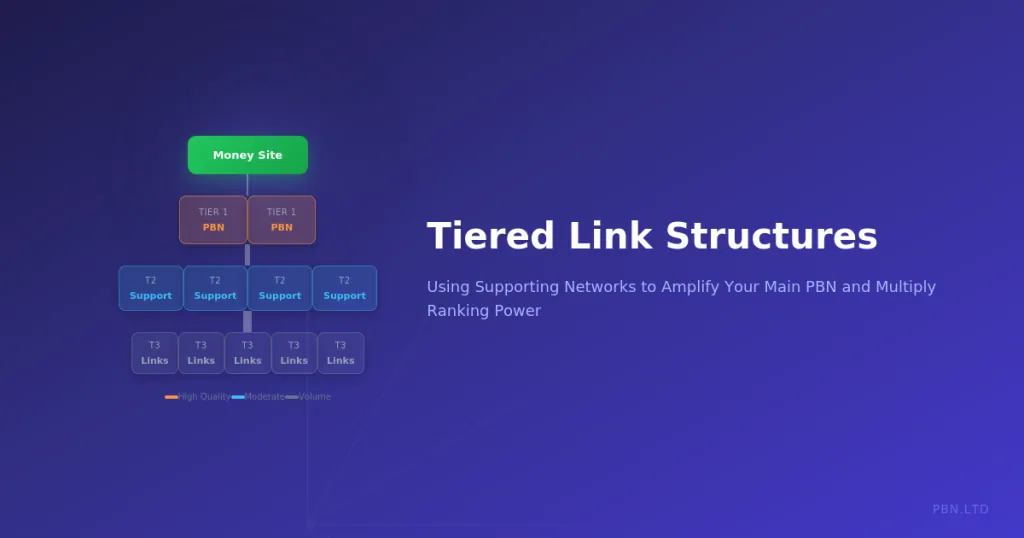
A PBN site linking directly to your money site is only as powerful as its own authority allows. Sites with weak backlink profiles pass limited value regardless of how well they are built. Tiered link structures solve this by building supporting networks that strengthen your main PBN sites.
The concept is straightforward. Tier one sites link directly to your money site. Tier two sites link to your tier one sites, increasing their authority. Tier three sites can link to tier two sites, and the structure can extend further. Each tier amplifies the power of the tier above it.
This guide explains how to build and manage tiered link structures effectively. We cover the strategic logic behind tiering, practical implementation approaches, and how to balance complexity against benefit.
Understanding Tiered Link Logic
Before building tiered structures, understanding why they work helps you implement them effectively.
How Authority Flows Through Tiers
Link equity flows from linking pages to linked pages. When a tier two site links to a tier one site, some of the tier two site’s authority transfers to the tier one site. The tier one site becomes stronger and passes more value to the money site it links to.
Each tier acts as an amplifier. A tier one site receiving links from ten tier two sites accumulates authority from all ten. This concentrated authority then flows to the money site through a single, controlled link.
The amplification is not perfect. Some authority dissipates at each tier. But the net effect is that well-structured tiers deliver more value to money sites than standalone PBN sites with no supporting links.
Risk Distribution Benefits
Tiered structures also distribute risk. Lower tiers can use more aggressive link building techniques because they do not link directly to your money site. If a tier three site gets penalized, it affects tier two, which affects tier one, which affects your money site. The impact is diluted through each layer.
This buffering allows you to use link sources on lower tiers that would be too risky pointing directly at money sites. Blog comments, forum profiles, web 2.0 properties, and other high-volume link sources can safely strengthen lower tiers.
The separation also protects against algorithmic detection. Even if Google identifies tier three links as manipulative, the connection to your money site passes through multiple layers. Understanding how Google’s spam detection works helps you structure tiers to maximize this protection.
Natural Link Profile Simulation
Real websites accumulate links from diverse sources at varying quality levels. Some links come from high-authority sites. Many come from average sites. Some come from low-quality sources. This diversity is natural.
Tiered structures can simulate this natural diversity. Tier one sites receive carefully curated, high-quality links from tier two. Tier two sites receive a broader mix of links from tier three. This creates organic-looking link profiles throughout the structure.
Tier One: Your Main PBN
Tier one sites link directly to your money sites. They require the highest quality standards and the most careful management.
Quality Requirements
Tier one sites should be indistinguishable from legitimate websites. High-quality content, professional design, proper technical implementation, and believable site history all matter at this tier.
These sites need strong domains with clean histories and genuine metrics. The domain evaluation framework we have published covers how to assess domains for tier one use.
Content on tier one sites should meet publication standards. Real depth, genuine usefulness, and proper research make these sites defensible if ever reviewed manually. Thin or obviously generated content has no place at tier one.
Link Placement Standards
Money site links from tier one require careful placement. Natural context, appropriate anchor text, and editorial integration all matter. These links face the most scrutiny because they point directly to what you are trying to rank.
Follow careful anchor text strategies at tier one. Over-optimized anchors at this level create the most risk. Brand anchors, URL anchors, and natural phrase variations should dominate.
Limit outbound links from tier one sites. Each money site link should be special, not one of twenty outbound links on every page. Selective linking maintains value concentration and editorial appearance.
Maintenance Priority
Tier one sites deserve the most maintenance attention. Regular content updates, security monitoring, and performance optimization all apply. These sites represent your greatest investment and carry the most direct risk.
Monitor tier one sites for indexation, link integrity, and any signs of problems. Issues at tier one require immediate attention because they directly affect your money sites.
Tier Two: Supporting Your Main PBN
Tier two sites link to tier one sites. Their purpose is amplifying tier one authority. Quality standards remain important but can be somewhat relaxed compared to tier one.
Quality Calibration
Tier two sites should still appear legitimate but do not need tier one polish. Good content rather than exceptional content. Decent design rather than premium design. Functional rather than impressive.
Domain quality can also be somewhat lower at tier two. Domains with moderate metrics, less extensive histories, or minor blemishes that would disqualify them from tier one can serve effectively at tier two.
This calibration allows more efficient resource use. Premium domains and content investment concentrate at tier one where they matter most. Tier two receives adequate but not premium resources.
Linking to Tier One
Each tier two site typically links to one or a few tier one sites. Spreading tier two links across multiple tier one sites dilutes the amplification effect. Concentration builds more authority in targeted tier one sites.
Links from tier two to tier one can be more liberal with anchor text. Since these links do not point to money sites, keyword-rich anchors carry less risk. However, extreme over-optimization still looks unnatural.
Place tier two links contextually just as you would tier one links. The sites being linked to are your own PBN sites, but the linking pages should still look natural to any observer.
Scale Considerations
Tier two typically requires more sites than tier one to provide meaningful amplification. A ratio of three to five tier two sites per tier one site is common. This means tier two represents a larger operational footprint.
Managing this scale efficiently requires systems. Documentation of which tier two sites link to which tier one sites. Tracking of link status across the structure. Scheduled maintenance across a larger site inventory.
Our centralized management tools help operators manage tiered structures at scale without losing track of relationships and dependencies.
Outsourcing Tier Two Links
Not every operator wants to build and maintain their own tier two infrastructure. The operational overhead of managing additional sites, creating content, and maintaining links can exceed available resources.
For those who prefer to focus on tier one quality while outsourcing tier two support, affordable tier two PBN backlink packages provide a cost-effective way to amplify your main network without the management burden. This approach lets you concentrate resources on what matters most while still benefiting from tiered amplification.
Tier Three and Beyond
Lower tiers provide further amplification and allow increasingly aggressive link building techniques.
Quality Flexibility
Tier three and lower tiers can accept substantially lower quality. Web 2.0 properties, social bookmarks, wiki links, forum profiles, and other easily obtained links become viable at these levels.
The distance from your money site provides insulation. A spammy forum profile linking to a tier three site linking to a tier two site linking to a tier one site linking to your money site has minimal direct association with your money site.
This flexibility allows high-volume link building that would be dangerous at higher tiers. Automated link building tools can populate tier three and below while manual, careful work focuses on higher tiers.
Diminishing Returns
Each additional tier provides diminishing returns. Authority dilutes as it passes through more layers. The operational complexity of managing additional tiers increases while the incremental benefit decreases.
For most operations, two or three tiers provide optimal balance. Tier one for quality sites linking to money sites. Tier two for supporting sites amplifying tier one. Tier three for high-volume, low-quality links strengthening tier two.
Beyond three tiers, the complexity often exceeds the benefit. Resources are usually better spent strengthening existing tiers rather than adding new ones.
Automation Opportunities
Lower tiers present opportunities for automation. Since quality requirements are lower and direct connection to money sites is distant, automated tools can handle link building at these levels.
GSA Search Engine Ranker, RankerX, and similar tools can build tier three and below links efficiently. The key is ensuring these automated links never accidentally point higher than their intended tier.
Strict URL management prevents automation accidents. Automated tools should only receive tier two URLs as targets. Tier one URLs and money site URLs should never appear in automation target lists.
Building Tiered Structures
Implementing tiered structures requires planning and systematic execution.
Planning Your Structure
Before building, plan the complete structure. How many tier one sites will you maintain? How many tier two sites per tier one site? Will you include tier three? What link sources will you use at each tier?
Document the planned structure visually. Diagrams showing which sites link to which help maintain clarity as the structure grows. This documentation also helps if you need to troubleshoot problems or hand off management.
Plan resource allocation across tiers. Budget for domains, content, and hosting at each tier level. Understand the total investment required before starting rather than discovering mid-project that resources are insufficient.
Build Order Strategy
Build tiers in reverse order for best results. Start with tier two or tier three sites. Let them age and develop before building tier one. When tier one is ready, supporting infrastructure is already in place.
This approach means tier one sites immediately receive supporting links rather than launching alone. The authority amplification begins from day one of tier one operation.
Building tier one first and then adding supporting tiers later works but requires patience. Tier one sites operate at reduced power until supporting tiers mature, which may take months.
Link Velocity Across Tiers
Manage link velocity at each tier level. Lower tiers can accept faster link building because natural sites at those quality levels often do gain links quickly through various means.
Higher tiers should see more gradual link acquisition. Tier one sites especially should accumulate links at natural-looking rates. A tier one site gaining fifty tier two links in one day looks suspicious.
Coordinate velocity across your structure. When building new tier two links, spread them across time. When those tier two sites link to tier one, also spread that timing. Gradual, natural-looking growth protects the entire structure.
Managing Tiered Networks
Ongoing management keeps tiered structures effective and identifies problems before they cascade.
Monitoring by Tier
Monitor each tier at appropriate intensity. Tier one requires close monitoring of indexation, rankings, and link integrity. Tier two requires regular but less intensive monitoring. Lower tiers may only need periodic spot checks.
Our automated indexation monitoring can track sites across all tiers, alerting you to deindexation at any level. This early warning allows quick response before problems affect higher tiers.
Track relationships between tiers. If a tier two site shows problems, immediately check the tier one sites it links to. If a tier one site weakens, review the tier two sites supporting it.
Maintenance Prioritization
Allocate maintenance time according to tier importance. Tier one sites should receive content updates, security patches, and performance optimization. Tier two sites need periodic attention but less frequent updates. Lower tiers may only need basic upkeep.
When time is limited, prioritize higher tiers. A tier one site needing attention takes precedence over a tier three site with similar issues. The impact of tier one problems is more immediate and severe.
Handling Tier Failures
Sites at any tier can fail through deindexation, domain expiration, or other problems. The tiered structure provides resilience but failures still require response.
Lower tier failures have limited impact. If one of many tier three links dies, the effect on tier two is minimal. These failures often do not require replacement unless they represent significant portions of a tier’s link profile.
Higher tier failures require more attention. A tier two site failure means reduced support for tier one. Multiple tier two failures significantly weaken tier one authority. Plan for replacement or reinforcement when higher tier sites fail.
Tier one failures are critical. If a tier one site is lost, the money site loses direct link value. Having multiple tier one sites provides redundancy, but each tier one loss still represents significant impact.
Common Tiering Mistakes
Understanding common mistakes helps you avoid them.
Over-Complicating Structures
Building more tiers than necessary creates management burden without proportional benefit. Five or six tier structures become nearly impossible to track and maintain. The complexity exceeds what most operations can handle effectively.
Start simple. Two tiers provide significant benefit with manageable complexity. Add a third tier only if you have systems and resources to manage it properly. Go beyond three tiers only with compelling reason and exceptional organizational capacity.
Skimping on Tier One
Some operators invest heavily in lower tiers while under-investing in tier one. This is backwards. Tier one carries the direct connection to your money site and deserves the best resources.
A powerful tier two and tier three structure supporting a weak tier one site delivers poor results. The tier one site becomes the bottleneck. No amount of lower tier amplification overcomes fundamental tier one weakness.
Cross-Tier Contamination
Accidentally linking lower tier sites directly to money sites defeats the purpose of tiered structures. A tier three site should never link to your money site. Strict URL management prevents this contamination.
Similarly, using the same anchor text patterns across all tiers creates detectable patterns. Vary anchor text approaches by tier just as you vary quality standards by tier.
Conclusion
Tiered link structures multiply the effectiveness of your PBN investment. Supporting networks amplify tier one authority while providing risk insulation. Properly structured tiers deliver more ranking power than equivalent standalone sites.
Build tiers with appropriate quality standards at each level. Invest heavily in tier one. Allow quality flexibility at lower tiers while maintaining operational discipline. Manage the complete structure as an integrated system.
Start with manageable complexity. Two or three tiers serve most operators well. Add complexity only when you have systems to manage it. The best structure is one you can actually maintain over time.
For PBN hosting that supports tiered structures at scale, our platform provides the infrastructure and management tools to operate complex networks effectively. Build tiers with confidence knowing your hosting supports the operational demands of sophisticated link structures.