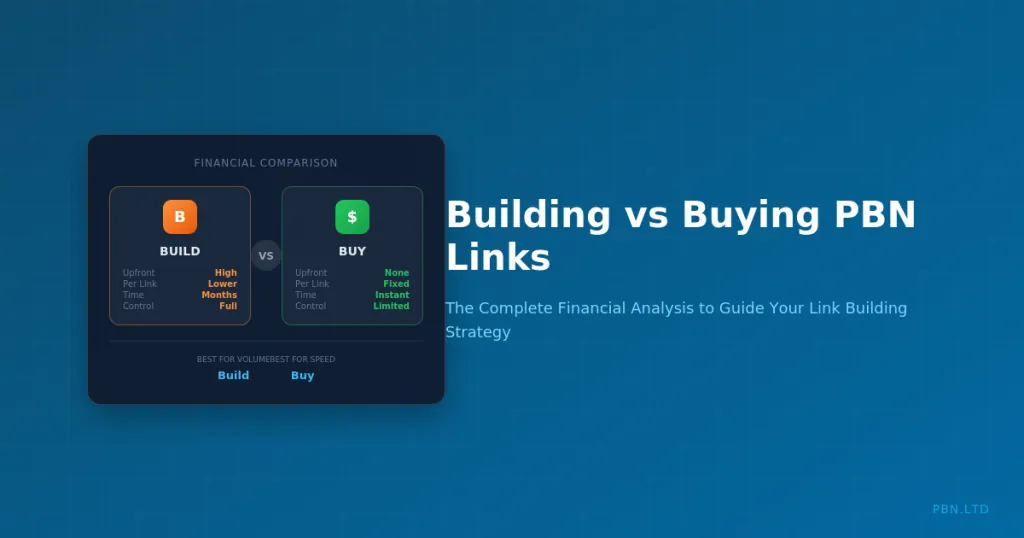
Building your own PBN requires significant investment in domains, hosting, content, and time. Buying links from established networks offers immediate access without the operational burden. Both approaches have their place, but understanding the true costs helps you make informed decisions about where to allocate resources.
Most cost comparisons oversimplify this decision. They compare the price of a purchased link against domain and hosting costs without accounting for the full picture. Time investment, opportunity cost, failure rates, and long-term value all affect the real economics.
This analysis breaks down the complete cost structure of both approaches. We examine upfront costs, ongoing expenses, hidden costs, and the factors that shift the equation in different directions for different operators.
The Full Cost of Building Your Own PBN
Building a PBN involves far more than buying expired domains and cheap hosting. The complete cost structure includes multiple categories that operators often underestimate.
Domain Acquisition Costs
Quality expired domains form the foundation of effective PBNs. Domain costs vary dramatically based on metrics, history, and competition.
Entry-level domains with modest metrics might cost fifty to one hundred dollars at auction. These domains have some backlink history but limited authority. They provide a starting point but deliver correspondingly modest link value.
Mid-tier domains with stronger metrics typically run two hundred to five hundred dollars. These domains have established authority, cleaner histories, and more valuable backlink profiles. They form the backbone of most serious PBN operations.
Premium domains with exceptional metrics can cost thousands. High DR or DA domains with extensive natural backlink profiles command premium prices. These domains deliver the most link value but require significant capital commitment.
Beyond auction prices, domain research takes time. Evaluating domains properly using a thorough evaluation framework prevents costly mistakes but requires hours of analysis per quality domain acquired.
Hosting Expenses
PBN hosting requires diversity to avoid footprints. This diversity comes at a cost premium compared to hosting multiple sites on a single server.
Cheap shared hosting might cost five dollars per month per site. However, cheap hosting often means poor performance, limited support, and potential footprint issues when multiple PBN sites end up on the same IP ranges.
Proper PBN hosting with IP diversity costs more but provides the separation needed for safe operations. Budget ten to twenty dollars per site per month for hosting that actually protects your network.
Annual hosting costs for a ten-site PBN range from six hundred to over two thousand dollars depending on hosting quality. This is a recurring cost that continues as long as you operate the network.
Content Creation Costs
PBN sites need content to appear legitimate. The quality and quantity of content directly affects both site believability and the value of links from those sites.
Minimum viable content might include ten to fifteen articles per site to establish basic legitimacy. At fifty to one hundred dollars per quality article, that represents five hundred to fifteen hundred dollars per site just to reach baseline content levels.
Higher quality content that truly passes manual review costs more. Well-researched articles with genuine depth might run one hundred fifty to three hundred dollars each. Premium content makes sites more defensible but increases costs substantially.
Writing content yourself saves money but costs time. A thousand-word article takes two to four hours to research and write properly. Our guide on PBN content standards covers what content needs to accomplish, regardless of who creates it.
Setup and Configuration Time
Each PBN site requires setup time. Installing WordPress, configuring themes and plugins, setting up basic pages, and establishing site structure takes hours per site.
An experienced operator might set up a site in two to three hours. Someone newer to the process might spend five to eight hours on initial setup. Multiply by the number of sites in your network.
Value your time appropriately. If your time is worth fifty dollars per hour, three hours of setup represents one hundred fifty dollars in opportunity cost per site. This cost is often ignored but very real.
Ongoing Maintenance Costs
PBN sites require ongoing attention. WordPress updates, security patches, content refreshes, and monitoring all consume time over the life of the network.
Budget at least one to two hours per site per month for basic maintenance. For a ten-site network, that represents ten to twenty hours monthly. At fifty dollars per hour, that is five hundred to one thousand dollars in monthly time cost.
Centralized management dashboards reduce maintenance time but do not eliminate it. Even with efficient tools, networks require regular attention to remain effective and safe.
Tool and Software Costs
Effective PBN operation requires various tools. Domain research tools, backlink checkers, rank trackers, and SEO analysis platforms all cost money.
Ahrefs or Semrush subscriptions run one hundred to five hundred dollars monthly depending on plan level. These tools are essential for domain research and monitoring but represent significant ongoing expense.
Specialized PBN tools, premium themes, and plugins add further costs. Budget fifty to two hundred dollars monthly for the tool stack needed to operate effectively.
Total Cost Example: Building a 10-Site PBN
Let us calculate realistic costs for building a modest ten-site PBN from scratch.
Year One Costs
Domain acquisition at three hundred dollars average per quality domain totals three thousand dollars. This assumes mid-tier domains rather than premium or budget options.
Hosting at fifteen dollars per site per month totals eighteen hundred dollars for the year. This assumes proper PBN hosting rather than cheap shared options.
Content at one thousand dollars per site for initial articles totals ten thousand dollars. This provides adequate content for legitimacy without premium investment.
Setup time at three hours per site at fifty dollars per hour totals fifteen hundred dollars in opportunity cost.
Monthly maintenance at fifteen hours at fifty dollars per hour over twelve months totals nine thousand dollars in opportunity cost.
Tools at one hundred fifty dollars per month totals eighteen hundred dollars for the year.
Total first year cost: approximately twenty-seven thousand dollars. This provides ten functional PBN sites ready to deploy links.
Ongoing Annual Costs
After year one, costs decrease but remain substantial. Domain renewals at fifteen dollars each total one hundred fifty dollars. Hosting continues at eighteen hundred dollars. Maintenance time continues at nine thousand dollars. Tools continue at eighteen hundred dollars.
Ongoing annual cost: approximately twelve thousand seven hundred fifty dollars to maintain the ten-site network.
Content refreshes, domain replacements for failed sites, and network expansion add further costs. Realistic ongoing budgets often exceed fifteen thousand dollars annually.
Cost Per Link Calculation
If your ten-site network produces one hundred links in year one, your cost per link is approximately two hundred seventy dollars. This assumes one link placement per site initially plus additional placements as content accumulates.
Over time, as sites mature and you place more links, the cost per link decreases. By year three, the same network might have produced three hundred links, bringing average cost per link down to around one hundred dollars.
But these averages obscure important variation. Early links cost more because infrastructure investment has not yet amortized. Later links cost less but still require ongoing maintenance and hosting expenses.
The Cost of Buying PBN Links
Purchased PBN links offer a different cost structure. You pay per link without infrastructure investment or ongoing maintenance burden.
Link Pricing Tiers
PBN link prices vary based on the authority and quality of the linking sites. Budget links from lower-authority sites might cost twenty to fifty dollars each. These links provide modest value appropriate for lower-competition keywords or supporting tier two structures.
Mid-range links from established sites with decent metrics typically run fifty to one hundred fifty dollars. These links form the backbone of most link building campaigns, providing meaningful authority transfer at reasonable cost.
Premium links from high-authority sites can cost two hundred to five hundred dollars or more. These links move rankings noticeably and work for competitive keywords where standard links struggle.
Our PBN link packages span these tiers, letting you match link investment to keyword competition and campaign requirements.
What Purchased Links Include
Quality link providers handle everything. The site exists and is maintained. Content surrounds your link appropriately. Technical optimization ensures the site performs properly. You receive a link without any operational involvement.
This bundled service means the link price includes amortized domain costs, hosting, content, maintenance, and provider profit. You pay more per link than the raw infrastructure cost but avoid all the work and risk of building yourself.
The best providers also handle link monitoring, replacement of deindexed sites, and ongoing optimization. These services add value beyond the raw link placement.
Comparing Link Quality
Not all purchased links equal the links you might build yourself. Quality varies dramatically between providers. Cheap links often come from low-quality networks that deliver minimal value.
Evaluate purchased links the same way you would evaluate your own PBN sites. Check the linking site metrics, content quality, and network footprints. A fifty dollar link from a poor network may deliver less value than a hundred dollar link from a quality provider.
Understanding how to read backlink profiles helps you evaluate link quality before purchasing and verify value after placement.
Hidden Costs of Each Approach
Beyond direct costs, both approaches carry hidden expenses that affect the true economics.
Building: Failure and Learning Costs
New PBN builders make expensive mistakes. Purchasing domains that turn out to have spam histories. Setting up sites that get deindexed due to footprint issues. Creating content that fails quality thresholds.
Budget for a learning curve. Your first few sites may not perform as expected. Some domains will be wasted. Some approaches will fail. These failures represent real costs not captured in idealized calculations.
Experience reduces failure rates over time, but early operations typically run twenty to thirty percent higher costs due to mistakes and suboptimal decisions.
Building: Opportunity Cost
Time spent building and maintaining PBNs is time not spent on other activities. If you could earn more doing client work or building money sites, PBN time has substantial opportunity cost.
For agency operators billing one hundred fifty dollars per hour, spending twenty hours monthly on PBN maintenance represents three thousand dollars in foregone billable work. This cost often exceeds the direct costs of buying links instead.
Solo operators with lower opportunity costs face different economics. If your alternative use of time generates less value, building makes more sense.
Buying: Dependency Risks
Purchased links create dependency on providers. If a provider closes, raises prices dramatically, or reduces quality, your link building strategy faces disruption.
Diversifying across multiple providers reduces this risk but increases management complexity. Building at least some internal capability provides insurance against provider problems.
Buying: Quality Control Challenges
When you build your own PBN, you control every aspect. When you buy links, you trust the provider’s quality standards. This trust can be misplaced.
Some providers oversell their networks, placing too many links from individual sites. Some let site quality degrade over time. Some fail to replace deindexed sites promptly.
Vetting providers carefully and monitoring link performance helps manage these risks but requires ongoing attention that adds to the true cost.
When Building Makes Financial Sense
Building your own PBN delivers better economics under certain conditions.
High Link Volume Needs
If you need hundreds of links annually, building becomes more economical. The high upfront investment amortizes across many link placements, bringing per-link costs below purchased alternatives.
Agencies managing multiple client campaigns often reach this threshold. The volume justifies infrastructure investment that would be excessive for occasional link needs.
Long Time Horizons
PBN assets appreciate over time. Domains age, sites accumulate natural signals, and authority builds. If you plan to operate for many years, building creates appreciating assets rather than recurring expenses.
Purchased links provide value but do not create owned assets. Building costs more initially but creates infrastructure with long-term value.
Low Opportunity Cost
If your time is not highly monetizable through other activities, investing it in PBN building makes sense. Solo operators, those between jobs, or those with flexible schedules can convert time into valuable assets.
Calculate your realistic hourly value. If it is under thirty dollars, building likely beats buying. If it is over one hundred dollars, buying usually wins.
Control Requirements
Some situations demand complete control over linking sites. Sensitive niches, demanding clients, or specific technical requirements may necessitate owned infrastructure.
Building provides full control over every aspect of your PBN. You decide content, placement, anchor text, and operational standards without negotiating with providers.
When Buying Makes Financial Sense
Purchased links deliver better economics under different conditions.
Low to Moderate Link Needs
If you need ten to fifty links annually, buying almost always beats building. The infrastructure investment required for building cannot amortize efficiently across limited placements.
For modest campaigns, purchasing high-quality PBN links delivers results without the overhead of network ownership.
High Opportunity Cost
Busy professionals and agency operators with high billing rates should buy rather than build. Time spent on PBN maintenance represents substantial foregone income.
A consultant billing two hundred dollars per hour who spends fifteen hours monthly on PBN work loses three thousand dollars in potential billings. Buying links for fifteen hundred dollars saves money while freeing time for revenue generation.
Speed Requirements
Building PBN infrastructure takes months. Domains need aging, sites need indexing, and content needs accumulation. Purchased links deploy immediately.
When timing matters, buying provides speed that building cannot match. New client campaigns, time-sensitive promotions, or competitive responses may require faster link deployment than building allows.
Risk Management
Purchased links from quality providers spread risk across their network. Your exposure to any single site is limited. If one site in their network is deindexed, your entire strategy is not compromised.
Building concentrates risk in your owned infrastructure. Network problems affect all your clients and projects. Diversification through purchasing reduces this concentration.
The Hybrid Approach
Most sophisticated operators use both approaches strategically.
Core Network Plus Purchased Supplements
Build a core network sized for baseline needs. This owned infrastructure handles regular link deployment at the lowest possible per-link cost after amortization.
Supplement with purchased links for overflow demand. When new clients come on or campaigns ramp up, purchased links provide immediate capacity without expanding owned infrastructure.
This hybrid approach captures the long-term economics of building while maintaining flexibility through purchasing.
Tiered Ownership Strategy
Build high-quality tier one sites that link directly to money sites. These critical links justify the investment in premium domains and careful management.
Purchase tier two links to support your owned tier one sites. Tier two PBN packages amplify your tier one authority without requiring you to build and maintain additional infrastructure.
This approach concentrates ownership investment at tier one where control matters most while using purchased links for supporting functions. For detailed implementation, see our guide on tiered link structures.
Specialization by Niche
Build owned sites in niches where you have expertise and ongoing needs. Deep knowledge allows better domain selection, more efficient content creation, and more effective site management.
Purchase links for niches outside your expertise. General or unfamiliar verticals benefit from provider knowledge rather than your learning curve.
Making Your Decision
Evaluate your specific situation against the factors discussed.
Calculate Your Real Costs
Do not rely on idealized estimates. Track actual time spent on PBN activities. Value that time honestly. Include all tool and resource costs. Calculate your real per-link cost for building.
Compare against quality purchased alternatives. Remember that cheap purchased links often deliver poor value. Compare your building costs against mid-tier purchased options that actually perform.
Assess Your Situation
How many links do you need annually? What is your honest hourly value? How long will you operate? What capital can you invest upfront? How much control do you require?
These questions determine which approach serves you best. Be honest in your assessment. The right answer varies by situation.
Start Small and Evolve
You do not need to commit entirely to either approach. Start with purchasing to establish baselines and learn what works. Build gradually as volume justifies infrastructure investment.
Allow your strategy to evolve as your needs change. What makes sense today may not make sense in two years. Maintain flexibility to shift between approaches as circumstances warrant.
Conclusion
Building and buying PBN links offer different economic profiles. Building requires high upfront investment but delivers lower marginal costs over time. Buying requires no infrastructure investment but carries ongoing per-link expenses.
The right choice depends on your volume needs, time value, operating horizon, and control requirements. Most sophisticated operators use hybrid approaches that capture benefits of both strategies.
Calculate your real costs honestly. Account for time, opportunity cost, and learning curve. Compare against quality purchased alternatives rather than the cheapest options available.
Whether you build, buy, or combine approaches, the goal remains the same: acquiring quality links that move rankings efficiently. For infrastructure to support building, explore our PBN hosting solutions. For immediate link needs, our link packages deliver quality without the operational burden. Choose the approach that serves your specific situation best.