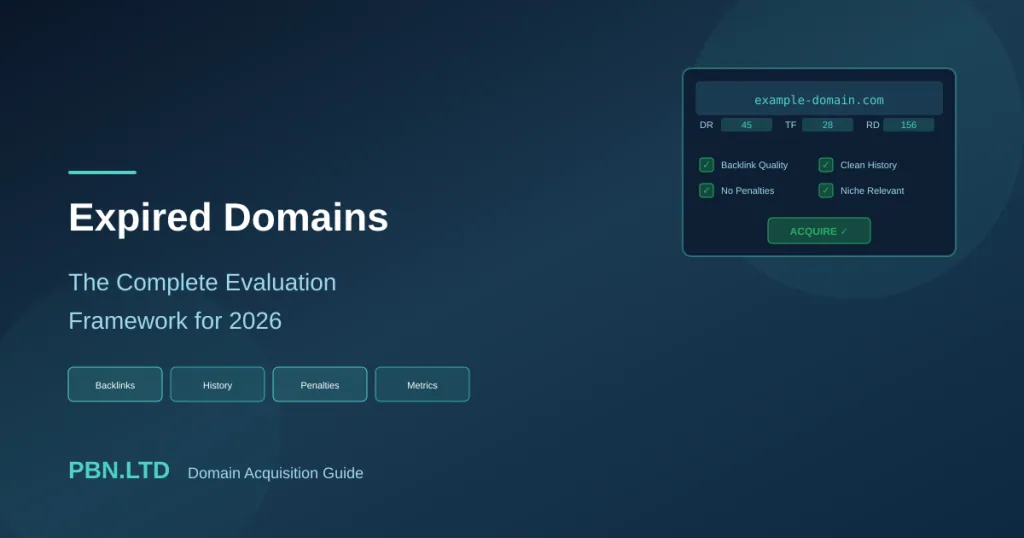
Written by the PBN.LTD Technical Team | We’ve evaluated thousands of expired domains for our own networks and client projects. This framework reflects the methodology we use to identify domains worth acquiring—and avoid costly mistakes.
Expired domains remain one of the most valuable resources in SEO. A quality expired domain comes with established backlinks, existing authority, and indexed history—assets that would take years and significant investment to build from scratch.
But not all expired domains are created equal. Many are worthless. Some are actively harmful—carrying penalties, toxic link profiles, or spam histories that will damage any project you attach to them. The difference between a valuable acquisition and a costly mistake comes down to proper evaluation.
This guide provides a comprehensive framework for evaluating expired domains in 2026. We’ll cover the metrics that actually matter, the red flags that disqualify domains, and the systematic process for making informed acquisition decisions.
Why Expired Domains Still Matter in 2026
With Google’s algorithm increasingly sophisticated, some question whether expired domains still provide value. The answer is definitively yes—but with important caveats.
What Quality Expired Domains Provide
- Established backlink profiles: Links that took the previous owner years to build transfer with the domain
- Domain age signals: Older domains with clean histories carry trust signals new domains lack
- Indexed history: Domains with historical content may retain topical associations
- Faster results: Skip the sandbox period and lengthy authority-building phase
- Cost efficiency: Often cheaper than building equivalent authority organically
The Critical Caveat
These benefits only apply to quality expired domains. A domain with spammy links, penalty history, or no real authority provides none of these advantages—and may actively harm your projects. Proper evaluation is the difference between an asset and a liability.
The Complete Evaluation Framework
We evaluate expired domains across five categories, each building on the previous. A domain must pass all five to be worth acquiring.
Category 1: Backlink Profile Quality
The backlink profile is typically the primary value of an expired domain. Evaluate it thoroughly.
Referring Domain Analysis
Start with the referring domains, not individual links:
- Quantity baseline: Look for at least 20-30 referring domains for meaningful authority. Under 10 rarely justifies acquisition cost
- Quality distribution: Check the authority of referring domains. A handful of quality links beats hundreds of spam links
- Relevance: Do the referring domains relate to the expired domain’s niche? Topical relevance matters
- Link type diversity: Natural profiles have varied sources—editorial, directory, social, etc.
Anchor Text Profile
Examine the anchor text distribution:
- Natural distribution: Expect mostly branded, URL, and generic anchors with limited exact-match keywords
- Red flag: Heavy exact-match commercial anchors suggest previous SEO manipulation
- Foreign language anchors: Non-English anchors on an English domain often indicate spam link building
Link Quality Indicators
| Signal | Good Sign | Red Flag |
| Referring domain quality | Mix of authority sites, niche sites, genuine blogs | Dominated by link farms, foreign spam, or PBNs |
| Anchor distribution | 70%+ branded/URL/generic | 50%+ exact match commercial |
| Link context | Editorial mentions, resource pages | Footer links, sidebar widgets, comment spam |
| Geographic distribution | Matches domain’s target market | Heavy links from unrelated countries |
| Link velocity history | Gradual, organic-looking growth | Sudden spikes suggesting bought links |
Category 2: Domain History
A domain’s past use directly impacts its current value. Investigate thoroughly using the Wayback Machine and other historical tools.
Historical Content Analysis
- Original purpose: What was the site about? Legitimate business, hobby blog, or link farm?
- Content quality: Was historical content substantial or thin/spammy?
- Niche consistency: Did the domain maintain consistent topical focus, or shift randomly?
- Multiple owners: Has the domain changed hands and purposes multiple times? Each change can dilute or damage authority
Red Flag Historical Uses
Avoid domains previously used for:
- Spam operations: Link farms, article directories, or obvious SEO manipulation
- Adult content: Unless your new use is also adult-oriented
- Malware distribution: Check blacklist histories
- Illegal activities: Counterfeit goods, piracy, pharma spam
- Parked domain spam: Long periods showing only parked/ad pages
Checking Historical Use
Tools and methods for historical analysis:
- Wayback Machine (archive.org): Review snapshots going back as far as possible
- Screenshots.com: Additional historical screenshots
- WHOIS history: Track ownership changes over time
- Google site: search: Check what Google still has indexed or cached
Category 3: Penalty and Spam Indicators
A penalised domain can poison your entire project. Check thoroughly for penalty indicators.
Manual Penalty Indicators
While you can’t directly check for manual penalties on a domain you don’t own, look for signs:
- Zero Google indexation: If site: search returns nothing for a domain with links, that’s suspicious
- Dramatic traffic drops: If you can access historical traffic data (some tools provide estimates), sudden drops suggest penalties
- Deindexed historical pages: Pages in Wayback Machine that never appear in Google cache
Algorithmic Penalty Indicators
- Spammy link profile: Obvious SEO manipulation in backlinks
- Thin content history: Historical snapshots showing low-quality content
- Anchor text over-optimisation: Heavy exact-match anchors suggest Penguin issues
- Unnatural link patterns: Sudden spikes, foreign link bursts, or network patterns
Blacklist Checks
Check the domain against spam and malware blacklists:
- Google Safe Browsing
- Norton Safe Web
- McAfee SiteAdvisor
- Spamhaus
- MX Toolbox blacklist check
Category 4: SEO Metrics Analysis
Third-party metrics provide useful shortcuts, but understand their limitations.
Key Metrics to Evaluate
| Metric | Source | What It Measures | Minimum Target |
| Domain Rating (DR) | Ahrefs | Backlink profile strength | DR 20+ (prefer 30+) |
| Trust Flow (TF) | Majestic | Link trustworthiness | TF 15+ (prefer 20+) |
| Citation Flow (CF) | Majestic | Link quantity/influence | TF:CF ratio > 0.5 |
| Referring Domains | Any tool | Unique linking sites | 30+ (quality dependent) |
| Domain Age | WHOIS/Archive | Registration longevity | 5+ years preferred |
Metrics Limitations
Important caveats about third-party metrics:
- Metrics can be manipulated: Sellers artificially inflate DA/DR with spam links
- High metrics don’t guarantee quality: A DR 50 domain can still have penalty issues
- Low metrics don’t guarantee worthlessness: Some quality domains have modest metrics
- Always verify manually: Use metrics as a filter, not final judgment
Metrics are just the starting point. What matters most is how you build and host the domain after acquisition. Learn about our hosting infrastructure.
Category 5: Strategic Fit
A domain can pass all quality checks but still be wrong for your specific needs. Evaluate strategic fit.
Niche Relevance
The most valuable expired domains are topically relevant to your target niche. A health-related expired domain provides more value for a health site than a generic domain with similar metrics.
Consider:
- Historical content topic alignment
- Topical relevance of linking domains
- Domain name appropriateness for your use
- Geographic targeting alignment
Use Case Suitability
Different use cases have different requirements:
| Use Case | Priority Factors | Acceptable Compromises |
| Money site rebuild | Clean history, brandable name, quality links, exact niche match | Lower metrics acceptable if quality high |
| PBN site | Relevant niche, quality backlinks, no penalty indicators | Name brandability less critical |
| 301 redirect | Strong metrics, clean profile, historical relevance | Current name irrelevant |
| Affiliate site | Niche relevance, commercial-friendly history, trust signals | Moderate metrics acceptable |
Quick Evaluation Checklist
Use this checklist for rapid domain assessment. A domain should pass ALL items before serious consideration:
- ☐ 30+ referring domains from quality sources
- ☐ Natural anchor text distribution (70%+ branded/URL/generic)
- ☐ Clean historical use (Wayback Machine review)
- ☐ No spam or adult content history
- ☐ Not on any blacklists
- ☐ Site: search shows indexation (or reasonable explanation if not)
- ☐ TF:CF ratio above 0.5
- ☐ No suspicious link velocity spikes in history
- ☐ Topically relevant to intended use
- ☐ Price justified by quality and use case
Frequently Asked Questions
Where should I find expired domains?
Multiple sources exist: ExpiredDomains.net for broad scanning, auction sites like GoDaddy Auctions and NameJet for premium drops, specialised services like Spamzilla or DomCop for pre-filtered results. Each has trade-offs between volume, quality filtering, and competition. Diversify your sourcing.
Should I restore the original content on an expired domain?
It depends on your use case. For PBN sites, restoring original content (via Wayback Machine) can help maintain topical relevance and natural appearance. For money sites or rebrands, fresh content aligned with your new purpose usually makes more sense. Either way, ensure content quality meets current standards.
How much should I pay for an expired domain?
Pricing varies enormously based on metrics, niche, and competition. Budget domains at registration cost ($10-15) can work if you find them before others. Quality auction domains typically run $50-500. Premium domains with exceptional profiles can exceed $1,000+. Always evaluate ROI against your use case—a $200 domain for a PBN site needs different justification than a $2,000 money site foundation.
Can I clean up a domain with a bad link profile?
Technically yes—you can disavow problematic links and build new quality ones. Practically, it’s usually not worth it. The time and resources required to rehabilitate a damaged domain often exceed what you’d spend acquiring a clean one. Exceptions exist for very high-value domains with fixable issues, but generally, it’s better to pass on damaged domains.
Do expired domain benefits transfer immediately?
Not fully. Google needs to recrawl the domain and reassess it under new ownership. Building quality content, getting the domain reindexed, and sometimes building fresh links helps activate the historical authority. Expect weeks to months before seeing full benefit, depending on the domain and how you develop it.
How many expired domains do I need for an effective PBN?
Quality matters more than quantity. 10 excellent domains outperform 50 mediocre ones. For most projects, start with 5-10 quality domains and scale based on results. Ensure proper infrastructure before expanding—there’s no point acquiring more domains than you can properly host and maintain.
Once you’ve acquired quality expired domains, proper hosting is essential. Our PBN hosting platform provides the infrastructure to maximise your investment.
Making Smart Acquisition Decisions
Expired domains remain valuable assets when properly evaluated. The key is systematic assessment across all five categories: backlink quality, domain history, penalty indicators, metrics analysis, and strategic fit.
Rushing acquisition decisions leads to costly mistakes—domains that look good on surface metrics but carry hidden problems. Taking time to properly evaluate protects your investment and ensures the domains you acquire actually contribute to your projects.
Remember: a quality expired domain is just the starting point. What you build on it—the content, the hosting infrastructure, the link placement strategy—determines whether you realise its potential value.
Maximise Your Domain Investments
Quality expired domains deserve quality hosting. PBN.LTD’s infrastructure ensures your domain investments are protected with footprint-free hosting, proper diversity, and professional management tools. Whether you’re building a PBN network or developing individual properties, our platform provides the foundation for success. Explore our hosting solutions.