
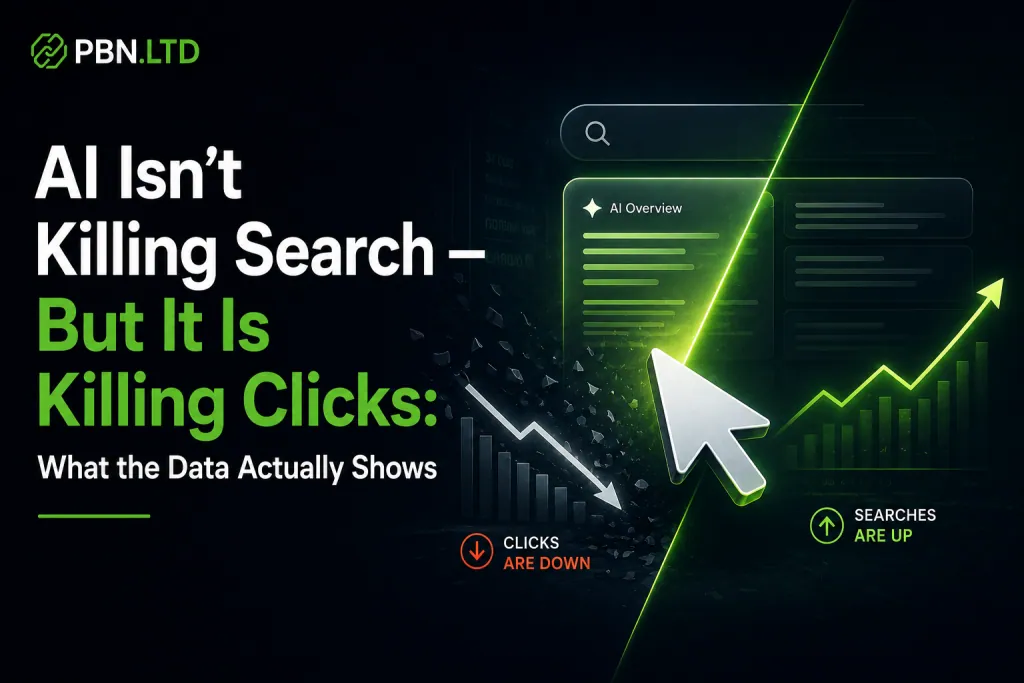
Two parallel conversations are happening in SEO simultaneously, and they’re producing contradictory conclusions. In one conversation, AI is destroying search. Google’s days of dominance are numbered, ChatGPT is eating its lunch, and anyone who still builds link strategies for organic rankings is optimising for a channel in terminal decline. In the other conversation, search is fine. Google is stronger than ever, AI tools are a rounding error on total web traffic, and the whole narrative of disruption is media hype disconnected from data.
Both of these conversations are partially correct and significantly incomplete. The actual picture — derived from the best available clickstream data rather than from prediction or narrative — is considerably more nuanced and considerably more useful for making decisions. What the data shows is that AI isn’t replacing search. But AI Overviews, the feature Google itself built into search, are doing real damage to click rates on specific query types. Understanding the difference between these two statements is one of the most practically important things an SEO or PBN operator can do in 2026.
The Datos/SparkToro Data: What It Actually Says
The most rigorous available data on this question comes from Datos, a Semrush company, in collaboration with Rand Fishkin, co-founder and CEO of SparkToro. Their Q1 2026 State of Search report draws on clickstream data from a panel of tens of millions of active desktop users across the United States, the European Union, and the United Kingdom, tracking behaviour from March 2025 through March 2026. This is not survey data or model-based projection — it is observed behaviour from actual device panels.
The headline finding is stark in how poorly it matches the dominant narrative: AI tools collectively account for less than 2% of total desktop web visits in both the US and Europe as of Q1 2026. ChatGPT, Gemini, Perplexity, Claude, and every other AI tool combined. Less than 2%. Fishkin himself described the figure as ‘shocking’ given the cultural attention AI tools have received — and he’s right. The gap between the coverage of AI search and the actual share of search behaviour it accounts for is one of the widest narrative-reality gaps in recent marketing history.
The directional trend is real. AI tool share roughly doubled in the 14 months covered by the report: from approximately 0.54% of desktop visits in January 2025 to 1.08% by March 2026. In the EU and UK, the quarterly figure reached 1.72% in Q1 2026, up from 0.98% in Q1 2025 — a 75% year-on-year growth rate. The growth is genuine and sustained. But doubling from 1% to 2% over 14 months is different from replacing a channel that handles 94.3% of search. Google’s US search share recovered to 94.3% by March 2026. Traditional search, by every available measure, is not in decline.
Another finding deserves specific attention: Google AI Mode — the fully conversational interface that replaces traditional results — reached only 0.16% of searches in the US and 0.21% in the EU/UK as of Q1 2026. This is the mode most commonly cited when people discuss AI replacing search entirely. Its actual presence in the search ecosystem is currently negligible. a decade of Google algorithm updates of Google adapting to perceived competitive threats while maintaining dominance provides the historical context for why this pattern — breathless claims of disruption followed by data confirming Google’s resilience — keeps repeating.
The Zero-Click Data: More Complicated Than Either Camp Acknowledges
The zero-click picture adds important nuance. The Datos Q1 2026 data found that zero-click searches actually fell in both regions during the quarter. In the US, the share of searches ending without a click dropped from 24.5% in December 2025 to 22.4% in March 2026 — the lowest level recorded in the entire study period. In the EU and UK, the decline was even more pronounced, from 22.5% to 19.6%. Organic click share simultaneously increased: US organic clicks rose from 42.0% to 44.9% of search sessions over the same period.
This is good news for publishers and SEO practitioners — and it sits in direct tension with a separate body of research that has documented severe click losses on queries where AI Overviews appear. The reconciliation of these two apparently contradictory findings is the most important analytical insight available for 2026 SEO strategy.
The Datos data measures aggregate behaviour across all searches. Most searches don’t trigger an AI Overview. For the majority of queries — particularly transactional, commercial, local, and brand queries — the SERP looks much as it did before AI Overviews launched, organic results are prominent, and users click through at historical rates. Across this majority, click behaviour is improving. At the aggregate level, zero-click searches are falling.
The separate research documenting click losses is measuring something different: what happens specifically on queries where an AI Overview does appear. A Carnegie Mellon and Indian School of Business randomised field experiment, using a browser extension to randomly assign users to see or not see AI Overviews, found a 38% reduction in organic clicks on triggered queries. Ahrefs’ February 2026 analysis found a 58% CTR drop at position 1 when an AI Overview was present. Pew Research found users click organic results 8% of the time with an AI Overview present versus 15% without — a 47% reduction. These figures are real and significant. They apply to the minority of queries where AI Overviews appear, which the Semrush Sensor data puts at approximately 13-16% of all queries.
The synthesis is this: traditional search is growing or holding steady. Clicks on most searches are recovering. But clicks on the specific subset of queries where AI Overviews appear are being severely compressed. Aggregate improvement and per-query damage are not contradictory — they’re measuring different things, and both are true simultaneously.
What AI Tools Are Actually Doing to Traffic
The relationship between AI tools and website traffic is more nuanced than the ‘AI is stealing traffic’ frame suggests. Referral traffic from ChatGPT to external websites grew 206% year-on-year between January 2025 and January 2026, according to Semrush data. AI tools, for all the narrative about zero-click behaviour, are actively sending traffic to websites — and growing their referral contribution at a rate that exceeds most traditional traffic sources.
The distinction matters. AI tools as search alternatives tend to send lower volumes of highly qualified traffic. Users who move from a query to an AI tool, receive an answer, and then click through to a cited source to read more are high-intent visitors who have already been pre-qualified by the AI’s response. Multiple studies have found that traffic arriving from AI citation sources converts at rates significantly higher than average organic traffic. The traffic volume is lower; the quality is higher.
This creates a bifurcated traffic landscape. For informational queries where AI Overviews or AI tools can provide satisfactory answers directly, traffic volumes are compressing — both through zero-click within Google and through users redirecting those queries to AI tools instead. For commercial, transactional, local, and complex research queries where an AI answer isn’t sufficient to complete the user’s task, traffic is stable or improving. Organic click share on these query types hasn’t been significantly affected by AI Overview deployment.
What This Means for Search Authority and Link Investment
The strategic implication for anyone investing in search authority — including through PBN link building — is that the channel itself is not in danger. whether links continue to drive rankings as AI reshapes search behaviour in 2026 is the right question to be asking, and the answer from the Datos data is unambiguous: Google handles 94.3% of desktop search, traditional search is not declining, and ranking signals including backlinks remain the primary mechanism for determining which sites appear in that 94% of queries. The existential threat narrative doesn’t hold up against the data.
The more nuanced strategic implication is about where within search the value is concentrated. Money sites that target primarily informational queries in categories with high AI Overview trigger rates are operating in the territory where click compression is most severe. A ranking improvement on a query dominated by AI Overviews delivers less traffic than the same improvement would have delivered in 2023. The link investment that achieved that ranking is functioning correctly — the ranking moved — but the return from that ranking position is lower.
Money sites that target commercial, transactional, and purchase-intent queries are in substantially better territory. AI Overview trigger rates on e-commerce queries are measured at 3-4%, leaving the vast majority of clicks in the organic layer. building topical authority as the foundation for sustainable search visibility within these commercial query clusters is the foundation for sustainable click delivery — a site that Google has deeply associated with a commercial topic area receives clicks that aren’t being absorbed by AI features in most cases.
The Additive Relationship: Search and AI Together
One of the most important framing corrections the Datos data supports is the shift from ‘AI versus search’ to ‘AI plus search’. Among US users tracked in the data, 95% continue to use traditional search each month, including users who also use AI tools regularly. The two behaviours coexist rather than substituting for each other. AI tools are being used for different query types than traditional search — longer, more conversational queries, complex synthesis questions, planning and brainstorming tasks — while traditional search continues to handle navigational queries, local queries, news, and commercial research.
This additive relationship has an important consequence for link building strategy. Sites that rank well in traditional search don’t need to abandon that investment to pursue AI visibility — they can pursue both simultaneously. The content signals that build authority in Google’s traditional algorithm, specifically topical depth, original research, and genuine expertise, are the same signals that make a site more likely to be cited in AI Overview responses. A site that ranks well for a query is disproportionately likely to appear in the AI Overview for that same query.
The platforms feeding AI tools are also not exclusively Google. According to SparkToro analysis, the sources AI systems draw from include forums like Reddit, Stack Overflow, community sites, and publisher content across the web. A site that ranks well across the traditional search ecosystem is already part of the corpus that AI systems train on and retrieve from. PBN sites that attract their own organic traffic alongside passing link equity are more deeply embedded in this corpus than thin link-passing sites — another dimension in which quality PBN site construction creates compound returns.
Regional Differences Worth Understanding
The Datos data reveals meaningful regional differences that complicate blanket strategies. AI tool adoption is higher in the United States than in the EU and UK, partly reflecting regulatory differences and partly reflecting market dynamics. Google AI Mode is more aggressively promoted in the US and has higher uptake there. AI Overview deployment has also been less consistent in some European markets, where regulatory attention from the EU AI Act has produced more cautious rollout.
For operators with money sites targeting primarily European markets, the aggregate zero-click picture is slightly more favourable than US-focused data suggests. EU/UK organic click share ended Q1 2026 at 46.0%, above the US figure. The compression from AI Overviews is real in both markets but slightly less severe in European search results as of the period covered by the data.
The Forecast: What the Growth Rate Implies
Taking the Datos growth data forward on a linear projection — which may understate the outcome if the growth rate accelerates, or overstate it if adoption plateaus — AI tools could reach approximately 2.5% to 3.5% of desktop visits by Q4 2026. If mobile data were included, which Datos’ desktop panel doesn’t capture, the figures would likely be higher given mobile users’ higher zero-click behaviour overall.
The 75% year-on-year growth rate in the EU/UK suggests that at the same pace, AI tool share could reach approximately 3% of visits in that region by Q1 2027. That’s still not a threat to Google’s dominance at 94.3% share. But it represents a non-trivial and growing slice of search intent, and the category distribution within that growing slice matters. B2B SaaS, developer tools, and certain consumer research categories already see AI tool referral in the 4-7% range according to category-level analysis. For money sites in those categories, the AI visibility question is already material.
Practical Conclusions for 2026
Distilling this data into actionable conclusions produces a clear picture that is neither apocalyptic nor dismissive.
- Traditional search investment remains sound. Google handling 94.3% of search with organic click share recovering is a good environment for link building and search authority investment. The existential risk to the channel that some commentary implies is not present in the data.
- Query type determines click risk. Informational queries with high AI Overview trigger rates are experiencing click compression. Commercial, transactional, and local queries are largely protected. Money site positioning within these query categories significantly affects the traffic return from link investment.
- AI tools are additive and sending traffic. ChatGPT referral traffic grew 206% year-on-year. AI tools are not only absorbing impressions — they’re sending qualified traffic to cited sources. Being visible in traditional search supports AI citation, not the reverse.
- Link signals haven’t changed. The mechanism by which rankings are determined — backlinks as a primary authority signal — is unaffected by AI tool adoption. natural link acquisition patterns that build durable search authority and the full link acquisition strategy that supports durable rankings operate in a channel that is growing, not contracting.
The nuanced reading of the Datos data is ultimately positive for anyone invested in search as a channel and in the link strategies that support it. how Google’s AI evaluates link quality is evolving alongside the AI features in search — the same Google systems that serve AI Overviews also evaluate link quality — but the ranking function links support is as active and consequential as it has ever been. indexation strategies that keep money site pages visible in a changing SERP landscape of money site pages, private blog network hosting infrastructure, and the full apparatus of good network management support a channel that the data confirms is holding its value. free personalised PBN and SEO advice is available for operators working through what these trends mean for their specific niche and network, and PBN hosting plans cover the full range of hosting options for networks of any scale.