
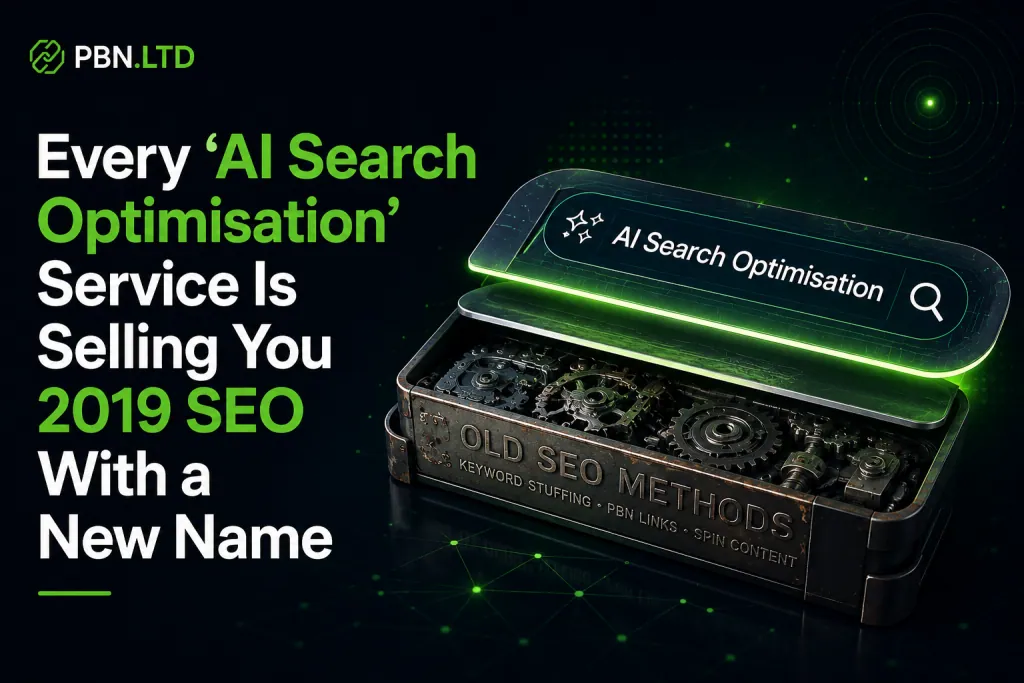
A marketing director told a story that’s become common in 2026: in a single week, three different agencies pitched her three different services. One sold ‘AIO strategy.’ One sold ‘LLMO optimisation.’ One sold ‘GEO services.’ She asked the obvious question — are these actually different things, or is everyone rebranding the same SEO package with a new acronym and a higher price? It’s the right question, and the honest answer is uncomfortable for a large and growing slice of the industry: mostly the latter. A whole category of ‘AI search optimisation’ services has sprung up to sell, at a premium, things that experienced SEOs have recommended for years — sometimes for decades.
This isn’t a blanket dismissal. Something genuinely has changed about how people find information, and there are real, specific implications worth understanding. But the gap between the small amount that’s actually new and the enormous amount being sold as new is where the money is being made — and where operators are being separated from it. This piece is about telling the two apart: what’s repackaged 2019 SEO with a fresh sticker, and what genuinely deserves your attention.
The Acronym Soup Is The First Red Flag
Start with the names, because the naming itself tells you something. In the space of about two years the industry produced GEO (Generative Engine Optimisation), AEO (Answer Engine Optimisation), LLMO (Large Language Model Optimisation), AIO (AI Optimisation), GSO, SXO, and more. GEO was only formally coined by Princeton researchers in late 2023. None of these terms has an agreed definition. They overlap by most estimates 80% or more. Analysis of how SEO professionals actually use them found that fewer than a third maintained consistent terminology across a single year — the people selling the services can’t agree on what their own acronyms mean.
When an industry generates six interchangeable names for roughly the same thing in two years, that’s not a sign of rapid genuine innovation. It’s a sign of a land grab — practitioners racing to plant a flag on a ‘new discipline’ they can own and charge for. A genuinely new field develops precise, distinct vocabulary because it needs to describe genuinely distinct things. A repackaging exercise generates a pile of synonyms, because the underlying thing is the same and only the label needs to be new. The acronym soup is the tell.
What They’re Actually Selling You
Look under the hood of the typical ‘AI search optimisation’ engagement and the recommendations are strikingly familiar. As one of the most respected voices in the field put it after auditing a wave of these services, many of the ‘novel’ recommendations for AI search visibility were verbatim the things SEO teams have been telling clients for years. The standard GEO/AEO deliverables read like an SEO checklist from the last decade:
- ‘Use structured data’ — schema markup, recommended for over a decade, and which Google has explicitly said is not required for its AI features anyway.
- ‘Break content into scannable chunks with clear headings’ — basic content structure advice that predates the entire AI era.
- ‘Write concise language that directly answers real user questions’ — this is just… writing well for search, which is what SEO content has always aspired to.
- ‘Use keyword-optimised URLs and meta descriptions’ — on-page SEO from the 2010s, presented as an AI-era discovery.
- ‘Build topical authority and earn authoritative mentions’ — core SEO and digital PR, with ‘so the AI cites you’ bolted onto the end.
There’s a reason these recommendations are identical to old SEO advice: Google itself has confirmed they’re the same thing. Its own 2026 documentation states plainly that, from Google Search’s perspective, optimising for generative AI search is optimising for the search experience — and is therefore still SEO. AI Overviews and AI Mode are built on the same ranking and quality systems, drawing from the same index, using retrieval to pull pages that already rank. If the AI is reading from the index, then the work of being in that index well is the work it always was. We broke down Google’s full guidance in our companion piece on optimising for generative AI; the short version is that the foundation hasn’t moved. This is also exactly why a genuine the AI visibility and link building services that actually move the needle approach looks like solid SEO done well, not a separate exotic discipline.
The Premium Is The Point
If the deliverables are largely old SEO, why does the packaging matter so much? Because the packaging is what justifies the price. The same playbook — keyword research, content production, technical hygiene, link and mention building — gets a new label and, frequently, a substantial premium simply because ‘AI’ is in the pitch deck. Buyers who would haggle over an SEO retainer will pay more for an ‘LLMO programme,’ because it sounds like the frontier and nobody wants to be left behind on the frontier.
This is a textbook pattern. Whenever a genuine shift creates uncertainty, a market appears to sell certainty back to the anxious — and the less a buyer understands the new thing, the easier it is to charge them a premium for a familiar thing wearing the new thing’s clothes. The fear of being left behind by AI is doing a lot of work in these sales conversations. The antidote is understanding enough to ask the one question that deflates most of these pitches: ‘How is this different from good SEO?’ If the honest answer is ‘it mostly isn’t,’ you’ve learned what you’re being sold.
What Genuinely Is Different — And Worth Your Attention
Now the fair part, because pure cynicism would be its own kind of dishonesty. The fundamentals haven’t changed, but the environment those fundamentals operate in genuinely has, in specific ways that matter. Here’s what’s actually new — and notably, almost none of it is the stuff being sold hardest.
Visibility Now Spans Multiple Engines With Different Rules
The biggest genuine change is that Google is no longer the only destination. ChatGPT, Perplexity, Claude, Copilot and Gemini’s app each run their own retrieval and their own source preferences, and they don’t all behave like Google. The same query can produce very different cited sources across them, and which sources get cited can change by 40 to 60% month to month — a level of instability that organic rankings never had. This is real, and it’s the one area where ‘optimise for Google’ genuinely isn’t the whole job anymore. It’s also far harder to sell as a tidy package, because nobody can yet promise reliable results on engines that reshuffle their sources monthly. We covered the traffic side of this in the data on AI citations, clicks, and where search traffic actually goes.
Being Cited Is Not The Same As Being Visited
The second genuine shift is the one the grift conveniently ignores: getting cited by an AI engine frequently sends almost no traffic. Major publishers have reported receiving under 1% of their referral traffic from AI platforms despite being frequently cited. So an ‘AI visibility’ service can succeed on its own terms — get you mentioned in answers — while delivering nothing to your actual business, because the mention never becomes a visit. Any honest AI-optimisation conversation has to start with what you’re actually trying to win: brand presence in answers, or traffic. They are increasingly different goals, which is the whole subject of what zero-click and AI answers mean for PBN strategy.
AI Engines Favour Certain Source Types
The third real change is that LLM-based answers lean heavily on particular kinds of sources — community platforms, established reference sites, and a relatively small set of trusted domains show up disproportionately in AI citations. This has genuine strategic implications for where you try to build presence. But notice that even this isn’t a new technical discipline — it’s a shift in where the same old work of building genuine presence and authority should be aimed. The skill is unchanged; the targets moved.
How To Tell A Real Service From A Repackaged One
You don’t need to be an expert to evaluate these pitches. A few questions cut straight through:
- ‘How is this different from good SEO?’ If they can’t give a specific, concrete answer beyond renaming familiar tactics, you’re being sold a relabel.
- ‘Are you optimising for Google’s AI features, or for ChatGPT and Perplexity too — and how do those differ?’ A real practitioner can speak specifically to the different engines. A repackager treats ‘AI’ as one undifferentiated thing.
- ‘What are you actually measuring — citations, or traffic, or revenue?’ If they only measure ‘AI visibility’ with no line to traffic or business outcomes, ask what that visibility is worth to you. Often the honest answer is: not much, yet.
- ‘Why does this cost more than SEO if the work is similar?’ Watch whether the premium is justified by genuinely different work or just by the word ‘AI’ being present.
What PBN Operators Should Actually Do
For network operators, the practical conclusion is liberating rather than worrying. You do not need to buy an ‘LLMO programme’ or retrofit your network for a new acronym. The things that make a network site eligible to be surfaced by AI features are the things that already make it rank: being genuinely indexed, genuinely authoritative on its topic, and genuinely useful enough that Google’s systems — the same ones the AI features draw on — rate it. There is no separate AI back door to optimise for, because the AI is reading from the front door you were already working on.
Where the genuine changes do apply, they reinforce advice we’ve given consistently. building genuine topical authority across a subject matters more in an AI-mediated environment, not less, because both ranking and citation favour sources with real depth on a subject. And the originality bar — genuinely contributing something rather than rehashing — is what gets a page cited rather than absorbed into a synthesis without credit, which is exactly the standard behind content that genuinely earns citations rather than gaming for them. The work that wins in AI search is the work that wins in search, full stop. The acronym is optional; the substance isn’t.
So when the next pitch lands promising to optimise your sites for the AI era with a brand-new methodology and a brand-new price, hold it up against the one question that matters and decide for yourself which column it belongs in. The fundamentals are laid out in the complete PBN guide for 2026, and if you want an honest read on whether a specific ‘AI optimisation’ service is selling you something real or selling you 2019 with a sticker on it, free personalised SEO and PBN advice is available.