
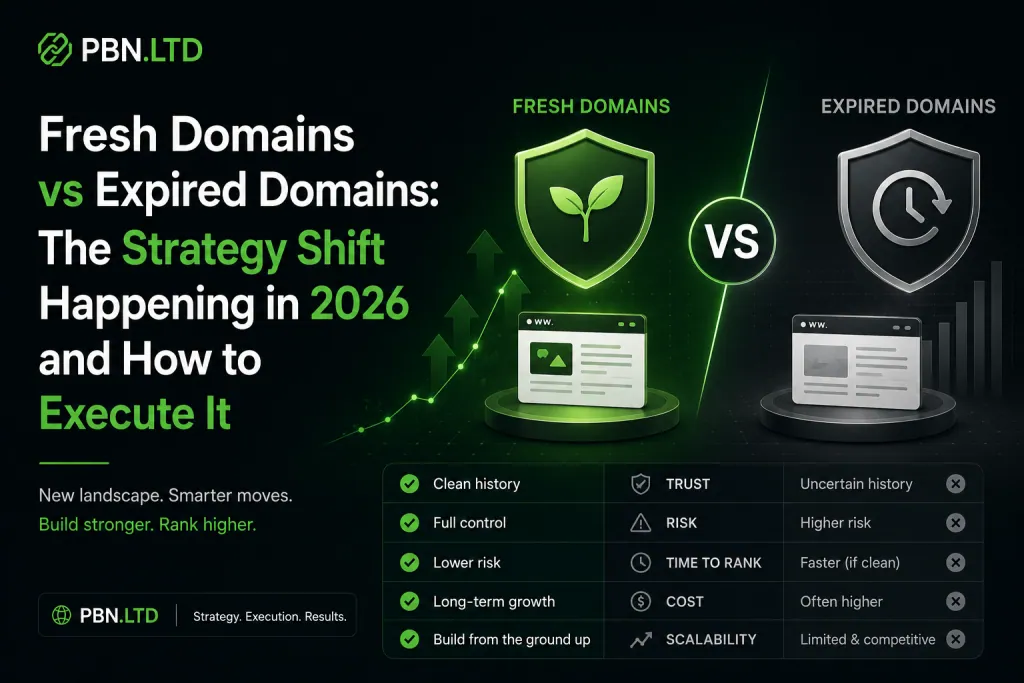
For most of PBN history, the question of which domains to build on had a straightforward answer. You bought expired domains with backlink profiles, restored the content, and let inherited authority do the heavy lifting. The strategy was logical, widely documented, and — when executed with genuine care — genuinely effective. In 2026, something has shifted. The community debate that used to be settled is open again, and a meaningful number of experienced PBN operators have quietly moved toward building on fresh, unregistered domains instead. Not as a fringe experiment, but as a deliberate strategic choice. PBN LTD hosting has watched this shift play out across thousands of hosted networks, and this piece is an attempt to explain honestly what’s driving it, where expired domains still make sense, and how to execute the fresh domain approach properly when you choose it.
Why Expired Domains Dominated for So Long
The logic behind expired domains was always compelling. When a website with genuine content and real editorial backlinks is abandoned by its owner, the domain carrying those signals becomes available for acquisition. A buyer who could find such a domain and rebuild it intelligently could redirect years of accumulated authority toward their own goals. The mathematical appeal was obvious — instead of starting from zero and waiting for Google to recognise a site as credible, you started with a head start measured in years.
That logic is still sound in principle. Domain age is a real signal. A backlink profile from genuine editorial sources carries real weight. Sites that Google has indexed and crawled over a long period have a different relationship with the crawler than brand new registrations. None of that has been invalidated. What has changed is the supply side and the signal clarity — both of which have degraded significantly over the past few years in ways that make the expired domain advantage increasingly difficult to reliably capture.
The Supply Problem Nobody Talks About Honestly
A detailed analysis of 915 expired domains with a Domain Rating of 20 or above, acquired on GoDaddy auctions over a 14-day window in early 2025, found that only 3.82% were actually used in PBNs. That figure is striking — not because it proves PBN operators have abandoned expired domains, but because it reveals how few domains reaching auction actually survive the vetting process to become productive network assets. The majority were flipped back to auction after failing to deliver, used for direct redirects, or snapped up by gambling-adjacent operations targeting Asian search markets where the risk calculus is different.
The underlying reason is supply exhaustion. The pool of genuinely clean expired domains — ones that have never been through a PBN cycle, carry backlinks from real sites in a coherent niche, and have a history that doesn’t collapse on inspection — has been shrinking for years. The most valuable domains were acquired first, years ago, by operators who are still using them. What remains on auction platforms today skews toward domains that have already been bought and used, domains with inflated metrics from link farms pointing at them, and domains in niches so specific that finding relevant content to build on them requires resources that erode the cost advantage.
the warning signs auction sellers rarely disclose have become increasingly sophisticated precisely because the market has responded to demand — sellers know how to present domains attractively without disclosing the full picture of what they’ve been through. A domain that shows a clean Majestic Trust Flow and a seemingly coherent backlink profile from a decade ago may have spent the intervening years cycling through multiple PBN networks, each of which added signals that don’t appear cleanly in the surface-level audit. Understanding what’s genuinely clean requires going deeper than most buyers do.
The Signal Clarity Problem
The second issue is how Google interprets expired domains when they’re acquired and rebuilt. The assumption built into the original expired domain strategy — that inherited backlinks automatically translate to inherited authority for the new owner’s purposes — has never been a certainty, and Google’s systems have become significantly better at evaluating what a domain’s history actually represents. how Google actually evaluates a site rebuilt on an expired domain in 2026 is a more complicated process than it was in 2020. Google doesn’t automatically pass the link equity accumulated by a previous site to a rebuilt version simply because the domain name is the same.
Topical coherence between the new site’s content and the previous site’s content is now a meaningful factor in how much of the historical signal carries forward. A domain that previously operated as a genuine gardening resource, rebuilt as another genuine gardening resource with original content, will likely inherit a significant portion of its historical authority. The same domain rebuilt as a generic blog with tangentially related articles, linking to an unrelated money site, is operating in territory where Google’s assessment of how much trust to extend becomes far less predictable.
Google has also gotten better at recognising the pattern of domains that cycle through acquisition, rebuilding, and link deployment. The signature of a site that exists to pass links — thin content, high outbound link ratio to a small number of targets, minimal internal linking depth, no genuine audience engagement signals — is something that has been trained into Google’s spam detection systems across billions of examples. A domain with clean surface metrics may still carry these signals in its behaviour pattern once rebuilt, regardless of how good its pre-acquisition profile looked.
Why Fresh Domains Have Become a Credible Alternative
Against this backdrop, the fresh domain approach makes more sense than it once did — not because fresh domains are inherently superior, but because they solve the specific problems the expired domain market has developed. A fresh domain has no inherited history, which means no inherited problems. There’s no previous owner whose link-building choices or content decisions you’re accountable for. There’s no pattern of prior PBN cycles baked into the domain’s profile. You’re starting from zero, and zero is predictable in a way that ‘uncertain’ is not.
The counterargument has always been that starting from zero means waiting. Fresh domains take time to accumulate the trust and authority signals that expired domains arrive with. That’s true, and it’s a real cost. What the evolving community practice has recognised is that this waiting period can be used productively — and that doing so actually produces a stronger PBN asset than a quickly deployed expired domain with questionable history.
The Authority-First Approach
The strategy gaining traction among operators who’ve committed to fresh domains is sometimes described as authority-first or earn-then-deploy. Rather than registering a fresh domain and immediately deploying it as a link source — which would make it functionally identical to a thin PBN site with no history — operators are registering domains, building them out with genuine topical content, and waiting for them to accumulate their own organic signals before using them for links. building the kind of topical authority that makes a PBN site genuinely useful to Google through real content in a defined niche is the foundation this approach builds on.
In practice, this means publishing a meaningful volume of quality content on the fresh domain — typically 15 to 30 articles of genuine depth, covering a coherent topic area — and then allowing the domain to index, rank for some low-competition queries within that niche, and ideally attract a small amount of organic traffic. The timeline before link deployment varies by niche and by how aggressively the site is built out, but six to twelve months is a commonly cited window for operators working this approach seriously.
The result of that process is a site that Google has indexed, crawled repeatedly, and begun to associate with a topic area through its own evaluation rather than through inherited signals. A site with genuine organic rankings — even for low-volume, low-competition terms — has demonstrated to Google’s systems that it provides real value. That demonstration changes the weight of the links it eventually passes in a way that a domain with a rebuilt history, whose genuine user-facing value is uncertain, cannot replicate as predictably.
What Content Fresh PBN Sites Need
The content strategy for a fresh domain PBN site is the element that most distinguishes the approach from simply registering a domain and waiting. what content fresh PBN sites need to establish genuine topical signals to establish genuine topical signals requires a different standard than the minimum viable content that older PBN approaches relied on. Generic, surface-level articles that cover a niche without demonstrating real knowledge don’t produce the organic rankings that validate the site’s authority — they produce indexed pages that rank for nothing and attract no traffic, which is functionally the same as a thin PBN site regardless of the domain’s age.
What works is content that engages with a topic seriously. Articles that answer specific questions with real depth, that provide information a reader would actually benefit from, that link naturally to authoritative external sources, and that demonstrate editorial coherence across the site as a whole. This is a higher content production standard than the PBN industry has historically applied, and it’s also the reason the fresh domain approach takes longer and costs more in the early stages than buying an expired domain.
The trade-off is durability. A site that has genuinely earned its place in Google’s index — because real queries are being served, real readers are occasionally clicking through, and the content demonstrates real topical competence — is a significantly more resilient asset than one whose claim to authority rests entirely on backlinks from a previous incarnation that Google may be partially discounting. It’s also an asset that ages well, accumulating additional authority over time rather than relying on a fixed historical profile.
The Indexation and Timing Question
One operational reality of the fresh domain approach that requires careful management is indexation. A brand new domain has no prior relationship with Googlebot, which means the initial crawl and indexation process can be slow unless actively managed. getting a fresh domain indexed and crawled reliably in 2026 from day one rather than waiting passively for discovery is essential. This means submitting sitemaps immediately, ensuring internal linking is coherent from launch, and publishing content consistently enough that Googlebot’s repeat visit schedule keeps pace with your publishing cadence.
The link deployment timing is equally important. the timing and pacing of links from any new domain matters here — the natural pattern of a genuine site attracting its first external links is gradual, not immediate. Deploying PBN links to a fresh domain in the first weeks of its existence produces the same suspicious velocity signature as doing the same to an expired domain rebuild. The fresh domain approach only delivers its intended benefits if the link deployment timing reflects a believable history of a site that earned attention over time, not one that was built for the purpose of linking from day one.
Evaluating the Two Approaches Head to Head
The decision between expired and fresh domains isn’t uniform across all operators or all use cases. Some situations still strongly favour expired domains; others clearly suit the fresh approach.
When Expired Domains Still Make More Sense
Time-sensitive campaigns where ranking improvement is needed within a shorter window still favour quality expired domains. A fresh domain approach has an inherent minimum timeline that can’t be compressed without defeating its own purpose. If a campaign needs link support on a 60 to 90-day horizon, a well-evaluated expired domain — one that passes the full scrutiny described in vetting an expired domain properly before committing to a build — is still the more practical choice, provided the evaluation is genuinely thorough.
Niches where topical domain history is particularly strong — established local publications, former industry magazines, sites with editorial backlinks from within a specific professional community — also remain compelling when genuinely clean examples can be found. The key qualifier is ‘genuinely clean,’ which requires the detailed evaluation work that most buyers underinvest in.
When Fresh Domains Make More Sense
Operators building long-term networks who can absorb the time investment are the clearest candidates for the fresh domain approach. If a network is intended to operate for three to five years or more, the six to twelve months of authority-building investment becomes a proportionally small fraction of the asset’s useful life, and the durability advantage compounds significantly over that timeframe.
Operators in niches where genuinely clean expired domains are scarce — highly specific professional services, certain geographic markets, emerging industries with little relevant historical content — will often find that the fresh approach is more reliable than waiting for an expired domain that doesn’t really exist in adequate quality at any reasonable price.
Large network builders who can operate a fresh domain building programme at scale — maintaining a pipeline of sites at different stages of development, so that the authority-building phase for batch three is running concurrently with the link deployment phase for batch one — can achieve the throughput of an expired domain strategy without the quality ceiling that the shrinking supply of clean expired domains creates. Understanding which domain metrics actually predict network performance helps calibrate when a fresh site has accumulated enough signals to graduate from the content-building phase to link deployment.
The Hybrid Approach Many Operators Are Landing On
In practice, the operators getting the best results in 2026 are neither fully committed to expired domains nor fully committed to fresh domains. They’re running both, applying each where it makes sense based on availability, timeline, and network architecture. Expired domains of genuine quality — when they can be found and properly vetted — go into the network for positions where their head start on authority is genuinely useful. Fresh domains are built in parallel for positions where the quality ceiling of the expired market makes the head start not worth the quality compromise.
This hybrid approach also provides natural footprint diversity. A network entirely built on expired domains shares the characteristic of sites that all arrived with pre-existing backlink profiles — a detectable pattern to anyone examining the network. A network mixing rebuilt expired sites with organically developed fresh sites looks considerably more like the natural web, where sites of different ages and different histories coexist without a unifying acquisition pattern.
The Execution Summary
For operators who want to run the fresh domain approach properly, the practical steps are as follows. Register domains in target niches, ideally with some descriptive relevance to the topic they’ll cover. Publish genuinely useful content from launch — not AI slop, not thin rewrites, but articles that demonstrate real engagement with the topic and that could plausibly rank in their own right. Submit sitemaps, maintain consistent publishing frequency, and monitor indexation actively. After six to twelve months, once organic rankings for low-competition queries are established, begin link deployment at natural velocity, integrating the fresh sites into the network alongside any expired domain assets.
The fresh domain approach is not the easy path. It requires patience, genuine content investment, and operational discipline across a longer time horizon than buying an expired domain and deploying it quickly. What it offers in return is a network asset with a cleaner signal profile, a more predictable relationship with Google’s evaluation systems, and better resilience across the algorithm cycles that 2026 has demonstrated can be significant and compounding. For operators building networks they intend to rely on long-term, that trade-off is increasingly worth taking seriously. If you’re evaluating your network architecture and want to discuss the right balance for your specific situation, our professional PBN building service team works through exactly these decisions as part of every build.