The top-level domain you choose for PBN sites affects perceived legitimacy, geographic targeting, availability, and cost. While .com remains the default choice for many operators, country-code TLDs and newer generic TLDs offer advantages worth considering.
TLD selection also impacts footprint management. Networks composed entirely of .com domains look different from networks with TLD diversity. Understanding when different TLDs make sense helps you build more natural-appearing networks.
This guide examines TLD options for PBN operations. We cover the characteristics of different TLD types, their advantages and disadvantages for PBN use, and strategies for incorporating TLD diversity into your network planning.
Understanding TLD Categories
Top-level domains fall into several categories with different characteristics.
Generic TLDs (gTLDs)
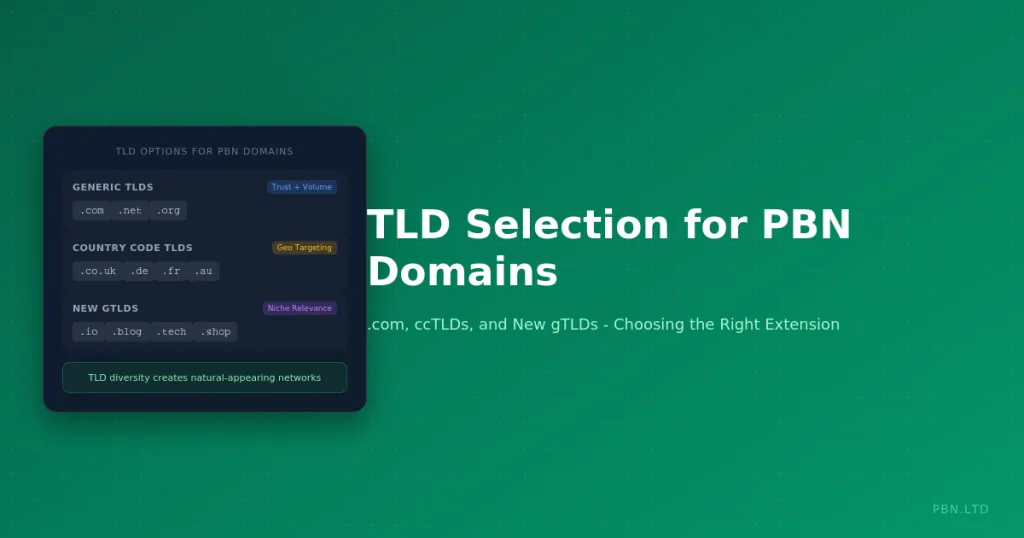
The original generic TLDs include .com, .net, .org, .info, .biz, and a few others. These carry no inherent geographic association. They are available to anyone regardless of location or purpose.
Among these, .com dominates. It carries the most recognition and trust with general audiences. Most legitimate businesses prioritize .com domains. This prevalence makes .com the default expectation for commercial websites.
The other original gTLDs have different associations. Net suggests technology or network services. Org implies non-profit or organizational purposes. Info and .biz have acquired somewhat spammy reputations due to heavy use by low-quality sites.
Country-Code TLDs (ccTLDs)
Country-code TLDs represent specific countries or territories. Examples include .uk for United Kingdom, .de for Germany, .fr for France, .au for Australia, and hundreds of others. Each country controls its own ccTLD policies.
CCTLDs carry strong geographic signals. Search engines interpret them as targeting specific countries. A .de domain is assumed to target German audiences. This geographic association affects how the domain performs in different markets.
Registration requirements vary by country. Some ccTLDs require local presence or citizenship. Others are open to anyone. Some have become popular for creative domain hacks regardless of geographic intent.
New Generic TLDs (ngTLDs)
Since 2014, hundreds of new generic TLDs have launched. These include category-specific options like .blog, .shop, .tech, and .photography, as well as branded TLDs operated by specific companies.
New gTLDs were intended to provide more naming options as .com became increasingly crowded. Adoption has been mixed. Some new TLDs have gained traction while others remain obscure.
For PBN purposes, new gTLDs present both opportunities and challenges. They offer availability that .com lacks but may carry less inherent trust. Their relative novelty means less established reputation patterns.
The Case for .com
Despite alternatives, .com remains the dominant choice for good reasons.
Trust and Recognition
Users trust .com domains more than alternatives. Decades of internet use have conditioned people to expect legitimate businesses on .com. This trust transfers to perceived site quality and authority.
For PBN sites that need to appear as legitimate websites, .com provides instant credibility. Visitors and reviewers expect .com. Meeting that expectation removes one potential suspicion trigger.
This trust factor matters most when PBN sites might receive direct scrutiny. Sites that only serve link purposes with no direct visitors can use any TLD. Sites that need to pass as real websites benefit from .com credibility.
Expired Domain Availability
The expired domain market is dominated by .com. More .com domains have existed, accumulated backlinks, and eventually expired than any other TLD. This means more quality expired domains are available in .com than alternatives.
Competition for quality .com expired domains is intense, driving up prices. But the volume means opportunities exist that simply do not in smaller TLD markets. More domains expire daily in .com than in most other TLDs combined.
The established .com aftermarket includes sophisticated tools, auction platforms, and services. Finding and acquiring expired .com domains is well-supported by industry infrastructure.
SEO Neutrality
Google treats .com as geographically neutral. A .com domain can target any country through Search Console settings and other signals. This flexibility suits PBN sites that might support money sites in various markets.
Unlike ccTLDs, .com does not send inherent geographic signals that might conflict with your targeting intentions. This neutrality provides maximum flexibility for how you position and use each domain.
Strategic Use of ccTLDs
Country-code TLDs serve specific purposes in PBN strategy.
Geographic Targeting
When your money site targets a specific country, ccTLD PBN sites provide geographic relevance. Links from .de sites carry stronger signals for German-targeted money sites than links from generic .com sites. This alignment strengthens international PBN operations.
Search engines use TLD as one geographic signal among many. A .uk site is assumed to target UK audiences unless other signals override. For PBNs supporting country-specific money sites, matching ccTLDs reinforce relevance.
This geographic matching matters most for competitive local searches. If your money site competes in German SERPs, German-language content on .de domains provides contextually appropriate links.
Less Competition
CCTLDs often face less competition in expired domain markets. Fewer operators hunt .de or .fr expired domains compared to .com. Quality domains may be available at lower prices with less auction competition.
This reduced competition creates arbitrage opportunities. Domains that would cost hundreds in .com might cost tens in ccTLD equivalents. For operators comfortable with non-.com domains, cost savings can be substantial.
The tradeoff is smaller overall markets. Fewer total domains means fewer quality expired options. You may need to monitor multiple ccTLD markets to find sufficient inventory.
Natural Diversity
Real websites use diverse TLDs. A link profile containing only .com links looks less natural than one with occasional ccTLD diversity. Including ccTLD PBN sites adds realism to the overall link patterns pointing to your money sites.
This diversity consideration extends to your network structure. A PBN composed entirely of .com sites has a detectable pattern. Mixing TLDs makes the network itself appear more natural and reduces certain footprint risks.
Popular ccTLDs for PBN Use
Some ccTLDs are more practical than others for PBN operations. The .co extension, originally Colombia’s ccTLD, has been marketed as a .com alternative and is widely used by legitimate sites globally. It carries minimal geographic association in practice.
The .io extension, technically British Indian Ocean Territory, has become popular with technology companies. Its tech association can benefit PBN sites in technology niches.
Major market ccTLDs like .uk, .de, .fr, and .au have active expired domain markets and established legitimacy. These work well for geographic targeting or general diversity.
Obscure ccTLDs may be cheap but can appear suspicious. A .tk domain hosting an English business site raises questions. Match ccTLD choice to plausible site purpose.
New gTLDs in PBN Strategy
New generic TLDs present evolving opportunities.
Niche Relevance
Category-specific TLDs can reinforce topical relevance. A photography blog on .photography, a tech site on .tech, or a recipe site on .recipes gains implicit topical signals from the TLD itself.
For PBN sites where topical alignment matters, relevant new gTLDs add another consistency signal. The domain name plus TLD together communicate what the site is about before any content is viewed.
This topical signaling is subtle but contributes to overall site positioning. When building niche-specific PBN sites, consider whether a category TLD reinforces your intended positioning.
Availability Advantages
New gTLDs offer naming availability impossible in .com. Descriptive, keyword-relevant domain names that have been registered in .com for decades may be available in newer TLDs.
For PBN operators who prefer descriptive domain names over random or brandable names, new gTLDs provide options. Bestrecipes.recipes or photographytips.photography communicate purpose clearly.
The expired domain market in new gTLDs is growing as these TLDs age. Domains registered when new gTLDs launched are now old enough to have accumulated history, backlinks, and eventual expiration.
Trust Considerations
New gTLDs carry less inherent trust than .com. Users are less familiar with them. Some have been heavily used by spammers, creating negative associations. Evaluate specific TLD reputation before committing.
Trust varies significantly between new gTLDs. Some like .app or .dev have maintained quality through registration requirements or operator reputation. Others have become spam havens.
For PBN use, new gTLD trust matters most when sites might face direct scrutiny. Background PBN sites serving only link purposes have less need for TLD-based trust signals.
Cost Considerations
New gTLD pricing varies dramatically. Some cost similar to .com. Others charge premium prices, especially for desirable names. A few offer bargain pricing to encourage adoption.
Watch for renewal price differences. Some new gTLDs offer low first-year pricing with higher renewals. Calculate total cost of ownership before building on premium-priced TLDs.
Registry stability matters for long-term planning. New gTLD registries can fail or change policies. Established TLDs have decades of operational history. Newer options carry more uncertainty.
TLD Diversity Strategy
Incorporating TLD diversity into network planning.
Portfolio Approach
Treat TLD selection as part of overall network diversity. Just as you diversify hosting and content, diversifying TLDs creates a more natural-appearing network. No legitimate group of websites would all share identical TLDs.
A reasonable TLD distribution might weight heavily toward .com while including ccTLDs and selective new gTLDs. The specific mix depends on your money sites, target markets, and available domain inventory.
This portfolio thinking applies to individual money site support as well as overall network composition. Links pointing to any single money site should show natural TLD diversity. Your link building strategy should incorporate varied TLD sources.
Matching TLD to Site Purpose
Different PBN sites serve different purposes. High-visibility sites that might receive direct traffic or manual review benefit from .com credibility. Background sites serving purely link purposes can use whatever TLD offers best value.
Geographic-targeted content matches geographic TLDs. A German-language site about German topics belongs on .de. An English site about UK matters fits .co.uk. Alignment between content and TLD strengthens positioning.
Niche-relevant new gTLDs suit topically focused sites. A photography PBN site might use .photography. A cooking site might use .recipes. Match TLD capabilities to site intentions.
Avoiding TLD-Based Footprints
While TLD diversity helps, avoid creating new patterns. All your sites using unusual TLDs creates a pattern as obvious as all using .com. The goal is natural distribution, not uniform difference.
Distribute TLD choices across your network without obvious groupings. Sites supporting the same money site should not share distinctive TLD patterns. Randomize TLD assignment where specific purpose does not dictate choice.
Consider how TLD patterns interact with other footprint factors. TLD diversity combined with hosting diversity and content diversity creates genuinely varied networks. TLD diversity alone provides limited protection if other factors remain uniform.
Practical TLD Selection
Applying TLD strategy to domain acquisition decisions.
Evaluation Criteria
When evaluating expired domains, TLD is one factor among many. Strong metrics on an unusual TLD may beat weak metrics on .com. Apply your standard domain evaluation criteria regardless of TLD, then consider TLD as a secondary factor.
Quality trumps TLD preference. A high-quality .net or .org domain serves PBN purposes better than a low-quality .com. Do not pass on excellent domains just because they lack preferred TLDs.
Consider TLD in context of intended use. A domain for a high-visibility PBN site warrants TLD attention. A domain for a background link source can prioritize metrics over TLD prestige.
Registration Considerations
Different TLDs require different registrars. Not all registrars support all TLDs. CCTLDs especially may require specialized registrars or local registrars. Plan registrar selection to accommodate TLD diversity.
Some ccTLDs have registration restrictions. Local presence, citizenship, or business registration may be required. Research requirements before pursuing domains in restricted TLDs.
WHOIS privacy availability varies by TLD. Some TLDs do not support privacy protection. Others have different privacy policies. Verify privacy options for each TLD you consider using.
Cost-Benefit Analysis
Calculate total costs including registration, renewal, and any premium pricing. A cheap first-year price means nothing if renewal is expensive. Multi-year cost projections reveal true economics.
Weigh cost against benefits. Premium TLD pricing for marginal benefit makes poor investment. Paying more for significantly better positioning may be worthwhile. Each domain decision should make economic sense.
Consider opportunity cost. Money spent on premium TLD domains could alternatively buy more standard domains. Sometimes quantity beats perceived quality. Balance portfolio composition against budget realities.
TLDs to Approach with Caution
Some TLDs carry risks or limitations worth noting.
Spam-Associated TLDs
Certain TLDs have become associated with spam and abuse. Free ccTLDs like .tk, .ml, and .ga attracted massive spam volumes. Some new gTLDs similarly developed poor reputations. Using these TLDs may create immediate credibility problems.
Research TLD reputation before using. Security companies and spam researchers publish data on TLD abuse rates. High-abuse TLDs face more scrutiny and may be treated with suspicion by algorithms and reviewers.
Unstable TLD Operators
Some new gTLD registries have uncertain futures. Registry business failures could affect domain renewals or operations. Established TLDs operated by stable organizations carry less uncertainty.
Policy changes can affect TLD usefulness. Registries can change pricing, requirements, or policies. Building significant PBN presence on TLDs with changeable operators creates risk.
Restrictive TLDs
Some TLDs have content or use restrictions. Verified TLDs like .bank or .pharmacy require qualification. Others prohibit certain content types. Ensure your intended use complies with TLD policies.
Restriction violation can result in domain suspension. Building PBN presence on domains that could be suspended for policy violation wastes investment. Understand and respect TLD requirements.
Conclusion
TLD selection adds another dimension to PBN planning. While .com remains the default for good reasons, strategic use of ccTLDs and selective new gTLDs can benefit network diversity, geographic targeting, and cost management.
Match TLD choice to site purpose. High-visibility sites benefit from .com credibility. Geographic-targeted sites match ccTLDs. Niche sites can leverage relevant new gTLDs. Background sites can prioritize value over prestige.
Incorporate TLD diversity thoughtfully. Natural-appearing networks include varied TLDs without creating new patterns. Avoid both uniform .com and uniform alternative TLDs. Aim for realistic distribution.
For PBN hosting that supports domains across all TLD types, our platform provides the infrastructure flexibility your diverse network requires. Whatever TLDs you choose, build on hosting designed for serious PBN operations.