
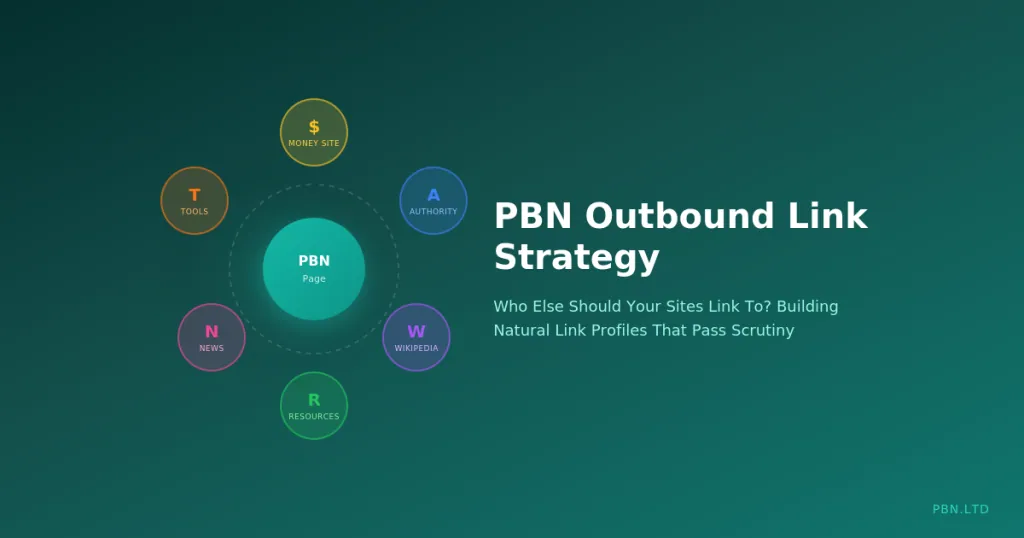
A PBN page with a single outbound link to your money site is a red flag. Real websites link to multiple sources. Real content references various authorities, resources, and related information. A page that links to exactly one commercial site and nothing else screams manipulation.
Strategic outbound linking makes your PBN sites look legitimate while potentially providing additional SEO benefits. This guide covers who else your PBN sites should link to, how to structure those links, and the patterns that separate natural-looking link profiles from obvious PBN footprints.
The goal is not to dilute link equity. The goal is to create pages that could exist on any legitimate independent website. Proper outbound linking is essential to that illusion.
Why Outbound Links Matter for PBN Sites
Every editorial decision on a PBN site either adds to or subtracts from its legitimacy. Outbound linking patterns are one of the most revealing signals.
The Natural Linking Pattern
Think about how real websites link. A blog post about home improvement might link to product manufacturers, how-to videos, building codes, tool reviews, and local contractors. The links serve readers by connecting them to relevant resources.
A news article references sources, quotes experts with links to their profiles, cites studies, and connects to related coverage. The outbound links add credibility and context.
A resource page links extensively to the resources it covers. That is its entire purpose. The outbound links are the content.
In all these cases, outbound links serve the reader. They exist because useful content naturally references other useful content.
The PBN Pattern Problem
Typical PBN pages break this pattern completely. They contain 800 words of generic content with exactly one link: the money site. No references. No sources. No related resources. Just that one commercial link sitting awkwardly in otherwise linkless content.
This pattern is statistically unusual. Content that discusses a topic without referencing any external information is rare on the real web. When it occurs repeatedly across multiple pages all linking to the same destination, the pattern becomes obvious.
Google’s systems are trained to identify unnatural patterns. A page with unusual outbound link characteristics fits patterns associated with manipulation. Even if individual elements seem innocent, the combination triggers scrutiny. This is exactly how SpamBrain identifies manipulative links.
The Legitimacy Benefit
Proper outbound linking does more than avoid detection. It actively builds site legitimacy.
Pages that link to authoritative sources demonstrate engagement with a topic. They show the content creator consulted references, considered multiple perspectives, and curated relevant resources. This is what quality content looks like.
Search engines may use outbound link patterns as quality signals. Linking to relevant, authoritative sources on-topic suggests the page itself is a legitimate contribution to that topic. Linking only to commercial sites suggests the opposite.
Who Your PBN Sites Should Link To
Strategic outbound linking requires understanding which external sites serve your legitimacy goals.
Authority Sites in Your Niche
Every niche has recognised authorities. Government sites, industry associations, major publications, educational institutions, and established brands. Linking to these sites signals your content exists within a legitimate information ecosystem.
For a health-related PBN site, links to NHS, Mayo Clinic, or peer-reviewed journals make sense. For a legal topic, links to government legislation sites, bar associations, or law school resources fit naturally. For home improvement, manufacturer sites, building code authorities, and recognised how-to resources work well.
Choose authorities that real content in your niche would naturally reference. The links should make sense to anyone reading the content.
Wikipedia and Reference Sources
Wikipedia links are extremely common across the web. When content mentions a concept, person, event, or technical term, linking to Wikipedia for background information is natural behaviour.
Reference links serve readers who want more depth on mentioned topics. They add value to your content by making it a gateway to further learning.
Other reference sources like dictionary sites, encyclopaedias, and educational resources serve similar purposes. Use them where naturally appropriate.
News and Current Information
Content that discusses current events, recent developments, or timely topics should reference news sources. This grounds your content in reality and demonstrates engagement with current information.
Major news outlets, industry publications, and respected journalism sources all work well. Choose sources appropriate to your topic and audience.
News links also help date your content appropriately. A post discussing industry trends should reference coverage from that time period, making the content timeline coherent.
Tools, Resources, and Utilities
Content that helps readers accomplish tasks should link to tools that assist with those tasks. A post about image optimisation might link to image compression tools. A post about keyword research might link to keyword tools. A post about legal compliance might link to official forms.
These links serve readers directly. They transform your content from information into action by connecting readers with resources they need.
Tool links also demonstrate that your content creator actually understands the topic well enough to know which tools are relevant and useful.
Complementary Non-Competing Businesses
Real websites often link to businesses that complement rather than compete. A wedding photography site might link to florists, venues, and caterers. A fitness site might link to nutrition resources and equipment retailers.
These links make commercial sense. Businesses in related fields often cross-promote or simply reference each other as useful resources for shared audiences.
For PBN sites, linking to legitimate complementary businesses adds commercial realism without conflicting with your money site link.
Outbound Links to Avoid
Some outbound links create problems rather than solving them.
Direct Competitors to Your Money Site
Linking from a PBN page to your money site’s direct competitors makes no strategic sense. It potentially helps competitors rank while providing no benefit to you.
More importantly, a page that links to multiple competing businesses looks like a link farm or paid link page. Real content rarely links to several competing commercial sites in the same article.
Keep commercial links focused. Your money site should be the primary or only commercial destination from each PBN page.
Low-Quality or Spammy Sites
Linking to low-quality sites damages your PBN site’s credibility. If your outbound links go to obvious spam, thin affiliate sites, or other PBN sites, you are associating your site with that quality tier.
Quality sites link to quality sites. The company your outbound links keep reflects on your site’s own quality signals.
Verify that outbound link targets are legitimate, maintained, and provide real value. Broken links to dead sites are almost as bad as links to spam.
Other Sites in Your PBN
Linking between PBN sites is one of the most common and dangerous footprints. Cross-linking creates network connections that make the entire PBN identifiable.
Each PBN site should operate as if it were an independent entity with no knowledge of your other sites. Outbound links should go to genuinely external sites, never to other properties you control. This is fundamental to avoiding PBN footprints.
Irrelevant Random Sites
Adding outbound links to random unrelated sites does not help. If your home improvement article suddenly links to a cryptocurrency exchange, that is as suspicious as linking to nothing at all.
Outbound links must be contextually relevant. They should make sense to a reader. They should fit the topic and purpose of the content.
Random links suggest the page was designed to include links rather than designed to serve readers. That is exactly the impression you want to avoid.
Strategic Link Ratios and Placement
How many outbound links and where they appear matters as much as who they point to.
Recommended Ratios
For a typical PBN blog post of 800-1500 words, three to seven outbound links is a natural range. This includes your money site link.
A reasonable ratio might be: one money site link, two to four authority or reference links, and one or two resource or tool links. The exact mix depends on the content type and topic.
Avoid rigid formulas. Real content does not follow exact link ratios. Some posts have many links. Others have few. Vary your approach to maintain natural patterns.
Link Placement Strategy
Links should appear where they make contextual sense. A reference to a study should link at the mention. A recommendation of a tool should link when discussing that tool. A citation of statistics should link to the source.
Your money site link should be placed where it fits contextually, not shoved into an awkward position. If the content discusses local plumbing services, the link to your plumbing client should appear in that discussion naturally.
Distribute links throughout the content. A cluster of links in one paragraph followed by linkless content looks unnatural. Real content links as needed throughout. For more on contextual link placement, see our guide on natural anchor text psychology.
Internal vs External Balance
PBN sites should also have internal links between their own pages. A site with only outbound links and no internal linking looks incomplete.
Create content clusters within your PBN sites. Related posts should link to each other. Category pages should link to relevant posts. This mirrors how real content sites structure their internal linking.
Strong internal site architecture makes PBN sites look more legitimate while helping Google understand their topical focus.
Anchor Text Strategy for Outbound Links
The anchor text you use for outbound links should look natural and serve readers.
Descriptive and Natural
Anchor text should describe what readers will find when they click. Linking to a Wikipedia article about mortgage rates should use anchor text like “mortgage rates” or “how mortgage rates work” rather than “click here” or the raw URL.
Natural anchor text varies. Sometimes it is the exact title of the destination. Sometimes it is a descriptive phrase. Sometimes it is part of a sentence that flows into the link. Mix approaches to maintain natural patterns.
Consistency with Money Site Anchors
The anchor text for your money site links should not look dramatically different from other outbound links on the same page. If all your authority links use natural descriptive phrases but your money site link uses exact-match keyword stuffing, the contrast is obvious.
Maintain stylistic consistency across all outbound links on a page. They should all appear to have been chosen by the same editorial process.
Practical Implementation
Implementing proper outbound link strategies requires systems rather than ad-hoc decisions.
Building Authority Link Libraries
For each niche you operate in, build a library of authority sites appropriate for outbound linking. Research the major authorities, reference sources, tools, and resources in that niche.
Categorise these by type: government sources, industry associations, educational resources, major publications, useful tools. Having this library available makes content creation faster and more consistent.
Update these libraries periodically. Sites change, resources become outdated, and new authorities emerge. Keep your reference sources current.
Content Brief Integration
When creating content briefs for PBN posts, include outbound link requirements. Specify the money site link, suggest appropriate authority sources, and indicate the expected link count.
This ensures consistent implementation whether you write content yourself or use writers. The outbound link strategy becomes part of the content specification rather than an afterthought.
If you are using our hosting, our built-in post management system helps streamline content deployment across multiple sites.
Quality Control Checks
Before publishing PBN content, verify outbound links meet standards. Check that authority links go to legitimate, current pages. Verify link ratios look natural. Confirm anchor text is appropriate. Test that all links work.
Our outbound link tracking system lets you monitor and manage links across your network, making it easier to maintain quality standards at scale.
Advanced Outbound Link Strategies
Beyond basic implementation, several advanced approaches can strengthen your PBN outbound link profiles.
Citing Original Research
Linking to original research, studies, and data sources adds significant credibility. Content that cites specific studies demonstrates depth that generic content lacks.
Academic databases, government statistics offices, and industry research firms produce citable content. For SEO-related PBN content, studies from sources like Search Engine Journal or data from Ahrefs and Semrush studies provide authoritative references.
Even if readers never click these links, their presence signals that your content engages with primary sources rather than simply rewriting surface-level information.
Strategic Resource Linking
Some outbound links can serve strategic purposes beyond legitimacy. Linking to resources that also link to your money site creates indirect connections that strengthen relevance signals.
If an authority resource page links to your money site, linking to that same resource page from your PBN creates a legitimate contextual cluster. The PBN links to an authority that also recommends your money site. This is natural and logical.
Research what resources and lists your money site appears on. These become valuable outbound link targets for your PBN.
Temporal Link Freshness
Outbound links should reflect when content was written. A post dated 2026 should reference 2026 sources, not exclusively cite articles from 2019.
When updating PBN content, update outbound links to current sources. This signals active maintenance and keeps the content temporally coherent.
For evergreen content, mix timeless authority sources with some dated references appropriate to the content period.
Measuring Outbound Link Strategy Effectiveness
How do you know if your outbound link strategy is working? Several indicators suggest success.
Indexation stability: PBN sites with natural outbound link patterns tend to maintain indexation better than those with suspicious patterns. Monitor indexation status consistently. For help with this, see our automatic indexation monitoring service.
Link value transmission: Properly structured PBN pages pass link equity effectively. If your money site rankings respond to PBN link building, the pages are working.
Manual review resilience: The ultimate test is whether pages would pass human review. Periodically review your PBN pages as if you were a Google quality rater. Do the outbound links look natural and useful?
Common Outbound Link Mistakes
Even operators who understand outbound link importance make implementation errors.
Formulaic patterns: Using the exact same outbound link targets across multiple PBN pages creates its own footprint. Vary your authority sources.
Outdated links: Linking to pages that no longer exist or have moved damages credibility. Periodically verify outbound links still work.
Over-optimisation: Making money site links dramatically different from other outbound links draws attention. Maintain consistency.
Ignoring context: Dropping authority links into content without contextual integration looks mechanical. Links should flow naturally from content.
Same sources everywhere: If every PBN page links to the same Wikipedia article and the same government site, that pattern becomes a footprint. Vary your sources.
Conclusion
Outbound link strategy is not an optional refinement for PBN operations. It is fundamental to creating pages that look and function like legitimate content.
Pages with proper outbound links to authority sources, reference materials, and useful resources pass scrutiny that single-link pages fail. They demonstrate engagement with topics rather than superficial keyword targeting. They serve readers rather than obviously serving only the site owner.
Implement outbound linking systematically. Build authority libraries for your niches. Include outbound links in content specifications. Verify quality before publishing. Monitor for broken links over time.
The goal is creating PBN pages indistinguishable from independent websites. Proper outbound linking is essential to achieving that goal. For more on building legitimate-looking PBN infrastructure, explore our PBN hosting services designed specifically for serious network operators.