Last updated: March 2026 | Reading time: 45+ minutes
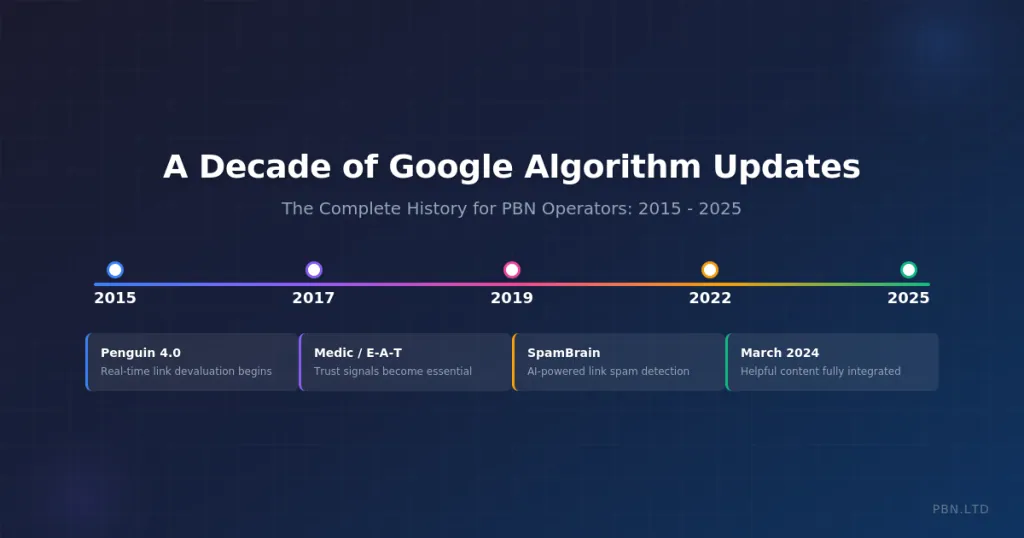
If you operate private blog networks, understanding Google’s algorithm history is not optional. Every major update over the past decade has shaped what works, what does not, and what gets your network deindexed. This guide covers every significant algorithm change from 2015 through 2025, with specific analysis of what each meant for PBN operators.
We have tracked these updates in real time since 2004, monitoring thousands of PBN sites through each rollout. This is not speculation or secondhand reporting. This is what we observed across our own networks and those of our hosting customers.
The industry has changed dramatically. Tactics that worked in 2015 will destroy your network in 2026. Understanding how we got here helps you avoid repeating the mistakes that cost others their rankings and their investments.
Why Algorithm History Matters for PBN Operators
Every PBN strategy is built on assumptions about what Google can and cannot detect. Those assumptions are only valid if you understand how Google’s capabilities have evolved.
In 2015, you could build a hundred sites on the same C-class IP range and rank with obvious exact-match anchor text. By 2020, that same approach would trigger manual actions within weeks. By 2025, SpamBrain would identify and discount the links before they even affected rankings.
Understanding this evolution helps you make better decisions today. For a deeper analysis of how Google’s spam detection has progressed, see our detailed breakdown in The Evolution of Google’s Spam Detection: From Penguin to SpamBrain.
This guide organises updates chronologically, but each section focuses on the practical implications for link networks. We skip minor updates that did not materially affect PBN operations.
2015: The Mobile Shift and Machine Learning Arrives
2015 marked a transition year. Google was shifting focus toward mobile and beginning to deploy machine learning at scale. For PBN operators, the year brought one development that would fundamentally change link spam detection within two years: RankBrain.
Mobilegeddon (April 21, 2015)
Google’s mobile-friendly update was heavily publicised in advance. Sites without mobile-friendly designs would lose rankings on mobile searches.
PBN Impact: Moderate. Most PBN operators were already using responsive WordPress themes. The update mattered more for money sites than for PBN infrastructure. However, it signalled that Google was willing to make dramatic changes to ranking factors with public announcements. This transparency would not last.
Lesson: Technical quality standards apply to PBN sites too. Sites that look and function like legitimate websites pass scrutiny better than those that cut corners.
Phantom 2 / Quality Update (May 2015)
Google declined to name this update or provide details. Analysis showed it targeted thin content, aggressive advertising, and poor user experience. The secrecy around this update established a pattern Google would follow increasingly going forward.
PBN Impact: Significant. PBN sites with thin content, excessive ads, or poor layouts saw ranking declines. This was an early indicator that Google was evaluating page quality at scale, not just backlink profiles.
Lesson: Content quality on PBN sites matters. Sites built only to pass links, with minimal content investment, were becoming identifiable.
RankBrain Announcement (October 2015)
Google confirmed it had been using machine learning to process search queries since early 2015. RankBrain was described as the third most important ranking factor.
The immediate impact was minimal. RankBrain initially focused on query interpretation, not spam detection. But the announcement signalled something important: Google was deploying AI at the core of its ranking systems.
PBN Impact: Delayed but massive. RankBrain itself did not target PBNs, but the machine learning infrastructure it introduced would eventually power SpamBrain, the system that now detects link manipulation at scale. The seeds of modern spam detection were planted in 2015.
Lesson: Google’s AI capabilities would only increase. Strategies that relied on patterns being too complex for algorithms to detect were operating on borrowed time.
2016: Penguin 4.0 Changes Everything
2016 brought the most significant algorithm change for link builders since the original Penguin update in 2012. Penguin 4.0 fundamentally altered how Google processed unnatural links, with implications that persist today.
Penguin 4.0 (September 23, 2016)
Penguin 4.0 was not an incremental update. It represented a complete rethinking of how Google handles link spam.
Key Changes:Real-time integration: Penguin became part of the core algorithm, running continuously rather than as periodic refreshes.Granular devaluation: Instead of penalising entire sites, Google could now devalue individual spammy links while crediting legitimate ones.Link-level targeting: Bad links would be discounted rather than triggering site-wide penalties in most cases.
PBN Impact: Transformative. The old model of Penguin penalties created clear cause-and-effect relationships. Build bad links, get penalised, submit disavow, wait for next Penguin refresh, maybe recover. Penguin 4.0 eliminated this clarity.
Now, Google could simply ignore your PBN links without telling you. No penalty. No manual action. Just no ranking benefit. This made diagnosis much harder. Were your PBN links working? Were they being discounted? You often could not tell.
The shift to real-time processing also meant consequences were immediate. Previously, you might build links for months before a Penguin refresh evaluated them. Now, bad links could be identified and discounted within days or weeks.
Lesson: Quality over quantity became essential. Building more low-quality PBN links would not overwhelm the algorithm. It would just create more links for Google to discount. This is when serious PBN operators began investing heavily in domain quality and site authenticity.
Possum (September 1, 2016)
Possum affected local search rankings, filtering results to show more diversity based on physical location and business address variations.
PBN Impact: Limited for most operators. Those building PBNs for local businesses saw increased importance of geographic relevance in both PBN content and target keywords.
2017: Fred and the Quality Reckoning
2017 was dominated by a single unnamed update that the SEO community labeled Fred. It marked an escalation in Google’s ability to identify low-value content created primarily to generate revenue.
Fred (March 8, 2017)
Google never officially confirmed Fred, but the pattern was clear. Sites with thin content, aggressive monetisation, and low editorial standards saw dramatic ranking declines.
The affected sites shared characteristics: affiliate-heavy content, excessive advertising, articles clearly written to rank rather than inform, and overall low value to users.
PBN Impact: Severe for many networks. PBN sites built with minimum viable content were hit hard. The typical pattern of one thin article with an outbound link, repeated across dozens of domains, became increasingly visible to Google’s quality systems.
Fred also affected money sites that relied on PBN links to rank thin affiliate content. Even if the PBN itself survived, the money site might not.
Lesson: Google was getting better at evaluating content quality algorithmically. PBN sites needed real content, not just the appearance of content. This increased costs but also increased effectiveness for those who adapted.
2018: Mobile-First and the Medic Earthquake
2018 brought two developments that would shape SEO for years: the completion of mobile-first indexing rollout and the Medic update that emphasised E-A-T (Expertise, Authoritativeness, Trustworthiness).
Mobile-First Indexing (March 2018 onwards)
Google began migrating sites to mobile-first indexing, meaning the mobile version of your site became the primary version for indexing and ranking.
PBN Impact: Moderate. PBN sites needed functional mobile versions. Those using desktop-only themes or hiding content on mobile faced problems. The update reinforced the need for PBN sites to meet the same technical standards as legitimate websites.
Medic Update (August 1, 2018)
The Medic update primarily affected YMYL (Your Money or Your Life) sites, particularly in health, finance, and legal niches. It operationalised E-A-T signals in ways that dramatically reshuffled rankings.
Sites without clear expertise signals, author credentials, or editorial standards lost visibility. Sites with strong E-A-T indicators gained.
PBN Impact: This update fundamentally changed how PBNs needed to be built, particularly in YMYL niches.
Previously, a generic blog with some topical content could pass link value to any niche. After Medic, PBN sites in health, finance, or other YMYL areas needed genuine expertise signals: real author bios, credentials, editorial policies, citations to authoritative sources.
Building PBNs for competitive YMYL niches became significantly more expensive and complex. The template approach that worked in entertainment or lifestyle niches would fail in health or finance.
Lesson: Niche matters. PBN strategies must account for the specific quality requirements of the target niche. One-size-fits-all approaches became increasingly ineffective.
2019: Core Updates Become Routine
2019 established the pattern of regular core updates that continues today. Google began naming these updates and releasing them on a roughly quarterly schedule.
March 2019 Core Update
This update partially reversed some Medic losses for sites that had improved their E-A-T signals. It confirmed that core updates could help sites recover if they addressed quality issues.
PBN Impact: Operators who had upgraded their PBN sites with better content and trust signals saw those investments validated. The update demonstrated that Google’s quality assessments were not permanent judgments but ongoing evaluations.
June 2019 Core Update
Another broad core update with particular impact on YMYL sectors. Analysis showed increased weighting for site reputation and external references.
PBN Impact: Sites with no external footprint beyond inbound links became more suspicious. This pushed operators toward building PBN sites with actual web presence: social profiles, brand mentions, directory listings. The isolated PBN site became a liability.
BERT (October 25, 2019)
BERT (Bidirectional Encoder Representations from Transformers) improved Google’s understanding of natural language, particularly for complex queries with prepositions and context-dependent meaning.
PBN Impact: Indirect but important. BERT improved Google’s ability to understand whether content actually addressed a topic or merely mentioned keywords. PBN content that was keyword-stuffed or topically shallow became easier for Google to identify as low-value.
Lesson: Natural language processing was improving rapidly. Content written for algorithms rather than humans was becoming detectable.
2020: The Pandemic Year and Passage Ranking
2020 brought fewer major updates than surrounding years, possibly due to pandemic-related resource constraints. However, the updates that did roll out had significant implications.
January 2020 Core Update
A broad core update that continued the E-A-T emphasis. Analysis showed particular scrutiny of author credentials and content accuracy.
PBN Impact: Author pages became more important. PBN sites with fake or generic authors faced increased risk. Operators began investing in consistent author personas across their networks, complete with social profiles and verifiable details.
May 2020 Core Update
Released during peak pandemic lockdowns, this update caused significant volatility. Many sites saw dramatic swings in either direction.
PBN Impact: The volatility made it difficult to isolate PBN-specific effects. However, the update reinforced that sites providing genuinely useful content were being rewarded over those optimised primarily for rankings.
Passage Ranking (October 2020, rolled out February 2021)
Google announced the ability to rank specific passages within pages, not just pages as a whole. This allowed long-form content to rank for queries addressed in specific sections.
PBN Impact: Mixed. On one hand, thin PBN pages with limited content had fewer opportunities to rank. On the other hand, well-developed PBN sites with substantial content could potentially rank for multiple queries, increasing their apparent legitimacy and value.
Lesson: Content depth was increasingly rewarded. The minimum viable content approach for PBN sites was becoming less viable with each update.
2021: Page Experience, Link Spam, and Core Update Acceleration
2021 was a pivotal year for PBN operators. Google launched multiple updates targeting link spam specifically, while also rolling out Page Experience as a ranking factor. The pressure on low-quality PBNs intensified significantly.
Page Experience Update (June-August 2021)
Core Web Vitals became ranking factors: Largest Contentful Paint (LCP), First Input Delay (FID), and Cumulative Layout Shift (CLS). Sites with poor user experience metrics faced ranking disadvantages.
For detailed guidance on these metrics and how they affect modern sites, see our guide to Core Web Vitals in 2026.
PBN Impact: Substantial. PBN sites on cheap shared hosting with slow load times, unoptimised images, or bloated themes were disadvantaged. This was when dedicated PBN hosting became not just a safety measure but a performance requirement.
Our hosting infrastructure was built specifically to address this. Learn more about why dedicated PBN hosting outperforms generic alternatives.
Link Spam Update (July 26, 2021)
Google launched a dedicated link spam update, the first named link-focused update since Penguin 4.0. The update targeted link schemes across all languages and improved detection of unnatural links.
PBN Impact: Direct and significant. Networks with obvious patterns were hit. Common templates across multiple domains, identical outbound link structures, similar content formats, and consistent anchor text distributions all became higher risk.
The update particularly affected large-scale operations that had prioritised quantity over quality. Networks with hundreds of domains using identical WordPress themes, similar plugins, and templated content saw widespread deindexation.
Lesson: Footprint elimination became critical. Not just hosting footprints, but content footprints, design footprints, and structural footprints. Each PBN site needed to appear genuinely independent.
November 2021 Core and Spam Updates
Google released both a core update and a spam update in November 2021, with overlapping rollout periods. This made diagnosis particularly difficult for affected sites.
PBN Impact: The dual updates caught many operators off guard. Sites that survived the July link spam update but had marginal quality issues were hit by the core update. The combination reinforced that link quality and content quality were both being evaluated simultaneously.
2022: Helpful Content, SpamBrain, and the AI Content Question
2022 brought the Helpful Content Update, the public introduction of SpamBrain, and the beginning of widespread AI content generation that would reshape the industry.
Product Reviews Updates (March and July 2022)
Google rolled out multiple updates targeting product review content, rewarding in-depth reviews with original research and first-hand experience while demoting thin affiliate content.
PBN Impact: Affiliate-focused PBNs saw particular scrutiny. Review content needed original photography, detailed analysis, and genuine evaluation to rank. Template review content became largely worthless.
Helpful Content Update (August 25, 2022)
The Helpful Content Update introduced a site-wide signal targeting content created primarily for search engines rather than users. Sites with substantial unhelpful content would see their entire domain affected, not just individual pages.
This was a fundamental shift. Previous updates evaluated pages individually. The Helpful Content Update meant that a site with mostly good content could be dragged down by its worst pages.
PBN Impact: Severe for many networks. PBN sites typically have mixed content quality. Strong cornerstone content might coexist with thin supporting articles. Under the Helpful Content Update, those thin articles could torpedo the entire domain’s ranking ability.
This forced operators to audit existing PBN sites and either improve or remove low-quality content. The economics of PBN building shifted: fewer sites with better content became more effective than many sites with minimal content.
SpamBrain Updates (October and December 2022)
Google publicly named SpamBrain, its AI-powered spam detection system. The October 2022 spam update was explicitly credited to SpamBrain improvements in detecting link spam.
For a detailed analysis of how SpamBrain works and what it targets, see our guide: Understanding Google’s SpamBrain: How AI Detects Manipulative Links.
PBN Impact: SpamBrain represented a qualitative shift in detection capability. Rather than relying on pattern matching and heuristics, Google now used machine learning to identify link manipulation.
The December 2022 update extended SpamBrain’s reach to multiple languages and introduced detection of sites built specifically to host outbound links. This directly targeted PBN-style operations.
Lesson: AI-based detection changed the game. Patterns that humans might not notice could be identified by machine learning. The arms race had entered a new phase.
2023: The Great Reckoning
2023 was the most destructive year for content sites since Penguin 4.0. The Helpful Content Update expanded, multiple core updates rolled out, and AI-generated content became widespread while simultaneously becoming a target.
Helpful Content Update Expansion (September 2023)
The September 2023 Helpful Content Update was devastating. Reports of 30-90% traffic losses became common across affiliate sites, niche publishers, and content-heavy operations.
The update appeared to more aggressively target sites created primarily to generate search traffic rather than serve genuine user needs. Third-party content on subdomains was now evaluated as part of the main domain’s quality assessment.
PBN Impact: Widespread destruction of older networks. PBN sites built with the minimum viable content approach were classified as unhelpful and lost ranking ability entirely. Links from these sites became worthless.
Money sites that relied heavily on PBN links saw their traffic collapse if those PBNs were hit. The downstream effects rippled through the industry.
Core Updates (March, August, October, November 2023)
2023 brought four core updates, an unprecedented frequency. Each appeared to reinforce and extend the Helpful Content Update’s impact.
PBN Impact: The constant updates made recovery difficult. Sites that might have recovered from one update were hit again before they could stabilise. This created a continuous pressure that eliminated marginal operations.
Operators who survived 2023 did so by maintaining genuinely high-quality PBN sites that could pass as legitimate independent websites. The gap between professional operations and amateur efforts widened dramatically.
2024: March Core Update Carnage and HCU Integration
2024 brought the most significant algorithmic shift since the original Helpful Content Update: the March 2024 core update that integrated multiple systems and explicitly targeted scaled content abuse.
March 2024 Core Update
The March 2024 update was different from previous core updates in several ways. It integrated the Helpful Content system into the core algorithm, meaning there would be no more separate HCU updates. It also introduced explicit policies against scaled content abuse, site reputation abuse, and expired domain abuse.
The update took over 45 days to fully roll out, the longest core update in Google’s history. Throughout this period, rankings remained volatile and unpredictable.
PBN Impact: The expired domain abuse policy directly targeted a common PBN practice: buying expired domains with good backlink profiles and rebuilding them as PBN sites. Google explicitly stated this was now a violation of their spam policies.
The scaled content abuse policy targeted sites mass-producing content regardless of whether it was AI-generated or human-written. This affected PBNs using article spinning, template-based content, or any form of scaled production.
For deep analysis of this update’s long-term effects, see our one-year retrospective: Google’s March 2025 Core Update: One Year Later.
Site Reputation Abuse Policy (May 2024)
Google’s site reputation abuse policy targeted the practice of publishing third-party content on high-authority domains to exploit their ranking power. This was sometimes called parasite SEO.
PBN Impact: While not directly targeting PBNs, this policy reduced the effectiveness of alternatives to PBN link building. Operators who had diversified into parasite SEO found that channel closing.
August 2024 Core Update
The August 2024 update appeared to provide some recovery opportunities for sites affected by the March update. Analysis showed that sites which had genuinely improved their content were rewarded.
PBN Impact: Operators who had invested in improving their PBN sites during the March-August period saw those investments validated. The update demonstrated that recovery was possible with genuine quality improvements.
November 2024 Core Update
The final core update of 2024 continued the quality emphasis with particular attention to content originality and first-hand experience.
PBN Impact: PBN content that demonstrated genuine expertise and original insights performed better than generic informational content. The bar for what constituted valuable PBN content continued to rise.
2025: Refinement and the AI Visibility Shift
2025 brought continued refinement of the systems introduced in 2024, along with the emergence of AI-powered search experiences that began changing how links and content are valued.
March 2025 Core Update
The March 2025 core update was one of the most significant we have tracked. It appeared to finalise many of the quality systems that had been in development since 2023.
Notably, the update showed strong preference for content demonstrating genuine first-hand experience. Reviews with original photos outperformed reviews with stock images. Guides written by practitioners outperformed guides written by content mills.
PBN Impact: The experience signals requirement made PBN building more specialised. Generic PBN sites could no longer effectively support money sites in competitive niches. PBNs needed to demonstrate the same expertise signals as the money sites they supported.
AI Search and Link Equity (Throughout 2025)
The expansion of AI Overviews and other AI-powered search features raised questions about the future value of traditional backlinks.
We covered this topic extensively in Link Building for the AI Search Era: What Changes and What Stays the Same.
PBN Impact: Links remain important for traditional rankings, which still drive the majority of search traffic. However, brand visibility and authoritative mentions are gaining importance for AI search visibility. Smart operators are thinking beyond just links.
December 2025 Core Update
The December 2025 update reinforced the helpful content signals that had been integrated into core in March 2024. Sites that had maintained quality improvements continued to perform well.
PBN Impact: The update confirmed that the new quality bar was permanent. Operators hoping for a relaxation of standards were disappointed. The high-quality approach established in 2024 remains necessary.
Key Patterns Across the Decade
Looking at ten years of algorithm updates reveals several consistent patterns that should inform current PBN strategy.
Pattern 1: Detection Capabilities Only Improve
From RankBrain in 2015 to SpamBrain in 2022, Google’s ability to identify manipulation has only increased. Tactics that work today will likely be detectable within 2-3 years. Building strategies that assume permanent undetectability is foolish.
Implication: Build PBN sites that could survive detection. If Google discovered your site was part of a network, would it still appear to be a legitimate website worth keeping in the index? If not, you are taking unnecessary risk.
Pattern 2: Quality Requirements Continuously Rise
The minimum viable content for PBN sites in 2015 would be laughably inadequate today. Each year has brought higher content quality requirements, better technical standards, and more sophisticated trust signals.
Implication: Cost per effective PBN site increases over time. Operators who maintain margins by cutting corners are degrading their networks. Investment in quality is investment in longevity.
Pattern 3: Footprint Scope Expands
In 2015, hosting footprints (C-class IPs) were the primary concern. By 2025, Google evaluates content fingerprints, design patterns, structural similarities, author networks, registration patterns, and dozens of other potential connections.
We have covered this evolution in detail. See our guide on IP Diversity Explained: Understanding Class A, B, C and ASN Distribution for PBN Hosting.
Implication: Footprint elimination requires comprehensive approach. Solving hosting footprints while ignoring content footprints is pointless. Every connection between PBN sites is a potential vulnerability.
Pattern 4: Manual Reviews Become Less Important
In the Penguin era, manual reviews and penalties were the primary enforcement mechanism. By 2025, algorithmic detection handles most cases. SpamBrain can identify and devalue links without human review.
Implication: You cannot appeal to algorithmic devaluation. There is no reconsideration request when SpamBrain discounts your links. Building right the first time is essential because there may be no recovery path if you build wrong.
Pattern 5: Link Value Correlates with Site Legitimacy
The value a PBN link passes increasingly depends on whether the PBN site itself would be considered legitimate. A link from a site with real traffic, genuine engagement, and authoritative content passes more value than a link from a thin site that exists only to pass links.
Implication: Building PBN sites that attract real visitors and earn natural links makes those sites more effective for their primary purpose: passing link equity to your money sites.
What Still Works in 2026
Despite a decade of algorithm updates specifically targeting link manipulation, private blog networks remain effective when built and maintained properly. Here is what works now.
Quality Domains with Genuine Link Profiles
Domain selection is more important than ever. We have detailed the evaluation process in Expired Domains: The Complete Evaluation Framework for 2026.
Key factors: Trust Flow above 15, linking root domains above 20, clean backlink history free of spam, topical relevance to your target niche, and no history of previous penalties or deindexation.
Sites Built as Genuine Websites
PBN sites that pass as legitimate independent websites outperform those that look like link farms. This means real design effort, substantial content, about pages, contact information, privacy policies, and all the elements a genuine site would have.
We cover best practices for building effective PBN sites in How to Retain Maximum Link Juice When Building Your PBN Websites.
Proper Hosting Infrastructure
Hosting footprints remain detectable and dangerous. Proper PBN hosting eliminates IP-level footprints, DNS fingerprints, server signatures, and the dozens of other technical markers that can connect sites.
This is what we built PBN.LTD to provide. Learn more about our approach in What is PBN Hosting?.
Natural Link Profiles and Anchor Distribution
Anchor text distribution that mimics natural link acquisition remains essential. We cover this in depth in The Psychology of Anchor Text: Building Natural Link Profiles.
The key insight: study how real sites naturally acquire links, then replicate those patterns. Exact-match anchor text should be a small minority of your profile. Branded, URL, and generic anchors should dominate.
Appropriate Link Velocity
Link acquisition speed matters. Natural sites do not gain dozens of links overnight. We covered this in Link Velocity: The Science of Natural Link Acquisition Patterns.
Conclusion: What the Next Decade Will Bring
Ten years of algorithm history teaches one clear lesson: Google’s detection capabilities improve continuously, and tactics that work today will likely be detectable tomorrow.
The operators who have survived this decade did so by staying ahead of detection, not by finding loopholes. They invested in quality when competitors cut corners. They eliminated footprints comprehensively when others focused only on IPs. They built sites as genuine assets when others built disposable link farms.
The next decade will bring AI detection capabilities we cannot yet imagine. SpamBrain is just the beginning. Large language models will likely be deployed to evaluate content quality, link context, and network patterns at scales that make current detection look primitive.
The strategy that will survive: build PBN sites that could exist independently. Sites that provide genuine value. Sites that attract real visitors. Sites that would not embarrass you if Google published a list of your network.
That approach worked in 2015. It works in 2026. And it will work in 2035.
The question is not whether you can build PBN sites that work. It is whether you are willing to invest in building them properly.
Further Reading
Technical Deep Dives:
• Understanding Google’s SpamBrain: How AI Detects Manipulative Links
• The Evolution of Google’s Spam Detection: From Penguin to SpamBrain
• IP Diversity Explained: Understanding Class A, B, C and ASN Distribution
PBN Building Guides:
• Expired Domains: The Complete Evaluation Framework for 2026
• How to Retain Maximum Link Juice When Building Your PBN Websites
• Best Metrics for Selecting PBN Domains
Link Strategy:
• The Psychology of Anchor Text: Building Natural Link Profiles
• Link Velocity: The Science of Natural Link Acquisition Patterns
• Do Links Still Matter in 2026? Separating Google’s Claims from Reality
Modern SEO Context:
• Link Building for the AI Search Era: What Changes and What Stays the Same
• The Complete Guide to Topical Authority: How Modern Sites Dominate SERPs
• Google’s March 2025 Core Update: One Year Later
Hosting Infrastructure:
• Why Dedicated PBN Hosting Outperforms Generic Web Hosting
• Indexation Strategies for 2026: Getting New Sites Crawled Faster