We’ve managed link building budgets ranging from hundreds to hundreds of thousands monthly. This analysis reflects real-world costs and returns we’ve observed across different link building approaches.
Link building isn’t free. Whether you’re paying agencies, buying placements, or investing time, every link has a cost. The question isn’t whether to spend on links—it’s how to spend most effectively.
Different link building methods have vastly different cost structures, risk profiles, and returns. A £50 link isn’t automatically worse than a £500 link, and an expensive link isn’t automatically better. Understanding the true ROI of each approach helps you allocate budget for maximum impact.
This guide provides an honest analysis of link building economics in 2026: what different link types actually cost, their realistic effectiveness, and how to calculate whether your link building investment is paying off.
Understanding Link Building Costs
Before comparing link types, understand that ‘cost’ includes more than the sticker price:
Direct Costs
- Payment for placement: What you pay for the link itself
- Content creation: Cost of producing guest posts, linkable assets, or PBN content
- Outreach costs: Tools, email services, or agency fees for prospecting
- Infrastructure: Hosting, domains, and tools for PBN or in-house operations
Hidden Costs
- Time investment: Hours spent on outreach, relationship building, or network management
- Opportunity cost: What else could you do with that time and money?
- Risk cost: Potential penalties or wasted investment on ineffective links
- Maintenance: Ongoing costs to maintain link sources over time
Link Type Cost Comparison
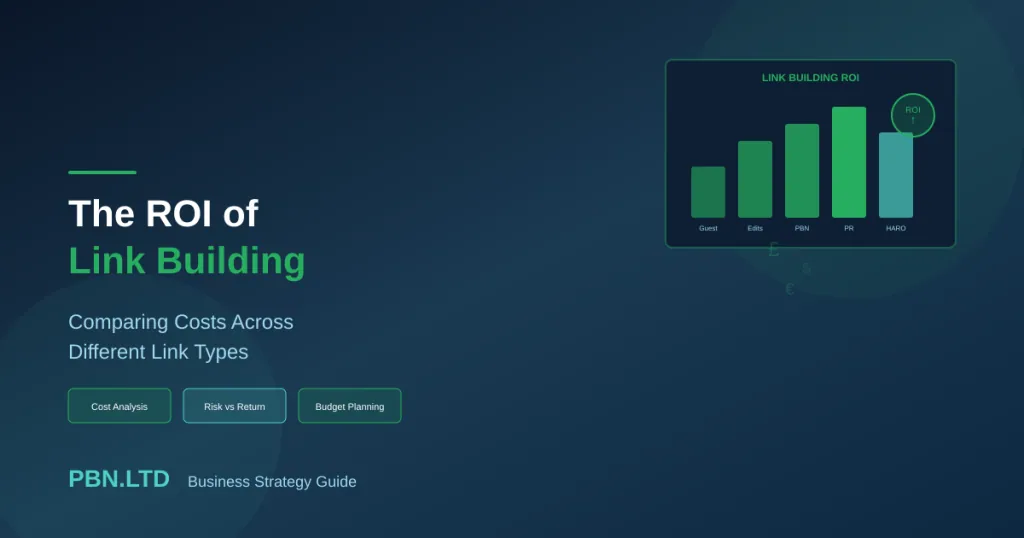
Here’s what different link types actually cost in 2026, based on market rates and our experience:
| Link Type | Cost Range | Time Required | Risk Level | Scalability |
| Guest Posts | £100-£1,000+ | High | Low-Medium | Medium |
| Niche Edits | £50-£500 | Low | Medium | High |
| PBN Links | £20-£200 | Low-Medium | Medium-High | High |
| Digital PR | £500-£5,000+ | Very High | Very Low | Low |
| HARO/Quotes | £0-£100 | High | Very Low | Low |
| Resource Links | £0-£50 | Very High | Very Low | Low |
| Broken Link Building | £0-£100 | Very High | Very Low | Low |
Detailed ROI Analysis by Link Type
Guest Posts
True cost: £100-£1,000+ per link depending on site quality. Add £50-£200 for quality content if outsourced.
What you get: Contextual link in fresh, relevant content. Often dofollow. Control over anchor text and surrounding content. Brand exposure alongside link value.
ROI considerations: High-quality guest posts on relevant sites provide excellent ROI—you get content, exposure, and a contextual link. However, the market has become inflated; many ‘guest post’ opportunities are thinly-veiled paid placements on low-quality sites. Vet opportunities carefully.
Best for: Building authority and brand alongside links. Sites where relevance and context matter most.
Niche Edits (Link Insertions)
True cost: £50-£500 per link. No content creation cost since link goes into existing content.
What you get: Link placed in already-indexed, often already-authoritative content. Immediate value rather than waiting for new content to index and gain authority.
ROI considerations: Strong ROI when placed in genuinely relevant, established content. The link benefits from the existing page’s authority. However, quality varies enormously—many sellers place links in content that’s clearly been monetised to death. The best niche edits feel genuinely editorial.
Best for: Quick wins with established page authority. Scaling link building efficiently.
PBN Links
True cost: Per-link costs range £20-£200. But factor in infrastructure if building your own network: domains (£10-£2000+ each), hosting (£5-£30/site monthly), content (£20-£100+ per site). Buying PBN links from providers has lower upfront cost but less control.
What you get: Complete control over anchor text, placement, and timing. Links from sites you own (if building your own). Scalability once network is established.
ROI considerations: The ROI equation for PBNs depends heavily on execution. Low-quality PBNs have poor ROI—the links may not pass value and carry deindexation risk. High-quality PBNs with proper infrastructure, real content, and professional management can have excellent ROI—you’re essentially building assets that produce links indefinitely.
Best for: Competitive niches where you need control and scale. Long-term operators willing to invest in quality infrastructure.
The ROI of PBN links depends heavily on hosting quality. Learn how our infrastructure maximises your network investment.
Digital PR
True cost: £500-£5,000+ per campaign. Agency retainers can run £2,000-£10,000+ monthly. In-house requires skilled staff and tool subscriptions.
What you get: High-authority editorial links from news sites and publications. Brand awareness and traffic alongside link value. Links that are essentially penalty-proof.
ROI considerations: When it works, digital PR provides exceptional ROI—a single campaign can generate dozens of high-DA links. But success isn’t guaranteed; many campaigns fail to gain traction. The per-link cost when successful is often lower than alternatives; the per-link cost when unsuccessful is infinite.
Best for: Brands with newsworthy angles. Companies needing penalty-proof links. Building long-term domain authority.
HARO and Quote Links
True cost: Free to low cost (HARO subscription £0-£150/month). Main cost is time responding to queries.
What you get: Editorial links from journalists and publications. Often high-authority sources. Builds genuine expertise signals.
ROI considerations: Excellent ROI when you land placements—essentially free high-quality links. However, success rate is low (often 5-10% of pitches succeed), and competition has increased significantly. Time investment is substantial for uncertain returns.
Best for: Experts with genuine credentials. Companies with unique data or perspectives. Patient link builders willing to play the long game.
Resource Page and Broken Link Building
True cost: Primarily time. Tool costs for prospecting (£50-£200/month). Occasionally content creation for linkable assets.
What you get: Editorially-earned links from resource pages. Contextually relevant placements. Penalty-proof approach.
ROI considerations: Low direct cost but very high time investment. Success rates have declined as the tactics became widely known. Still works but requires excellent content and persistent outreach. Best ROI when you have genuinely valuable resources that fill gaps.
Best for: Sites with genuinely useful resources. Link builders with time but limited budget. Building natural link profiles.
Calculating Your Link Building ROI
Measuring link building ROI requires connecting link investment to business outcomes:
The ROI Formula
Link Building ROI = (Revenue from Organic Growth – Link Building Cost) / Link Building Cost × 100
The challenge is attributing revenue to link building specifically. Here’s a practical approach:
Step 1: Establish Baseline Metrics
Before starting link building, document:
- Current organic traffic
- Rankings for target keywords
- Organic revenue or conversions
- Current backlink profile metrics
Step 2: Track All Link Building Costs
Include everything: link purchases, agency fees, content costs, tool subscriptions, and time (valued at your hourly rate or staff costs).
Step 3: Measure Outcomes
After a meaningful period (minimum 3-6 months), compare:
- Traffic increase from organic search
- Ranking improvements for target keywords
- Revenue/conversion increase from organic
- Backlink profile growth
Step 4: Calculate Value
Assign monetary value to organic growth. For e-commerce, this is straightforward (revenue). For lead gen, use: (Additional Leads × Conversion Rate × Customer Value). For content sites, consider ad revenue or alternative traffic acquisition cost.
ROI Benchmarks and Expectations
| Scenario | Typical ROI | Timeframe | Notes |
| New site, competitive niche | 50-200% | 12-24 months | Slow start; compounds over time |
| Established site, growth phase | 200-500% | 6-12 months | Existing authority accelerates results |
| Authority site, maintaining | 100-300% | 3-6 months | Defending position requires ongoing investment |
| Local business | 300-1000%+ | 3-9 months | Less competition; high customer value |
| Affiliate site | 200-800% | 6-24 months | Highly variable; depends on niche and execution |
Optimising Your Link Building Budget
Diversify Link Types
Don’t put all budget into one approach. A diversified portfolio reduces risk and creates natural-looking link profiles. Consider allocating across:
- 40-50% on your primary high-ROI tactic
- 20-30% on supporting tactics for diversity
- 20-30% on experimental or premium approaches
Focus on Relevance Over Metrics
A £50 link from a highly relevant site often outperforms a £500 link from an irrelevant high-DA site. Prioritise topical relevance in your spending—it typically provides better ROI than chasing metrics alone.
Relevance is key to building topical authority. See our guide on how topical authority drives modern rankings.
Build Infrastructure for Long-Term Savings
Investing in your own capabilities—PBN networks, in-house outreach, content production—has higher upfront cost but lower long-term per-link cost. If you’re spending £5,000+ monthly on links, building in-house capacity often provides better ROI over time.
Building your own PBN network requires quality hosting infrastructure. Our platform provides the foundation for cost-effective link building at scale.
Track and Iterate
Review your link building ROI quarterly. What’s working? What isn’t? Shift budget toward approaches delivering results and away from underperformers. The optimal mix changes as your site grows and market conditions evolve.
Frequently Asked Questions
How much should I budget for link building?
There’s no universal answer—it depends on your competition, goals, and timeline. As a rough guide: competitive niches often require £2,000-£10,000+ monthly to make meaningful progress. Local or less competitive niches might see results with £500-£2,000 monthly. Assess what competitors are doing and budget accordingly.
Is it better to buy fewer expensive links or more cheap links?
Quality generally beats quantity, but it’s not binary. A balanced approach often works best: some high-quality links for authority, combined with a volume of solid mid-tier links for diversity. Avoid the extremes of either all-expensive or all-cheap.
How long until I see ROI from link building?
Typically 3-6 months minimum for measurable ranking improvements, 6-12 months for significant traffic/revenue impact. New sites take longer; established sites see faster results. Link building is a long-term investment, not a quick win.
Should I do link building in-house or outsource?
Both can work. Outsourcing provides expertise and scalability but less control. In-house offers control and potentially lower long-term costs but requires building capability. Many businesses use a hybrid: in-house strategy and management, outsourced execution for specific tactics.
What’s the minimum effective link building budget?
Below £500/month, it’s difficult to build enough links to move the needle in competitive spaces. At that budget level, focus on high-ROI tactics like HARO, resource outreach, or selective PBN links rather than expensive guest posts. Quality becomes even more critical when volume is limited.
How do I know if I’m overpaying for links?
Compare offers to market rates. Request metrics before purchasing. Check if the linking site has real traffic (not just DA). Verify editorial quality. If a DA 50 site is selling links for £50, something is wrong. If a DA 30 site wants £1,000, they’re likely overpriced. Market-rate awareness comes from getting multiple quotes and evaluating enough opportunities.
Investing Wisely in Links
Link building is an investment, and like any investment, returns depend on how wisely you allocate capital. The best ROI comes from understanding the true costs of different approaches, matching tactics to your goals and risk tolerance, and consistently measuring results.
There’s no single ‘best’ link building approach—it depends on your situation. A new affiliate site might prioritise PBN links for controlled, scalable growth. An established brand might focus on digital PR for penalty-proof authority. Most successful strategies combine multiple approaches for both effectiveness and risk management.
Whatever approach you choose, track your investment and returns. Link building that doesn’t produce measurable results isn’t working—and link building that produces results is worth scaling. Let data guide your spending, and optimise continuously.
Maximise Your Link Building Investment
Whether you’re building your own PBN network or managing link placements across multiple sites, the right infrastructure is essential for maximising ROI. PBN.LTD provides the hosting foundation that makes your link building investment work harder—professional infrastructure, footprint-free hosting, and management tools that support efficient operation. Explore how our platform can improve your link building economics.