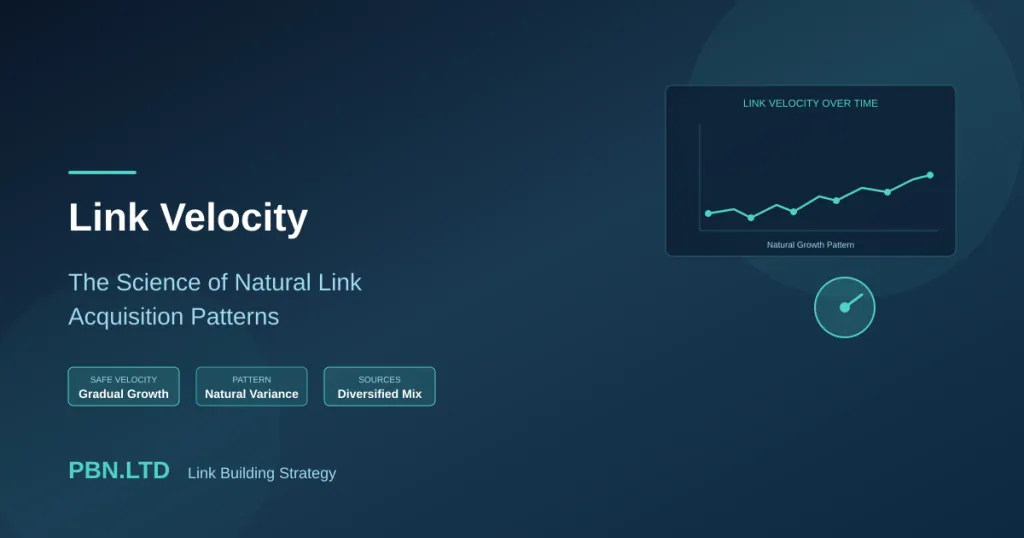
Our analysis of link acquisition patterns across thousands of websites has revealed clear patterns that distinguish natural growth from artificial manipulation—insights we share to help you build sustainable link profiles.
How fast should you build links? It’s one of the most common questions in SEO, and one of the most misunderstood. Build too slowly, and you’ll never compete. Build too fast, and you risk triggering algorithmic penalties or manual reviews.
The answer lies in understanding link velocity—the rate at which a website acquires new backlinks over time. More importantly, it lies in understanding what natural link velocity looks like, because that’s what Google’s algorithms are calibrated to expect.
This guide breaks down the science of link velocity: what it is, how Google evaluates it, what natural patterns look like, and how to plan your link building for sustainable results.
What Is Link Velocity?
Link velocity refers to the speed at which a website gains (or loses) backlinks. It’s typically measured as new referring domains or new backlinks per time period—daily, weekly, or monthly.
For example, a site gaining 50 new referring domains per month has a higher link velocity than one gaining 10. But raw numbers alone don’t tell the full story. Context matters enormously.
Why Link Velocity Matters
Google’s algorithms don’t just count links—they analyse patterns. Unnatural link velocity is one of the clearest signals of manipulation. Consider:
- A new website suddenly acquiring 500 links in its first month
- A site with stable link growth suddenly spiking to 10x normal rates
- Perfectly consistent link acquisition (exactly 5 links every day)
- Links appearing only on weekdays, never weekends
Each of these patterns suggests artificial link building rather than organic acquisition. Google’s systems are designed to identify and discount (or penalise) such patterns.
What Natural Link Velocity Actually Looks Like
To build links safely, you need to understand how real websites naturally acquire links. Here’s what the data shows:
Irregular Patterns
Natural link acquisition is inherently irregular. Real websites don’t gain links at consistent rates. They have days with multiple links, days with none, occasional spikes from viral content or press coverage, and quiet periods.
A natural monthly link profile might look like: 3 links in week one, 7 in week two, 2 in week three, 5 in week four. Not 4-4-4-4. The irregularity itself is a signal of authenticity.
Correlation with Content and Activity
Natural links correlate with site activity. When a site publishes exceptional content, link velocity increases. During quiet periods, it decreases. This correlation makes logical sense—people link to new, interesting content.
If your link velocity is completely disconnected from your content publishing, that’s a potential red flag. Links appearing steadily regardless of site activity looks artificial.
Gradual Acceleration for Growing Sites
Successful websites typically show gradually increasing link velocity over time. As a site builds authority and audience, more people discover and link to it. Month 12 should have higher link velocity than month 1—but the growth should be gradual, not explosive.
Mixed Link Types and Sources
Natural link profiles include variety: editorial mentions, resource links, social shares, forum references, and various other sources. If all your links come from a single type (e.g., only guest posts, only directories), velocity becomes less important than the obvious pattern.
Link Velocity Benchmarks by Site Stage
While every site is different, here are general benchmarks based on observed patterns across thousands of websites:
| Site Stage | Safe Velocity | Aggressive | Risky |
| New site (0-3 months) | 5-15 RDs/month | 15-30 RDs/month | 50+ RDs/month |
| Establishing (3-12 months) | 15-40 RDs/month | 40-80 RDs/month | 100+ RDs/month |
| Established (1-3 years) | 30-100 RDs/month | 100-200 RDs/month | 300+ sudden spike |
| Authority site (3+ years) | Variable – matches history | 2x historical average | 5x+ historical average |
RD = Referring Domains. These benchmarks assume a normal competitive niche. Highly competitive verticals may justify higher velocities; local or niche sites may need less.
Factors That Influence Safe Link Velocity
The ‘right’ link velocity for your site depends on several contextual factors:
Site Age and History
Older sites with established link profiles can absorb higher velocity without raising flags. A 10-year-old site with thousands of existing links adding 100 new ones monthly looks different than a 3-month-old site doing the same.
Your historical baseline matters enormously. If you’ve averaged 20 links monthly for two years, suddenly jumping to 200 is suspicious regardless of absolute numbers.
Niche Competitiveness
Competitive niches like finance, gambling, and legal have higher average link velocities because more is at stake and more is invested. What’s aggressive in a local services niche might be conservative in iGaming.
Research competitor link velocity to understand niche norms. If top competitors gain 50 links monthly, matching that velocity is contextually reasonable.
Content Output
Sites publishing more content can naturally justify higher link velocity. If you’re publishing 20 articles monthly, acquiring 40 links is proportionally reasonable. If you publish once monthly, 40 links looks disconnected.
This is why content strategy and link building strategy must align. Your content output creates the natural justification for link acquisition.
Brand Activity
Brands with active marketing—social media presence, PR activities, product launches, events—naturally generate more links. If your site represents an active brand, higher link velocity is explainable.
Anonymous affiliate sites without any brand presence need to be more conservative with velocity since there’s no external activity to correlate with link acquisition.
Planning Your Link Velocity Strategy
Step 1: Establish Your Baseline
Before building any links, understand your current position:
- How many referring domains do you currently have?
- What’s your historical monthly link acquisition rate?
- What’s your content publishing frequency?
- What are competitor link velocities in your niche?
This baseline informs realistic targets. Your goal is gradual acceleration from your current position, not arbitrary numbers.
Step 2: Set Monthly Targets
Based on your baseline and site stage, set monthly link acquisition targets. These should:
- Increase gradually over time (not stay flat)
- Align with planned content output
- Stay within reasonable bounds for your site stage
- Allow for natural variation (don’t hit exact numbers)
Step 3: Build in Variation
Never build links at perfectly consistent rates. Plan for variation:
- Some weeks heavier, some lighter
- Occasional spikes correlated with content launches
- Random quiet periods
- Weekend links (not just weekday business hours)
Managing link timing across a PBN requires proper infrastructure. Our dashboard helps you coordinate link placement across your network with natural timing patterns.
Step 4: Diversify Link Sources
Velocity concerns compound when combined with source homogeneity. If all 50 monthly links come from one source type, that’s a pattern. Mix your link acquisition across:
- Guest posts and contributed content
- Niche edits and contextual placements
- PBN links from quality network sites
- Resource page inclusions
- Digital PR and brand mentions
- Natural acquisition from quality content
Quality PBN links should be part of a diversified strategy. Learn how to build networks that complement rather than dominate your link profile with free SEO & PBN advice!.
Step 5: Monitor and Adjust
Track your actual link velocity against targets and watch for:
- Ranking improvements correlating with link building
- Any ranking drops that might indicate issues
- Competitor velocity changes requiring response
- Opportunities to accelerate based on success
Link Velocity Red Flags to Avoid
These patterns are most likely to trigger algorithmic scrutiny or manual review:
| Red Flag Pattern | Why It’s Problematic |
| Instant link explosion on new domain | New sites don’t naturally attract hundreds of links immediately |
| Perfectly consistent daily/weekly links | Natural acquisition is irregular; consistency signals automation |
| Sudden 10x velocity spike | Dramatic changes without corresponding content/PR activity look artificial |
| Links only during business hours | Real links appear 24/7; business-hours-only suggests manual campaigns |
| All links same type/source | Natural profiles have variety; homogeneity indicates single-tactic building |
| High velocity, low content | Links without link-worthy content raises obvious questions |
Link Velocity Considerations for PBN Strategies
When using PBNs as part of your link building, velocity management becomes even more important:
Stagger Link Placement
Don’t place all PBN links at once. Stagger placement across days or weeks, mixing with other link types. A burst of 20 PBN links in one day is far more detectable than 20 links spread across a month alongside guest posts and other sources.
Vary Timing Within Network
If linking from multiple PBN sites, don’t update them all simultaneously. Natural sites publish and link on their own schedules. Your network sites should appear independent with independent timing.
Our PBN hosting dashboard makes it easy to coordinate natural timing patterns across your network. See our platform features.
Balance PBN vs. Other Links
PBN links should be part of a diversified profile, not the entire profile. Aim for PBN links to represent 20-40% of your link velocity, with the remainder from other sources. This creates the diverse profile that looks natural and provides redundancy if any single source faces issues.
Frequently Asked Questions
Can I build links too slowly?
Yes. While there’s no penalty for slow link building, you’ll struggle to compete if competitors build faster. The goal is sustainable velocity that gradually increases over time, not artificial slowness. Building 5 links monthly when competitors build 50 means you’ll never catch up regardless of link quality.
How does link velocity interact with link quality?
They’re related but separate factors. High velocity of low-quality links is dangerous. High velocity of excellent links is less risky but still requires natural patterns. Low velocity of excellent links is safe but potentially insufficient for competition. Aim for reasonable velocity of quality links with natural patterns.
Should I slow down if I see ranking drops?
Not necessarily—ranking drops have many causes. If drops correlate clearly with link building campaigns, reassess quality and patterns rather than just velocity. If you’re building quality links with natural patterns, ranking drops are more likely due to other factors like content, competition, or algorithm changes.
Do nofollow links affect velocity calculations?
Natural profiles include nofollow links, so having them is actually a positive signal. For velocity planning, focus primarily on dofollow links that pass PageRank, but don’t actively avoid nofollow opportunities. A profile with zero nofollow links would itself be unnatural.
How do I handle link velocity for a new domain?
New domains require patience. Start conservatively (5-10 referring domains monthly), correlate link building with content publishing, and gradually increase over 6-12 months. If using an expired domain with existing links, you have more flexibility since the baseline is already established—but still avoid sudden dramatic increases.
What tools should I use to monitor link velocity?
Ahrefs, Semrush, and Majestic all track new referring domains over time. Use their historical charts to monitor your velocity and compare against competitors. Set up regular monitoring (weekly or monthly) to catch any issues early and adjust your strategy based on observed patterns.
Building Links at the Right Pace
Link velocity isn’t about finding the maximum speed you can get away with—it’s about building links at a pace that looks natural, supports sustainable growth, and doesn’t expose your sites to unnecessary risk.
The key principles: start from your baseline, increase gradually, build in variation, diversify sources, and correlate with content activity. Links should look like a natural result of running a quality website, because that’s exactly what Google’s algorithms expect.
Whether you’re building links through outreach, PBN networks, or a combination of strategies, velocity management is a fundamental skill. Master it, and you can scale link building aggressively while maintaining the natural patterns that keep your sites safe long-term.
Manage Your Network with Precision
Coordinating natural link velocity across a PBN requires proper infrastructure and management tools. The PBN.LTD dashboard gives you the visibility and control to place links with natural timing patterns, track your outbound links across your network, and maintain the operational efficiency that professional link building requires.