
Published: February 2026 | Reading Time: 0 minutes | Category: Technical InfrastructureThis technical guide is informed by years of managing IP infrastructure for PBN hosting at scale. We’ve analysed network configurations, tracked indexation patterns, and worked with thousands of PBN operators to understand what IP diversity strategies actually work in practice versus what looks good on paper.
IP diversity is frequently discussed in PBN circles, but often misunderstood. Terms like ‘Class C diversity’ get thrown around without clear explanation of what they mean technically, why they matter, or how they fit into the broader picture of network infrastructure.
This guide provides a comprehensive technical foundation. Whether you’re evaluating PBN hosting options, planning network architecture, or simply want to understand the infrastructure layer of PBN operation, you’ll find the detailed explanation here.
IP Address Fundamentals: How Internet Addressing Works
Before discussing diversity, we need to understand how IP addresses are structured and assigned.
IPv4 Address Structure
An IPv4 address consists of 32 bits, typically displayed as four decimal numbers separated by dots. Each number (called an octet) represents 8 bits and can range from 0 to 255.
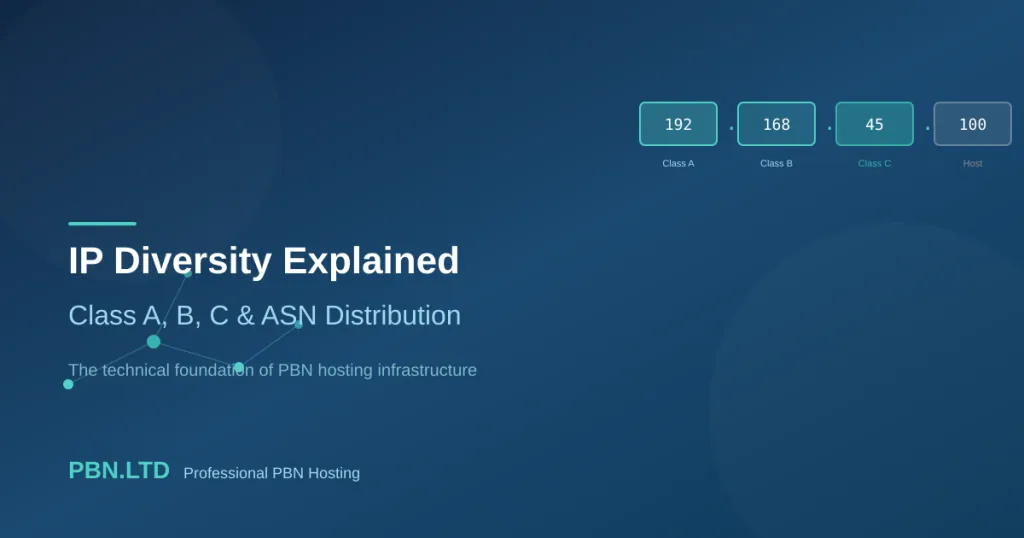
Example: 192.168.45.100
This address breaks down into a hierarchy that reflects network organisation:
| Octet | Value | Traditional Class | Network Significance |
| First (A) | 192 | Class A network | Major network block owner |
| Second (B) | 168 | Class B subdivision | Regional or organisational unit |
| Third (C) | 45 | Class C network | Local network segment |
| Fourth (D) | 100 | Host identifier | Individual device/server |
What ‘Class C Diversity’ Actually Means
When PBN discussions mention ‘Class C diversity’ (sometimes called ‘C-class’ or ‘/24 diversity’), they’re referring to variation in the third octet of IP addresses.
Two IP addresses share a Class C if their first three octets are identical:
- 192.168.45.100 and 192.168.45.200 — Same Class C
- 192.168.45.100 and 192.168.46.100 — Different Class C
In CIDR notation (the modern addressing system), a Class C range is equivalent to a /24 block—256 addresses that share the same first 24 bits.
Why Class C Is the Minimum Threshold
Class C diversity represents the minimum level of IP separation for PBN sites. Addresses within the same Class C are typically:
- On the same physical server or server cluster
- Managed by the same hosting provider
- Part of the same network infrastructure
- Obviously related from a network topology perspective
Sites sharing a Class C provide essentially no diversity benefit—they’re neighbours in the same network block.
Beyond Class C: Deeper Levels of IP Diversity
While Class C diversity is the baseline, it’s not the complete picture. Understanding deeper diversity levels helps you evaluate hosting infrastructure quality.
Class B Diversity
Class B diversity means variation in the second octet:
- 192.168.45.100 and 192.169.45.100 — Different Class B
Class B ranges represent larger network blocks, typically allocated to significant organisations or major hosting providers. Class B diversity indicates sites are on more distinctly separate network infrastructure.
Class A Diversity
Class A diversity means variation in the first octet:
- 192.168.45.100 and 185.168.45.100 — Different Class A
Class A blocks are the largest allocations, controlled by major telecommunications companies, large organisations, or regional internet registries. Class A diversity represents the highest level of IP address separation.
Diversity Level Comparison
| Diversity Level | Octets Different | Separation Strength | Typical Source |
| None | Only 4th octet | No diversity | Same server block |
| Class C | 3rd + 4th octets | Minimum acceptable | Different server ranges |
| Class B | 2nd, 3rd, 4th | Strong diversity | Different network allocations |
| Class A | All four octets | Maximum diversity | Different major providers |
ASN Diversity: The Layer Most People Miss
While IP diversity focuses on address structure, ASN diversity examines who controls those addresses. This distinction is crucial for understanding true network separation.
What Is an ASN?
An Autonomous System Number (ASN) is a unique identifier assigned to organisations that control large networks. When an organisation receives IP address allocations, those addresses are registered under their ASN.
Key points about ASNs:
- Every IP address block is registered to an ASN
- Large organisations may control multiple ASNs
- ASN information is publicly queryable through WHOIS databases
- Two very different-looking IP addresses can belong to the same ASN
Why ASN Diversity Matters
Here’s where it gets important: two IP addresses can have completely different Class A, B, and C values while still belonging to the same organisation.
Example scenario:
- IP 104.21.45.100 — Class A: 104
- IP 172.67.182.50 — Class A: 172
- Both belong to the same ASN (same organisation)
From an IP class perspective, these addresses look completely diverse. From an ASN perspective, they’re controlled by the same entity. Sophisticated analysis would identify both as related.
How to Check ASN Information
ASN lookups are straightforward using public tools:
- Command line: whois [IP address] reveals ASN and organisation details
- Online tools: Services like bgp.he.net, ipinfo.io, or Team Cymru provide ASN lookups
- Bulk analysis: APIs exist for checking ASN information across many IPs programmatically
Practical IP Diversity for PBN Hosting
Understanding the theory is one thing—implementing effective diversity is another. Here’s how these concepts translate to practical hosting decisions.
Minimum Requirements by Network Size
| Network Size | Minimum IP Diversity | Recommended ASN Diversity |
| 5-10 sites | Unique Class C for each site | Minimum 2-3 different ASNs |
| 10-25 sites | Unique Class C, varied Class B | Minimum 4-6 different ASNs |
| 25-50 sites | Unique Class C, strong Class B/A mix | Minimum 8-12 different ASNs |
| 50+ sites | Maximum diversity across all classes | 15+ ASNs recommended |
How Quality PBN Hosting Achieves This
Achieving genuine IP and ASN diversity requires infrastructure relationships that individual operators cannot practically establish. This is where purpose-built PBN hosting provides its core value.
Infrastructure requirements include:
- Multiple upstream providers: Relationships with numerous network providers across different ASNs
- Diverse IP allocations: Access to IP blocks from different registries and allocation periods
- Geographic distribution: Server infrastructure across multiple regions and countries
- Intelligent allocation: Systems that automatically distribute sites across available diversity
- Ongoing management: Monitoring and maintenance of diversity as networks scale
Common IP Diversity Misconceptions
Several misunderstandings persist in discussions about IP diversity. Clarifying these helps inform better infrastructure decisions.
Misconception: ‘Different IPs’ Equals Diversity
Simply having different IP addresses means nothing if they’re from the same Class C range. Many hosting providers offer ‘multiple IPs’ that are sequential neighbours—192.168.1.100, 192.168.1.101, 192.168.1.102. This provides zero diversity benefit.
Misconception: Class C Diversity Is Sufficient
Class C diversity is the minimum threshold, not the goal. For serious networks, relying solely on Class C diversity while ignoring Class B, Class A, and ASN considerations leaves significant room for pattern detection.
Misconception: More IPs Always Means Better Diversity
Quantity without quality is meaningless. 100 IPs from two ASNs provides less genuine diversity than 50 IPs spread across 15 ASNs. The distribution matters more than the count.
Misconception: CDNs Solve IP Diversity
Using a CDN like Cloudflare puts all sites behind the same infrastructure. While CDNs serve legitimate purposes, they don’t provide IP diversity—they actually consolidate sites onto shared IP ranges controlled by the CDN provider.
Frequently Asked Questions
How can I check the IP diversity of my current PBN?
Export a list of your sites’ IP addresses, then analyse the distribution. Group addresses by their first three octets (Class C), first two octets (Class B), and first octet (Class A). Use ASN lookup tools to identify the controlling organisations. Any clustering indicates diversity weaknesses.
Does IPv6 change these diversity considerations?
IPv6 introduces a larger address space but similar diversity principles apply. The focus shifts from Class A/B/C to prefix lengths and ASN allocation. However, most PBN hosting still operates primarily on IPv4 infrastructure, making traditional diversity considerations relevant.
Is IP diversity more important than content quality?
Both are essential but serve different purposes. IP diversity prevents infrastructure-level detection. Content quality prevents content-level detection and ensures sites function as legitimate web properties. Neither compensates for weaknesses in the other.
How often should I audit my network’s IP diversity?
Review diversity whenever you add significant numbers of new sites, when you migrate hosting infrastructure, or at least annually for established networks. Quality PBN hosting provides visibility into your network’s diversity distribution automatically.
Can I achieve proper diversity by using multiple regular hosting providers?
Theoretically possible but operationally impractical at scale. Managing 10+ separate hosting accounts, dealing with different control panels, handling varied billing cycles, and manually tracking diversity across fragmented infrastructure creates significant overhead. Purpose-built PBN hosting centralises management while maintaining distributed infrastructure.
Does geographic server location relate to IP diversity?
Geographic distribution often correlates with IP diversity since different regions use different IP allocations and involve different network providers. However, geographic diversity alone doesn’t guarantee IP or ASN diversity—a global provider might use similar IP ranges worldwide. Both geographic and IP diversity should be considered.
The Bottom Line
IP diversity is a technical foundation that determines whether PBN infrastructure can support long-term success. Understanding the hierarchy—from basic Class C separation through Class B and A diversity to ASN distribution—enables informed decisions about hosting infrastructure.
The key takeaways:
- Class C diversity is the minimum threshold, not the goal
- ASN diversity matters as much as IP address diversity
- Quality of diversity distribution matters more than quantity of IPs
- Achieving genuine diversity requires infrastructure most operators cannot build independently
This is precisely why purpose-built PBN hosting exists—to solve the infrastructure challenge so operators can focus on content and links rather than network engineering.
Infrastructure Built for IP Diversity
PBN.LTD’s hosting infrastructure is engineered from the ground up for genuine IP and ASN diversity. Our network spans multiple upstream providers, diverse IP allocations, and intelligent distribution systems that automatically optimise your network’s diversity profile. Explore how our infrastructure can support your PBN operations.