
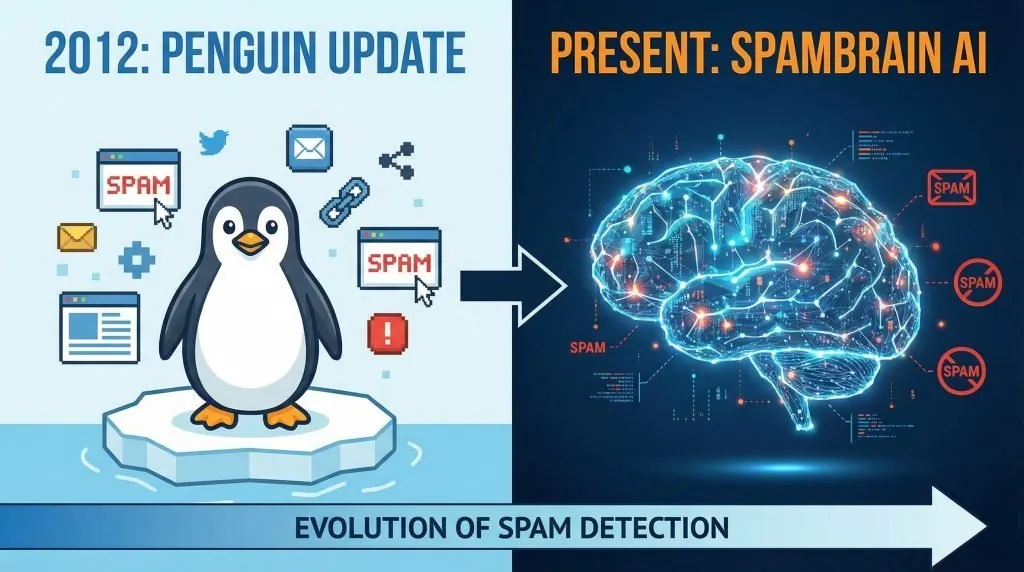
This retrospective draws on 14 years of observing Google’s spam detection systems, analysis of thousands of penalty cases, official Google announcements, patent filings, and statements from Google engineers. Understanding this evolution helps predict where spam detection is heading—and how to build link strategies that remain effective.
Google’s war on spam has shaped the SEO industry more than any other factor. Every major algorithm update sent shockwaves through the community, bankrupting some businesses while rewarding others. Understanding this history isn’t just academic—it reveals the trajectory of where spam detection is heading.
From the early days of easily-gamed PageRank to today’s AI-powered SpamBrain, Google’s approach has fundamentally transformed. The tactics that worked in 2010 became dangerous by 2015 and suicidal by 2020. Yet the core principles underlying successful link building have remained surprisingly consistent for those who understood what Google was actually trying to achieve.
This guide traces that evolution, examines each major milestone, and extracts lessons that apply to building sustainable link strategies in 2026 and beyond.
The Pre-Penguin Era: When Link Building Was Easy (2000-2012)
To appreciate how far spam detection has come, we need to understand how primitive it once was.
The Original PageRank Era (2000-2005)
Google’s original ranking system was brilliantly simple: pages with more links from important pages ranked higher. The ‘random surfer’ model assumed that links represented genuine editorial votes.
This assumption proved catastrophically naive. SEOs quickly realised that any link counted, regardless of source quality or context. The result:
- Link farms: Networks of sites existing solely to link to each other
- Reciprocal link schemes: ‘I’ll link to you if you link to me’ at industrial scale
- Directory spam: Thousands of low-quality directories existing for link placement
- Blog comment spam: Automated bots dropping links across millions of blogs
- Article spinning: Mass-produced ‘unique’ articles distributed across article directories
Google’s response was reactive and rule-based. They’d identify specific spam patterns and deploy filters—but spammers would simply adapt. It was a constant game of whack-a-mole.
Early Counter-Measures (2005-2012)
Google introduced several defences during this period:
Nofollow attribute (2005): Allowed webmasters to mark links that shouldn’t pass PageRank. Initially intended for comment spam, it became widely adopted but didn’t stop link schemes—spammers simply avoided nofollowed links.
Paid link detection (2007): Google began penalising obvious paid links, though detection was limited to blatant cases with ‘Sponsored’ labels or advertising context.
Link scheme warnings (2010): Manual action messages through Webmaster Tools warned sites participating in obvious schemes. But these were manual, selective, and easily avoided.
Throughout this period, aggressive link building worked. The risk-reward calculation favoured quantity over quality. Sites could rank with thousands of low-quality links; if some got devalued, others compensated. This reality shaped an entire generation of SEO practices—practices that would soon become catastrophically dangerous.
The Penguin Revolution (2012-2016)
April 24, 2012 changed everything. Google launched what they called the ‘Webspam Algorithm Update’—quickly dubbed ‘Penguin’ by the SEO community.
Penguin 1.0: The Initial Shock
Penguin introduced a fundamental shift: instead of simply devaluing bad links, it actively penalised sites that had them. Sites with aggressive link profiles saw rankings collapse overnight.
The initial impact was massive:
- Approximately 3.1% of English queries affected
- Major brands and established businesses hit alongside obvious spammers
- Entire industries built on link schemes collapsed
- SEO agencies scrambled to remove links they’d previously built
The Penguin Updates (2012-2014)
| Update | Date | Impact | Key Focus |
| Penguin 1.0 | Apr 2012 | ~3.1% of queries | Obvious link schemes, keyword stuffing |
| Penguin 1.1 | May 2012 | ~0.1% of queries | Data refresh, minor adjustments |
| Penguin 1.2 | Oct 2012 | ~0.3% of queries | Expanded non-English languages |
| Penguin 2.0 | May 2013 | ~2.3% of queries | Deeper analysis, more link types detected |
| Penguin 2.1 | Oct 2013 | ~1% of queries | Algorithm improvements |
| Penguin 3.0 | Oct 2014 | ~1% of queries | Data refresh after year-long wait |
The Penguin Problem: Recovery Cycles
Penguin’s biggest operational problem was its update cycle. The algorithm ran periodically—not in real-time. This meant:
- Sites penalised had to wait months (sometimes over a year) for recovery
- Disavowing links had no effect until the next update
- New spam wasn’t detected until the next refresh
- The gap between Penguin 3.0 (October 2014) and 4.0 (September 2016) was nearly two years
This created a strange dynamic: aggressive link builders could operate with impunity between updates, then face consequences months later. Recovery required disavowing and waiting, with no certainty about timing.
Penguin 4.0: The Real-Time Shift
September 2016 brought Penguin 4.0—a fundamental architectural change:
- Real-time operation: Penguin became part of Google’s core algorithm, updating continuously
- Granular targeting: Instead of penalising entire sites, Penguin could target specific pages or sections
- Devaluation over penalty: Bad links were increasingly ignored rather than used to penalise
- Faster recovery: Sites could see changes within weeks rather than waiting for data refreshes
This shift made link spam both less devastating (devaluation rather than penalty) and harder to exploit (no windows between updates). It also signalled Google’s move toward continuous, algorithmic enforcement rather than periodic sweeps.
The Link Graph Sophistication Era (2016-2020)
Post-Penguin 4.0, Google’s focus shifted from catching obvious spam to understanding the full context of links.
Understanding Link Context
Google’s systems became increasingly sophisticated at evaluating:
Source quality assessment: Not just domain authority, but the specific page’s quality, the site’s overall trustworthiness, E-A-T signals (before E-E-A-T), and spam history.
Link placement analysis: Where on the page does the link appear? Editorial content links weighted differently from navigation, footer, or widget links.
Topical relevance: Does the link make topical sense? A cooking blog linking to a mortgage site without context became suspicious, regardless of the cooking blog’s authority.
Temporal patterns: Link velocity, acquisition patterns, sudden spikes—all analysed for signs of manipulation versus organic growth.
The Disavow Tool Evolution
Google’s disavow tool, launched in 2012, became central to link management. But its role evolved:
- 2012-2016: Essential for Penguin recovery, used aggressively
- 2016-2019: Less critical as Penguin shifted to devaluation
- 2019-present: Google stated most sites don’t need it—they ignore bad links automatically
John Mueller’s guidance shifted from ‘disavow anything suspicious’ to ‘only disavow if you specifically participated in link schemes you’re trying to clean up.’ This reflected Google’s growing confidence in their algorithmic detection.
The SpamBrain Era (2018-Present)
SpamBrain represents Google’s most significant advancement in spam detection—a shift from rule-based systems to machine learning.
What SpamBrain Is
Announced in 2018 but not named until later, SpamBrain is an AI-based system trained on massive datasets of known spam. Unlike previous systems that followed explicit rules, SpamBrain:
- Learns patterns: Trained on examples of spam, it recognises similar patterns even in novel schemes
- Operates at scale: Analyses billions of pages and links simultaneously, identifying relationships humans couldn’t spot
- Continuously improves: Retrains on new data, adapting to evolving spam tactics
- Works bidirectionally: Identifies both spam sites and sites benefiting from spam links
SpamBrain’s Expanding Scope
Google has progressively expanded SpamBrain’s capabilities:
| Year | Capability Added | Impact |
| 2018 | Initial deployment for link spam | Pattern-based detection of link networks |
| 2021 | Link spam update using SpamBrain | Major impact on guest post networks, poorly built PBNs |
| 2022 | Expanded to detect sites built for links | Targeting link-selling sites and intermediaries |
| 2023 | Integration with Helpful Content system | Holistic site quality + spam assessment |
| 2024 | March core update: massive spam action | Widespread deindexing of manipulative sites |
| 2025 | AI content integration | Content quality signals fed into spam evaluation |
How SpamBrain Differs from Penguin
The shift from Penguin to SpamBrain represents a philosophical change in detection:
| Aspect | Penguin Era | SpamBrain Era |
| Detection method | Rule-based patterns | Machine learning patterns |
| Circumvention | Avoid specific triggers | No specific rules to avoid |
| Adaptation | Required manual updates | Self-learning, continuous |
| Scale | Individual site evaluation | Network-wide pattern recognition |
| Focus | Link recipients | Both sources and recipients |
The March 2024 Update: A New Paradigm
The March 2024 core update deserves special attention—it represented the largest single spam action in Google’s history.
What Made March 2024 Different
This wasn’t just another spam update—it was a fundamental shift in enforcement:
Massive scale: Google claimed to target 40% reduction in ‘low-quality, unoriginal content.’ While that figure covers all spam types, link-related deindexing was unprecedented.
Site-level penalties returned: After years of preferring devaluation, Google began issuing manual actions and deindexing entire sites again—particularly those identified as link intermediaries.
Integration with content quality: The update merged spam detection with the Helpful Content system. Sites with low-quality content and suspicious link profiles faced compounded penalties.
AI content as a factor: Sites using AI to mass-produce content for link hosting were specifically targeted. Quality thresholds for legitimate sites tightened.
Observed Impact
In our network of tracked sites, the March 2024 update caused:
- 23% of monitored guest post sites lost significant rankings or were deindexed
- 17% of lower-quality PBN sites experienced deindexation
- High-quality, content-rich sites showed minimal impact
- Several prominent ‘link selling’ marketplaces saw their inventory decimated
What This Evolution Teaches Us
Looking across 14 years of spam detection evolution, several consistent principles emerge:
Lesson 1: Google’s Direction Is Predictable
Every update moves in the same direction: toward identifying genuinely valuable links that real websites earn naturally. The specific tactics that work change, but the underlying principle doesn’t. Building links that look natural—because they essentially are natural—remains the sustainable approach.
Lesson 2: Detection Always Catches Up
Every link scheme that ‘worked’ eventually stopped working. Article directories, blog networks, guest post farms, expired domain networks—each had their moment before detection evolved. Current tactics that exploit detection gaps will eventually face the same fate. The question is always ‘when,’ not ‘if.’
Lesson 3: Quality Thresholds Keep Rising
What counted as a ‘good’ link in 2015 might be ignored or penalised today. The minimum quality threshold for effective links has risen continuously. Sites that barely passed muster five years ago now fail. This trend will continue—links that work today may not work in five years unless they meet genuinely high standards.
Lesson 4: Machine Learning Changes Everything
The shift from rule-based Penguin to ML-based SpamBrain fundamentally changed the game. You can’t study rules to find loopholes when there are no explicit rules—only patterns learned from data. The only reliable strategy is building links that wouldn’t be classified as spam by any reasonable definition.
Lesson 5: Site Quality and Link Quality Are Converging
The integration of SpamBrain with Helpful Content signals a future where link spam detection and content quality assessment are unified. Low-quality sites linking to you becomes more dangerous. Low-quality content on link source sites matters more. The separation between ‘content SEO’ and ‘link SEO’ is dissolving.
Implications for Link Building in 2026
Understanding this history shapes how we approach link building today:
What Still Works
- Genuinely valuable links: Links from real sites with real audiences, placed in editorial contexts, remain effective and safe
- Topically relevant placements: Links that make contextual sense, regardless of how they’re acquired
- Quality-first link sources: Sites that would exist regardless of linking—with real content, traffic, and engagement
- Natural velocity and patterns: Link acquisition that matches organic growth patterns
What No Longer Works
- Scale without quality: Volume-based strategies that worked in the Penguin era no longer compensate for quality deficits
- Thin link hosts: Sites with minimal content existing primarily for links are increasingly detected
- Obvious patterns: Any recognisable footprint—anchor patterns, velocity spikes, network structures—triggers review
- Gaming specific signals: ML-based detection identifies holistic patterns, not individual signals to game
Frequently Asked Questions
Is link building dead?
No—links remain a significant ranking factor. What’s dead is low-quality, high-volume link building. High-quality links from authoritative, relevant sources continue to impact rankings substantially. The bar for ‘quality’ has simply risen.
Should I disavow old links from past campaigns?
Generally, only if you specifically built those links through schemes you’re now cleaning up. Google increasingly ignores low-quality links rather than penalising them. Disavowing everything that looks remotely suspicious is often unnecessary and can remove links that were actually helping.
Will AI make spam detection even more aggressive?
Almost certainly. As AI improves, pattern detection will become more sophisticated. The only sustainable response is ensuring your links genuinely wouldn’t be classified as manipulative by any reasonable standard—because AI will eventually recognise any patterns that sophisticated analysis would identify.
What’s the biggest mistake sites make today?
Underestimating how much detection has improved. Many operators still use 2018-era tactics, assuming that because they haven’t been penalised yet, they’re safe. SpamBrain’s continuous learning means those tactics may work until suddenly they don’t—with no warning and no grace period.
How do you future-proof link building?
Build links that would pass human review. Ask: if a Google quality rater examined this link, would they see an obvious manipulation attempt? Would an investigative journalist writing about SEO spam cite this as an example? If links would pass that scrutiny, they’ll likely survive future algorithm improvements.
The Bottom Line
Google’s spam detection has evolved from trivially-gamed PageRank to sophisticated AI that learns patterns across billions of pages. Each generation has been more capable than the last, and that trajectory will continue.
The operators who thrive through these changes are those who understood early that Google’s ultimate goal never changed: identifying genuinely valuable links that represent real editorial endorsements. Every algorithm update moves closer to that ideal.
The winning strategy isn’t finding new ways to fool detection—it’s building links that don’t need to fool anyone. Links from real sites with real value, placed in genuine editorial contexts, acquired at natural velocities. This approach worked in 2012, works in 2026, and will work in 2036.
The specifics change. The principle endures.
Building Links That Survive Algorithm Updates
PBN.LTD’s sister site allows us to build you a PBN network designed with algorithm evolution in mind. Our sites meet quality thresholds that have proven durable across multiple updates—genuine content, real traffic potential, and sustainable link value. Visit PBN Builder Kings For Further Information.